Chapters
Show Highlights
- Release your first book version quickly, then update based on real customer reactions rather than guessing what will work.
- Look for what's already working in your business before trying to fix what's broken.
- Your book doesn't need to be perfect to start conversations with ideal prospects.
- Test your message with real people instead of spending months perfecting it in isolation.
- Focus on amplifying the parts of your message that get the strongest response from customers.
- A book that's out there imperfectly beats a perfect book that never gets published.
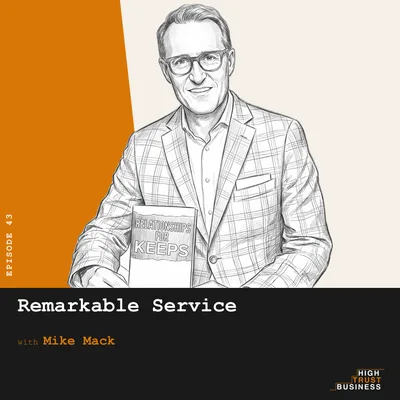
Most people sit on their book idea for years, waiting for the perfect angle. Mike Mack did the opposite. He published his first version of Remarkable Service, then updated it based on what actually resonated with his customers.
Mike's spent over 10 years helping companies excel through service. He works with businesses large and small to identify what already works inside their organization, then amplifies those strengths to make them stand out from competitors.
This conversation's perfect if you're holding back because you think your book needs to be perfect. Mike proves the opposite. Get your first version out there, see what lands with real people, then make it better.
You could have your message starting conversations before the year's over. The question isn't whether your book will be perfect. It's whether you'll let perfect kill good enough.
Transcript
AI transcript provided as supporting material and may contain errors.
"Foreign."
Stuart: Welcome to another episode of the book More Show. Another of my favorite types of episodes today because we're talking with one of our authors that has written a book with us and people tend to cross my radar when we're either doing something exceptional or people are ordering a lot of in volume terms, a lot of books because they're using them when they're out there or people come through to me with questions about how to use. And that's really how Mike came to cross my radar, as it were. We were doing an update to the book and then just the nature of the book itself really stood out as something that was interesting and Microsoft has been using it quite a lot. So it was great to have email conversations with Mike over the last couple of weeks, months maybe, and then great to get on the episode to share that story with you guys. So Mike, how are you doing?
Mike Mack: I'm great, Stuart, thanks for the opportunity to join you today.
Stuart: No problem, real pleasure. We've had some good email conversations back and forth. So it's always great to on a one on one level get to talk about it, but then share that with everyone listening as well. For the guys listening then, Mike wrote a book called Remarkable Services. His organization is really helping organizations to take their business to the next level and discover the the little differences, the things within their business that can make an exceptional service difference to customers. Mike, you probably gave a better explanation than me. Do you want to share with the audience what the background of the organization is and then lead into the background of the book?
Mike Mack: Indeed. Thanks for the opportunity again, Stuart. I have been an entrepreneur now for 11 years. I started my business back in the fall of 2006. Really a few areas that we focus on and support customers with. And I say we because I have associates that work with me. I still lead a lot of projects personally, but under the umbrella of training, coaching, consulting and then I also do keynote speaking as well. And as you commented in the introduction, the key focus is specializing in improving customer service and as a result that links to improve sales. But going about that, we look at it really from the ground up. So that might include team building work and training or coaching, leadership development. And in some cases we do a lot of work on strategic planning. The concept of remarkable service and how the book came to be specific to our business was really twofold. Number one, in my opinion, any business in any industry can produce remarkable service, but they have to put some focus in it. And the reality is that we can apply this in all shapes and sizes of businesses. Organizations in any country, in any industry. And the book has really been a great catalyst to create greater awareness of customer service as a whole. And it's been great. We've threaded that in a lot within our services and getting ready to launch the new book, if I can chime in on that and give you some perspective on that, Stuart, if you're open to that.
Stuart: Yeah, absolutely. Absolutely.
Mike Mack: So I've had the good fortune of being a customer of yours of 90 minute books now for just shy of two years. So maybe I'm unique in that. I initially put the original book together, which was titled Remarkable Service Be the Business Everyone's Talking About. And in fact, that was published in February 2016 and decided early this year about January that, you know, I'm going to make some revised tweaks to my book. And as you probably can appreciate, Stuart, when you start to do that, the project becomes bigger than you anticipate. So in fact, my. Go ahead, Stuart.
Stuart: I was just going to say it's always surprising how much you start to see. It's like you see people at art galleries as they get closer and closer to a piece of art and start seeing more and more detail. It's one of the key things that we try and get people to do, particularly in that first version, to get something out there and collecting leads and then do an iteration, do an update based on that feedback. Because time and time again we see it that people want to make a variation or iterate not too soon, but very early on, and then it just slows the whole process down. So it's really interesting to hear you see it as, hear you say it as well, that once you start looking, the scope of that project gets bigger and bigger and bigger, either because you see more and more or more and more opportunities reveal themselves and it can be difficult to constrain.
Mike Mack: Very true. I mean, the good news is I'm, I'm feeling great about the launch of the new book. So title is still the same Remarkable service, but change it from the original in 2016 of Be the Business everyone's Talking about to now how to keep your doors open. So the spin on that, if you will, is in any economy and any area in any sector, we have the ability to provide remarkable service and keep your doors open, metaphorically, that customers will come and go, but also keep your business going as well. Ironically, the revised edition is about two and a half times bigger than the original book. And while that was a daunting task because I added a significant amount of word count, the Amazing. Part of the process was your team. So I know you're interviewing me today, but I want to pass on a compliment to you personally and your team, people like Betsy and Kim, because it just made the process so much easier. Methodically, I got to do the creative side and your team really helped package it together. So in fact, that book just came to our office yesterday, just received it so a time of this podcast. So I'm incredibly excited about that and kudos to your team as well. I've got another book in the works for 2018, and I know that I'm going to be calling on you and your team again just because you made the process.
Stuart: Well, thanks for those words. I mean, it's always nice to hear the good stories like that and the team themselves. I mean, I'll make sure before this podcast is going to be releasing it in a week or two, but I'll pass the message back onto the team before that because it's so easy to get caught up in the weeds. And I guess that's what you must see to a certain degree with the guys that you work with, the people on the shop floor or doing the customer service or executing the task. It's so easy to get caught up in the weeds of it, the process of it, that you kind of sometimes miss the bigger picture and miss that the end result is the customer satisfaction or the real tangible benefits that the customer gets. So it's always good to be reminded of that. And I guess to a certain degree that ties in with what you help companies do, you help them focus back on.
Mike Mack: Well, indeed. And if you think of the premise of the book, a remarkable service for you as a business owner person, to do something that your customers would remark about, and I know I'm going to remark about your business for a long time, and specifically in an example of you emailing me personally on a Saturday evening on a commitment that you were going to help me with. That was a wow. I'm going to make sure I tell everybody that because that doesn't happen very often in any business for someone in your position within the organization. So again, grateful. But it validates that you really stand behind the service process of 90 minute books and what it's all about and how authors can put a book together with relative ease. There is some work involved, obviously, but you really help with the heavy lifting in your team. So I am indeed grateful for that.
Stuart: Fantastic. Well, always nice to always joke with people that I really don't have any interest in anything that's on TV at the moment. So dealing with particularly, like I say, people like yourself, where there's a real. Not just going through the process of it, but there's a real passion behind what you're doing that comes across in our communications, which is why the conversation stood out in the first place. So I can really get quite enthusiastic about using this as a tool and helping people see the benefits. And when that mirrors against someone that's enthusiastic about what they're doing on their side that those, those passions align a little bit and it creates something greater than the sum of the individual parts.
Mike Mack: Agreed, Agreed.
Stuart: So in terms of. So the book itself, remarkable service has a. I think anyone that listening would have see the relative. The, the obvious connection with the business and what you do. It's. It's a book that's really talking about how service can help people even in the. The smaller parts through to the, to the bigger parts. There's opportunity all the way through. So the kind of construct of the book itself is. Is relatively straightforward. It's not that you're trying to attract leads from a funnel across to the side, so you're trying to bridge one subject with another. This is pretty direct and almost. We were talking a couple of weeks ago on the show about the lead generating books versus the lead converting books. This to a certain degree bridges that those two, those two stages because it's obviously lead generating because it's tweaking people's interests, sparking people's interests who have, who are looking at service in their company and then it's doing some of the lead conversion job as well because it's explaining a number of the steps. But was there anything particular that took you from this is what we talk about day to day to this really should be in a book. Was there anything particularly that sparked the idea that this should be in a book format or. A lot of people come to us just because they hear a number of other people talking about books. So there's quite a. It's very doable at the moment that people should have a book.
Mike Mack: It's a great question and I've had lots of time to think about that over the last few years in terms of when anyone decides to write a book. The motive for me to initially write a book specific to customer service, remarkable service attributed to our local economy. So I live in Alberta, Canada and Western Canada over the years have done incredibly well, relied heavily on the oil and gas sector. And that's been more challenged in the last number of years. So. Well, in my past I'VE been able to help companies with sales, service leadership, etc. There was a strategic play that service could be a bit more all encompassing than just saying sales. So that was one in terms of why putting it to paper. There's a lot of great books in the marketplace regarding customer service. Your comment earlier about going from generation to conversion potentially for customers was also strategic, but I became educated in the process working with your team. So the first book, it's a quick read by design. Most everyone read it. So I think it 71 pages, give or take. My revised book is about 168 pages. So it has a lot more depth to it, including stories on a global basis referring to remarkable service, whether it be in the lighting industry in India, to health care in Ontario, to American Express in the us. So it's broad and like anything in terms of marketing or awareness. If you can make it readable, entertaining and make you think about your business differently, it was best served capturing that in a book. You could write 30 blogs on that, but everything is really packaged together and again, your process allowed that. So collectively that was, that was the motive and the strategy to get it to where it is today. And I have a lot of exciting ideas of what I'm going to do with the new book differently than I did with the original book as well.
Stuart: Yeah, I think that's one question that came up just as you were describing the change of the economy there. So as you said, the first version of the book came out last year. Last year? Yeah. I'm losing track of what year.
Mike Mack: February.2016.
Stuart: February. So that's 18 months ago. As we record now the change in the economy, the subheading of the book we talked about changing to now being remarkable service. How to keep the doors open, is that a reflection of the change in the environment? So people looking having service as an element of keeping the doors open rather than generating a whole number of not new business. But it seems like there's a slight different focus. Is that a reflection of the external environment or is that just coincidence?
Mike Mack: Great observation. I would say it is the first point in part that we need to be mindful that a lot of companies will approach me and my team about hey, we want to increase sales in our organization, but when we do a discovery with them and we roll up the sleeves in most cases we discover that there's some customer service issues fundamentally. So the play on how to keep your doors open and book cover shows a red door that's open. You could look at that twofold as the business owner, how do I need to keep my doors open so the customers keep coming back and retaining business? So there's strategy on that also. So it did tie in though to the economy because sadly, in fact I was at an event as recent as last night and we're still hearing in some cases businesses are winding down, restaurant chains are closing because of the cost of operating and the economy isn't what it was here anyway three to five years ago. So I think it really plays a twofold point. And as I'm sure you can appreciate, Stuart, if you can get more than one message and purpose out when putting a book together, that can be even more beneficial than just a one point takeaway.
Stuart: Absolutely. Particularly when it reinforces it's all kind of part of the same message, just triggering slightly different receptors in the, in the person that's looking at it. I think it's a great opportunity to tick more than one box. And that's one of the benefits we talk about in terms of the COVID When we had an interview with Glenn a few weeks ago when I was in, in Toronto catching up with him and we were there talking about the, the COVID being the amplifier for the book title. So having visual cues that tie in with the message or the subtext is really another great way of as you have the book physically there or advertising it online or sharing it online, having that cover image and a cover image that amplifies the message that you're trying to make or amplify to another, another part of the, of the puzzle is really a great benefit and triggers something else. One of the other things you're talking about is the, or one of the things that it's worth mentioning in this example is going from version one to version two. The whole premise around the 90 minute book being a fast and effective way of getting a tool out there collecting leads, but not at the expense of huge amounts of time or huge amounts of cost. So the great thing is doing exactly what you've done. Have version one out there that gets you the first 80% of the way, collect a whole load of feedback, understand how it works in the funnel, decide on a way that allows you to use it in the best possible way within the funnel that you're trying to create and then make an Update to version 2 is a far more effective way of doing it than either A Going with a solution that's much more expensive or time consuming to create something that is perhaps bigger as the first version, but then not necessarily any more fit for purpose, but a Lot of times with those solutions, making updates to it isn't particularly practical either. Because the whole infrastructure that's set up to create a bigger, more traditional book means that updating it further down the line is then much more expensive or time consuming or far less cost effective. So one of the things I really like about this approach is the kind of agile nature of create something, get it out there, and then test and pivot based on real feedback and changes to your own circumstances, if nothing else. Because the process or the function of creating a book, I mean all of the content's in your head, so the message is there, you know it better than anyone else. But the whole idea overhead in concept and how it fits in the funnel and how it can best be used and how people are responding to it. If you had to do all of that upfront, all of that as part of version one, there's a lot of kind of cognitive resistance there to getting it out there as opposed to the other way of getting something out there and then quickly and easily being able to pivot after that.
Mike Mack: Drew, I want to comment on that twofold. One, I'm not certain I would have written the first book without the process that your team and business model provided because it made the process easier. So the revised edition, while I could argue I put a lot more work into it, the process fundamentally was easy and I was more on task all the time, which was helpful. Interesting. When you commented earlier about pivoting, I already had another book in queue. In fact, I have it documented, I probably have it 2/3 done 10 months ago, made the conscious decision to rewrite the original book rather than releasing a new book when I did. And that was strategic from a business perspective. But I knew that I could also add greater value to the reader to put the prospective customer by making that book better, which was still a foundational piece of the business. And again, your process made that possible. You could argue it was a no brainer to do that. And while the book is significantly bigger with a lot more content, it just made it the right decision. And really from a time perspective, it took long because of the creative process for me, not because of working with you and your team. Once it was ready, that turned around very quickly to get it to print and final reviews and revised cover done. So again, grateful for that support and ready to see what the book looks like in the marketplace and what people do with it, more importantly.
Stuart: Yeah, well, absolutely. And that leads to the next question, really, which is the first version of the book and now the Second version of the book in terms of using it and getting it out there. Have you got at the moment any particular channels that you're thinking of? So you're thinking about advertising it through Facebook advertising, that type of thing? Or are you working with a particular set of groups? Obviously the business is very established up there and you've got a lot of contact. So are you thinking more of a referral based strategy of using it as an opportunity to share knowledge and value to other people? But through referrals, yeah.
Mike Mack: There's a number of items that I'm going to focus on. Obviously social media is valuable. My strongest presence in the world of social media is LinkedIn. I've been on it for 12 years. I've got a pretty solid local and global presence there. So social media plays an important factor and the visual aid of a cover on a book grabs attention. I have a book summary component that I'll have on my website so people can have a free download of the book summary. Of course it's available on Amazon. We'll have Kindle as your team helps me with one of the strategies I'm going to do differently this time is I'm also going to record an audiobook. So that's a unique strategy. I do a lot of speaking as well. So that connection with what Mike Mack is about, what he sounds like, how he can potentially help. Got a book launch coming up in latter November, so I'm really excited about that. And I'm affiliated with a few organizations, one of which you probably know. So one in Canada is Tech Canada. So I'm a speaker, an approved speaker with that. So CEO forms and executives get together across the country and I speak to those, those executive groups. This is affiliated with Vistage, which you may have heard of before. Vistage International. So the CEO group gets together. So generally when I'm invited to speak, depending upon the compensation model. But in most cases I'm speaking to a group of 20 CEOs. I would provide them with a copy of my book just as a given. So it's again, twofold, provides some degree of credibility, at least perceived credibility and number two, adds value to their business potentially and they decide to reach out to me. All of the contact information and my relative background is there. And again that's where the book becomes such a valuable marketing tool on many levels. Whether it's coaching, training, consulting, speaking. In my case it covers a lot of angles in the marketing strategy.
Stuart: And almost at that C suite level there's an opportunity to engage in a slightly different way, particularly I think at this moment in time, because there's such an awareness of book writing as a strategy that a lot of people think that they should do, but not everyone gets around to it. So to be able to give something that has that credibility into that group as opposed to just a business card or a one page flyer in an event that someone goes to and then it ends up in a bag and their secretary throws it away when, when they get back to the office. We were working with, although Steve wrote the book before 90 Minute Books existed, but we've worked in the past with a guy called Steve Maughan who owns a Salesforce Consulting, a salesforce sizing company based out of Orlando. So he's close to the office down there. They had a series of blog posts that they'd written on relevant subjects that had been on their website for, I mean, a number of years prior to that. But they were able to bring that together into a relatively straightforward book. It almost was just the blog posts in a book format. And again, this is going back five or six years now maybe, but send those as part of their follow up sequence. So once they'd had an introduction to someone and made some contact, even if it was only at the very top level, passing those books, physically passing those books with handwritten notes or physically delivering those books rather with handwritten notes to the person that had the. Had the meeting with or the contact with in a completely sales free or not obvious sales free way of. Here's some additional information. We were talking about a particular subject. So actually we wrote this book a while ago that some people have got value from. What we were talking about is really highlighted in chapter seven. So I've highlighted it for you here. Then that after not too long at all, but they were starting to get significant business coming back from that because of that extra connection and all just from taking that little extra step to make a little bit of an extra personal connection to follow up on something that didn't seem to be just like a mass marketing campaign. There was an individual connection there and really it was just the book that was the catalyst or the, the mechanism for sending this additional personal contact. But I think that opportunity, the book itself, that's what we say to people when we talk about it. Having, particularly at the moment having some extra power, some extra aura around it above and beyond just the raw usefulness of the contact. It almost breaks through in a way that other channels don't manage to do.
Mike Mack: True. Quick comment on that, if I may, Stuart. One we all appreciate. So I've gifted many of my books and my strategy going forward with some of my close contacts I will do that. So while you can send a gift lot of cases, maybe that's another book of a famous author. But if you can gift your book, it can serve many layers. So thank you for the introduction, whatever occurred as a gift. And then secondly, create awareness to what you potentially can do and it's incredibly powerful relative to the investment of what can come of that opportunity. Not to mention building a strong relationship even if no business occurs. That wow, that was a nice gesture and this was valuable information. So even when I work on lead opportunities, I just acquired a new customer recently and you could look back and say how did that occur? Well, that was a referral from someone that I've known personally for about 15 years and never had a referral before. It just came out. But all the dots align including the book and service offering. So planting the seed with a good tool such as a book is incredibly beneficial potentially.
Stuart: I think you'd mentioned there that all the stars aligned and all the points aligned and it was the right place at the right time. Having the book is a great additional way to put quite a big sun in that. That starscape of there's so many reasons why it then ties into or you've got so many opportunities to link additional points along that journey through the mechanism of a book which really comes across as. As non salesy and, and adding value rather than just a much cruder sales message of well, come and work with us and we can give you the answer to this question. Being able to share something with them as the answer to the question. And obviously there's always more that you can add to it or the more questions that people could ask. But it's such a great, such a great tool, a great way of kind of cutting through that and really coming from the position of giving and almost having the. It's like the Robert Cialdini book from last year, the pre suasion book. It's almost like you're able to give something entirely innocuous and pure value. But then there's a whole load of pre suasion signalers under the surface that lead to a recommendation or a reminder or a conversion trigger that they're on the right path, this is the right decision and they should really take that next step. It is exciting stuff and so many opportunities. You mentioned a book tour when you were just talking about it. Was that a book tour for your stuff or is that a book tour for someone else's that you're working with.
Mike Mack: Sorry, I'm not certain I understand the question.
Stuart: Oh, sorry. When we were talking a few minutes ago, I think. I think you said something about you were doing a book tour next month. Is that for this book or is that for someone else?
Mike Mack: Oh, I see.
Stuart: Yeah.
Mike Mack: No, I. Yeah, the. Well, so this was back to the affiliation with Tech Canada. So they line up speakers that will add value to their executive groups. And ironically I was invited to speak on remarkable service months ago. Those engagements are coming up in November 2017 in Vancouver, British Columbia. And so it's specific to customer service. And my book is the content of that presentation. So that was good fortune to be able to have that and strategically updating the book because I had a lot of lead time on this event, I felt it to be beneficial. So enhanced content, greater value. So not so much a tour, but two speaking events. I'm going to have a book launch in my local marketplace coming up as well in latter November. So not so much a tour, but obviously that local market is still equally important. I can speak anywhere, but if I'm doing a large consulting project or training project, the Province of Alberta where I reside in Canada, obviously has been very kind to me over the years in terms of where a lot of that potential business can come from. Doesn't mean I can't do it elsewhere, but so those will be people that will be physically face to face during
Stuart: this point about the local market, because especially these days when online and I mean, I'm in the UK at the moment, you're in Canada at the moment, so geography really isn't a barrier anymore to conversations. But if you're going to put in any amount of time to win business, there's a huge argument for winning it locally first, because of all of the benefits of physically and geographically being there. So although you definitely wouldn't exclude things further away, putting some effort into the local market for people who are listening and think of themselves as less geographically constrained, putting some of those artificial constraints around things and really focusing on individual campaigns in the local area can have huge returns just because of the efficiency of doing something on your doorstep rather than doing something far away. I think we've done things with people in the past around client appreciation evenings and using the book as a. As a talking point around particular things, referral strategies in the local area. So physically sending, physically saying to existing clients if they know someone who would benefit from this book, to let us know and then we'll give them a copy of the book to give to their friends so that they. There's no. Instead of asking for referrals with the kind of subtext of okay, if you open up your phone book to me now, I'd be very appreciative, kind of taking away that element of resistance. And then all of the local speaking events and local chamber of commerce or trade organizations or industry bodies or even things like meetup and socially focused meetings in areas then the being able to lead with the book as a reason to do things just sometimes smooth those wheels so much more. It oils the machinery to really make that a in particularly if you're coming from the point of view of giving value, you're going to those events to really share as much value as you possibly can. And then if business comes out of it, that's great, but you're not. It's not a selling opportunity. You're not going into. You're going to add value, not going to sell. I think that's a difference for people to understand. And a book is a great way to kind of bring that together and kind of crystallize that different approach.
Mike Mack: Sure is.
Stuart: So the next steps for the book, you've got some events coming up over the next couple of weeks which would be a great opportunity for it. Is there any one particular campaign that you're focused on to kind of get the most out of it first? Is it new business or existing customers or. I mean literally we're a little early on this call because we've just finished it in the last week or so. So potentially haven't got that far into thinking about individual funnels yet.
Mike Mack: Great question. I think bit of a multi pronged approach. Obviously all of my existing customers are going to get a copy of the book and they're aware that it's. And that would be a gift to them. They pay for their services. So I'm going to include that to create greater awareness and help them out. The book launch locally is going to create some greater awareness. The other item that I'm proud of in this particular book that turns into a marketing strategy is I added a lot of customer service stories in the book that are more global in nature. So I've got a friend of mine that's running a large lighting company in India, a friend of mine who's a brand and marketing guru out of Toronto, someone else who's in San Francisco, that really an opportunity to leverage social media. So they'll do a video promo, the copy of the book, they're also in the book. So that gives a bit more of a global exposure to it and very cost effective, obviously, because they can, they can shoot a video clip on their smartphone if they so choose to do that. So that's a bit of a different strategy than I've used in the past and putting that book also in front of as many of my centers of influence. And by definition I call a center of influence someone that likes, respects and trusts me. Lrt. And again, that just simply creates that awareness of what the book can potentially do without a sally sales approach to it, if you will. My mentor Arnold, who's out of Vancouver, British Columbia, told me years ago, mike, you should always drop a pebble, chase the ripples leveraging the book such as this, that's, that's the magic. So you can drop that pebble by gifting a book to someone and the ripples may take months, weeks to evolve, but the book is there, it's present. And that's the exciting part about it. I did comment earlier, the other strategy that's a bit outside the norm on my end is producing the audio book. So I've got a great, solid book thanks to your team. But I'm going to produce that locally in studio and then I have an opportunity to do some work with that on itunes and Amazon. So it's cost effective to get that out to the marketplace and it's really just going to expand the listening audience and readers, if you will too. So that's just an additional strategy that I'm going to test out.
Stuart: And it's especially, as you say, with some of these things being far more cost effective now than they would have been even five years ago, to have such a strong seed core piece in the content, in the book itself and then to be able to leverage that into all of the different channels in the way that it makes sense. But I'm not sure whether it happens in Canada or the US but quite often in the UK you'll get books, I mean more traditional celebrity type books, but they'll have deals with the newspapers where they'll release individual chapters and maybe do a little bit of a behind the scenes interview to discuss that chapter a little bit more. So as part of the whole traditional publishing book launch thing, kind of seeding these individual bits of chapters out. But when you were talking about having a strong presence in LinkedIn before almost serializing the content or a subset of the content into that channel, particularly if you structure it around a particular topic, because LinkedIn, as I see linked from my exposure to LinkedIn, there is a lot more of that traditional publishing platform element to it rather than as it started the more the commenting on other publishing platforms. More like a Twitter type environment. There's a big push for it to become more of a standalone platform in its own right. So I wonder if there's opportunities for that type of thing as well, particularly for people like you who have got a strong presence there already. And as is mentioned with the audiobook and with all of the different channels, wherever your particular strength is, there's a great opportunity to use that seed piece and just filter it into that environment in a way that's the most effective for that environment. And the people in that environment are likely to be the most responsive. Responsive too.
Mike Mack: A quick comment on that, that could be a tip for your clients and the listeners of the podcast is I will take some chapters and condense them from the book and put that into a LinkedIn article. So not just a post but an article. So if I'm going to talk about no worries, Mr. Mac, that becomes my problem, which is one of my chapters in the book. It's going to reference what that's all about and how you as a business owner can make your customer's problem your problem. So that will be. That's another trickle effect of the awareness. But I'm less interested in selling the book more versus adding value for that one particular piece. Again, that's where social media can come in. And there's so much information available on social media. We all have to be strategically careful to not overload it, make it memorable, make it catch people's attention and ultimately add value. That's really the strategy. So thanks for bringing that up. That is another component that I will include as well.
Stuart: And it's a great point having that dialing the message into the marketplace, dialing it into so, you know, known the platform well, knowing that it's not going to be as effective just to cut and paste some content, but by putting a little bit more effort around a subset of the information that you've already created. So kind of incrementally only small increases in terms of effort, but much greater increases in terms of effectiveness because you're tailoring it for the platform. That's such a fantastic reminder and pointer for people to do. And depending on what their, what their strength is, where their presence is, there's some so much opportunity out there to kind of see those individual channels in the best way possible. As always happens with these calls, I've just looked down at the clock again and we've blasted past the half an hour mark. So we should start wrapping up a little bit. But I think it would be great if you're up to it, maybe in six months or so. Let's jump back on a call again and just see how it's been going over the last six months and see what you've learned from the experience and what's been working and where you've got some great results. Because even in this conversation, I think there's a lot of value been added to people who are listening in. And I'm sure there's a lot of interest in what you do because even this call has been a great reflection on your organization. So what's the best place for people to find out more about Mike Mac and the organization that you've got over there?
Mike Mack: Well, thanks for, first of all for the. For the invitation. And I would be privileged to come back and join you in a podcast in six months. The simplest way is mikemac ca so Mac is M A C K CA I'm in Canada and if any one of your listening audience wants to connect with me on LinkedIn and you reference the podcast, that would be great.
Stuart: Fantastic. That'd be perfect. In the show notes, I'll make sure I've got links to both your LinkedIn account and to the website. So if people don't have a pen and paper with them at the moment, then just head over to 90minutebooks.com podcast and look for the Mike Mack episode and all of the links will be in there. I just want to take a moment and say thanks again for your time. This podcast came about because we'd had good, a really, really great conversation on emails. We brought the update of the book to a close and it's just such a. These episodes are really my favorite because talking to people who are actually using the books out there, adding value in the real world and getting some results out of really makes the whole business that we have here worthwhile. So just want to say thanks again for your time today, Mike, and really looking forward to keeping in touch and catching up on a show in the future to see how this is working out.
Mike Mack: Again, thanks for the opportunity, Stuart, and on behalf of me and the authors that are out there, grateful again for the service that you provide. And I know my next book that's in queue in 2018. I'm going to be reaching out to you and your team again for the process. So best wishes to you and thanks again for the opportunity. Make it a great day.
Stuart: Fantastic. Okay, thanks everyone. Speak soon.