Chapters
Show Highlights
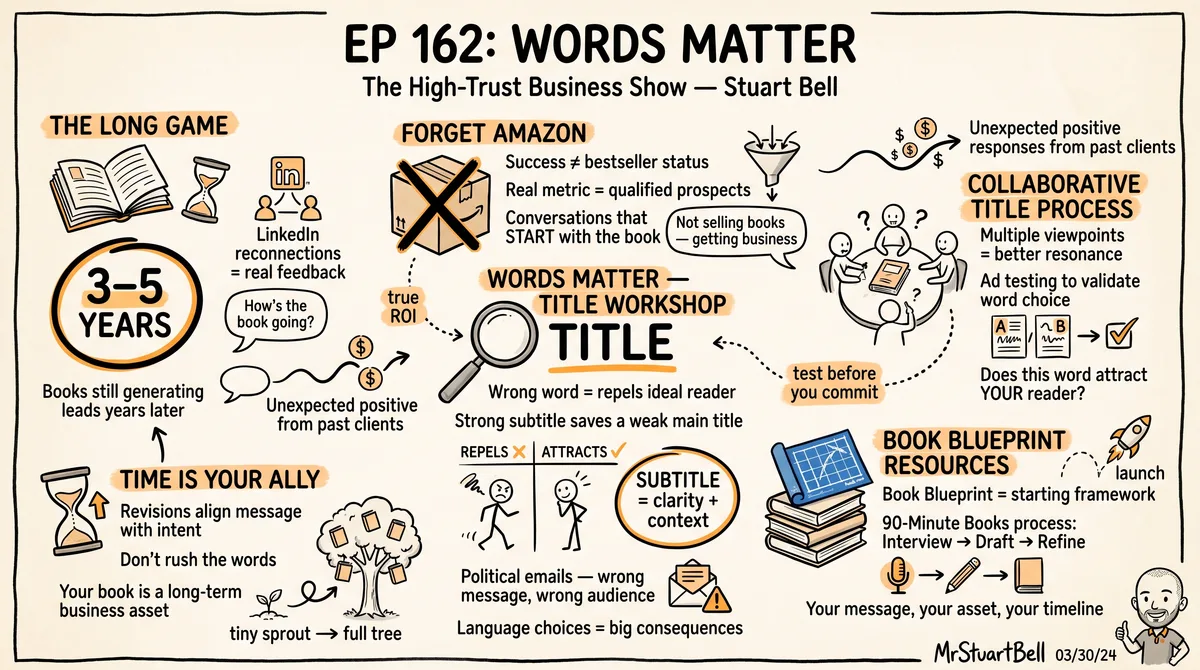
- Books continue generating business for clients 3-5 years after publication, often exceeding initial expectations.
- Your book's success isn't measured by Amazon sales but by how many qualified prospects it brings to your business.
- Word choice in titles and marketing materials can accidentally repel the exact audience you're trying to attract.
- A strong subtitle can save a weak main title by providing clarity and context for potential readers.
- The collaborative title selection process should include multiple viewpoints to ensure it resonates with your target audience.
- Time is your ally in book creation, allowing for revisions that ensure your message aligns with your intent.
Your book isn't going to make you rich on Amazon. But it might still be generating leads five years from now.
Stuart shares feedback from clients who wrote books years ago and are still getting business from them today. The real payoff isn't bestseller status or book sales. It's the conversations that start when the right person picks up your book.
This episode digs into why word choice matters more than you think. From book titles that either attract or repel your ideal reader to political emails that accidentally send the wrong message, small language choices create big consequences.
You'll hear about the collaborative process of finding titles that actually work, why subtitles can save a weak main title, and how to think about your book as a long-term business asset rather than a quick win.
If you're considering writing a book or wondering whether the effort pays off, this conversation shows what success actually looks like in the real world.
Transcript
AI transcript provided as supporting material and may contain errors.
Stuart: Foreign. Welcome back to another episode of the book More Show. Stuart Bell here. And today we are joined by Betsy Vaughan. Betsy, how are you doing?
Guest: I'm great, Stuart. Good to be here with you.
Stuart: I know it's been a little while. We used to do every week, but people don't think that you're replaced by other guests. But. But I.
Guest: We just figured some really great guests, though. So, you know, I love to hear what the guests are saying and listen to those podcasts, you know, more than listening to myself.
Stuart: Well, definitely about time that we were back on talking about things because it gives us the opportunity just to chat through a few ideas for people who aren't familiar. You're obviously running the book business for us day to day, so dealing with a lot of clients and potential clients, I run through a lot of those common questions. So good to chat about some of that. And then I made a post yesterday on LinkedIn, so I thought we'd give an opportunity to dive into that a little bit deeper as well.
Guest: Sounds good.
Stuart: Okay, so let's start with clients, I guess, quickly. So one of the things that's been super interesting, I might title this episode lessons learned from LinkedIn, because we've put a little bit more focus on that recently than perhaps we have done in the past few years. So one of the things that came up as I've been connecting with past clients, I was a little bit sporadic with making those connections as we were going along, so doing a bit of a job of catching up with people now. And the thing that's been a real, I want to say, surprise, not only a surprise, but maybe unexpected, is the positive feedback. So as I'm connecting with clients who were there from maybe three, four, five years ago, I'm asking them, how's it going with the book? And the response has been really quite interesting. And there's quite a broad. We're gonna have some people as guests in the future. There's quite a broad set of ways that people are using the books and one step removed to a certain degree compared with you. But that feedback of people really talking about how they're using them and the way that they're being received. Do you hear that?
Guest: You know that that is such a. I think the universe has a world, a way of sending those nice comments just when you need them. So you're having a frustrated day. All of a sudden, a nice comment from a client who's just finished their book, you know, or, you know, somebody who shares, hey, this is what I'm doing with the book. And it's funny, we've talked about this in the past, so we can talk about it again. People say, oh, I'm not selling as many books on Amazon as I thought I would. Which is exactly what we tell them when they want to put it on Amazon. But wow, you know, they're getting a lot of response. People are either downloading it or asking for it. And you know, it's turning into real business for these individuals. So, you know, y. Selling your book on Amazon is great and it's, you know, impressive, you know, but really the goal is exactly that, to, you know, reach people so they raise their hand so that they do business with you and that's where the financial value is. And so, right. We're a lot, you know, so that is really, you know, a positive thing. People don't know what they're doing when it comes to writing a book, so they're pleasantly surprised with how simple our process is. We get that a lot. Like we're just easy and, and not toot our own horn by any means. But we are a small team and we have, you know, so there's a, we're very personal. So you know, I'm getting text messages and phone calls, you know, so we, I think we bring that advantage. And so I think the client really feels that personal customer service touch, you know, so it is, it's positive to hear. So, you know, people use it in different ways. Some free do free download, some give them away at event, some, you know, charge a little bit for them. But the end result seems to be the same. People are having great success with their books.
Stuart: It's that it's funny, isn't it? The whole kind of bestseller BS type approach that we have of that. So going into the project thinking that's the only option, that you're going to do it, and then sit back and wait for the New York Times to bring their award around to your front door. There's such a small use case where that's valid and then it's such an expensive and time consuming group. For the majority of us who are running real world businesses where we want to get in front of the 100,000 people within 50 miles of where the office is, it's a real different take. I had a comment come back. Someone put a LinkedIn note saying that they'd, they wrote their book first and then they'd referred us to a business partner. And the comment was along the lines of, hey, I'm, I'm more of a implementer type Interested in the process and the details a little bit like my personality and the process worked very well for me. And then the person that I referred across is a very kind of visionary, if you're familiar with the EOS type language. Visionary person rather than implemented person is a little bit more scattered and a little bit more high level and less in tune with the details. But the process worked equally well for them as well and they were just as pleased with the outcome. So yeah, it's nice to see that we're doing something right and it's resonating with the people we can help. Okay, so LinkedIn. I put a post out a couple of days ago and titled it Words are important. And I think this is worth talking about because the same applies whether an email, which was the example that we'll talk about, or a book title or a blog post or a letter, any way of communicating with people. It's this idea that words are important and they actually mean something different. So the email that I received was from the Robert Kennedy campaign. I'd signed up for something at some point and that's why I'm on the list. So got nothing to do with politics. As the candidate. I'm actually somewhat of a fan of the candidate. But the email that got sent out that the subject was, the subject was bail into the sunset with rfk. Now, given that this person's a third party candidate in the media narrative is that third party candidates have an impossible job every point. Now with the Republican candidates all dropping out, the Democratic candidates, I mean, there were very few other candidates anyway and other people, apart from the two primary nominees, the narrative is that these people are dropping out. Then an email titled Killing to the Sunset is a little bit of a subliminal message that, hey, this is over now, I'm off and good luck, I'll see you later.
Guest: Yeah, absolutely.
Stuart: The purpose of, the purpose of the message was a fundraising thing and it was actually some invitation to go on a sunset cruise on like a donors type boat ride, whatever the, whatever they call it. As you can tell from the accent, I'm not that up on American politics completely or not in the history at least. So the language being important, given that there's an underlying narrative of, hey, it's only a matter of time before this person has to drop out because it becomes unviable. It was just such a clear smack in the face of, hey, what you actually mean here isn't what you're saying. As an example, it takes two seconds of thinking about it and I don't want to pick on this particular. Whoever wrote this email because, hey, I've sent out a whole load of stuff and looked back at it later and realized it wasn't quite what I meant. But hopefully this is an example for everyone to think about. The words that they say, particularly, obviously we're talking about book titles or subheadings, which is a thing in front of people as you present your book out there. But the Sail into the Sunset with RFK has a very different vibe to the message that is Setting Sail with rfk. I mean, even changing those words, Setting Sail has such a positive connotation to opens up possibilities and potential. Setting Sail to New Horizons, which actually is also 100% on brands with the candidate. I mean, that's what he's trying to be there as the difference maker between the incumbent systems. So I thought it was worth just diving into a little bit and this idea of words are important and they mean something and it's worth taking two seconds to put it to one side and come back and look at it again.
Guest: Right.
Stuart: In terms of people that you're talking to and titles that people come up with, do you hear any. Is there any common thread of people making title mistakes or things that they want to do that perhaps we advise against?
Guest: You know, I think people, everybody knows their content, like, they know truly what they want to put in the book and they have all of that, like in their mind. But the title is something that people really, maybe not the title so much, but the subtitle, you know, that we tend to struggle with a little bit. And it's. Sometimes it's, it can be very. You just put a book up that says focus, Focus. What. What does that mean? You know, I mean, there's nothing. So you need, you know, some sort of, you know, some sort of subtitle that says what this book is actually about. Because the reality of is you're going to take a, you know, oh, I'm not interested in that because I don't know what it's about. You know, whereas saying focused how to, you know, focus your dollars so you have a great retirement, that's a bad example. But whatever, you know, like saying just knowing what. Okay, great, this tells me something. So I think we struggle a little bit with that. And some people tend to question a lot and sometimes some things don't make sense and, you know, we have to sort of. I tend to pull, you know, ask your opinion, Dean's opinion. Nobody else really wants to. They're like just doing their job. So they don't get excited about it. Like, you know, like I would sometimes.
Stuart: Like we do, you know.
Guest: Yeah, exactly. God want our designer. He does. And he always. We have side conversations a lot, you know, about really. Don't you think this would be a better subtitle? So we do that, you know, a
Stuart: lot and we'll kind of make what's interesting. What's interesting about God's take on it is because he's coming from a design perspective. He's got such a narrow focus on just the COVID Who doesn't have the context of the rest of the book. He hasn't worked through the outline. He hasn't. Isn't at the front cover stage. At least isn't looking at the call to action. It's more. Hey, all the only information I've got is what's presented here. There's a really interesting take because from a receiver's point of view, a potential customer that's on LinkedIn and sees an ad for their book scroll by. That's all that they've got as well. So Goblin's almost the canary in the coal mine. If. I'm not sure whether that. Does that saying translate from UK to American?
Guest: I don't think so. Canary in the coal mine. No.
Stuart: So there's a. I wonder if how many people listening, whether it means anything. So canary in a coal mine is a saying for. It's an early warning. Like it's an indicator of something might be wrong. It's. And it comes. This is going to be one of those historic things that as you question it in 2024, you know, is that really what happens? So canaries, like the little birds. Canaries used to be taken live down coal mines because they were very susceptible to methane gas. So if you were down the mine with your canary and your canary died, that was a sign that you needed to get out there. Yeah. Canary in the coal mine. It's a bang for. It's an early warning.
Guest: That's great. Now, see, I mean, I should. I have coal mining family like my mom's, West Virginia. Her family's all now.
Stuart: Okay.
Guest: Yeah. Maybe something that, you know, she made.
Stuart: Yeah, Ask her and then report back on the next podcast and we'll see whether other people know.
Guest: Yeah, he doesn't. Unless he has more, you know, unless for some reason he happens on again on a call sometimes he. It really is kind of like crapshoot, if you will, you know, with what he's doing. Especially when you have such a vague title or subtype, particular title yeah, yeah.
Stuart: So I think tying that back to the job of work that we're trying to do it is those one word titles became very kind of a couple of years ago for bestseller, those types of books and I think in that context. So if you've got, if you've got a book like Clarity.
Guest: Jamie Smart.
Stuart: Yeah. Am I thinking of Clarity in the book that we wrote, he was the. Okay, this turned into a terrible example. The best selling book. There's something like Clarity by someone who I can't quite remember, but it was the best seller a couple of years ago. That title. There's a lot of marketing effort put behind the fact that that title resonates. So it's a name it and claim it type title. Because the person's name is on the tip of my brain, but it's fallen the wrong way, not out of my mouth. Anyway, that tile has got a lot of marketing push behind the fact that it gets traction and people know what it means. It's like a company name. If you called your company Google now it makes perfect sense. But for many years and $80 that doesn't make any sense. And if you had a shop front that was just called Google, as people drive past, they're not exactly going to get a lot of insights into what you do. So having that explicit, explicit it does what it says on the tin type title is just way more effective as we're working with people to start conversations with real clients. The subheading, actually if people don't have a copy, they should get a copy of the book. Blueprint scorecard. I'll stick a link for it in the podcast notes. But the title that stops people in their track and makes people say I want that is one of the key, one of the eight building blocks that we talk about. And then the amplifying subheading, something that builds on the message of the title and amplifies it, not adds confusion by bringing in irrelevant subject, irrelevant talking points or isn't. We're not trying to keyword stuff. All of the different possible terms that you can just throw into a subheading rather than a title. For those two things, it really does act like the headline and the subheading on a, on an ad. And that's a pretty clear way of thinking about it. This idea of the language being clear. I think the other element that it triggers or touches upon is context. So just as we were talking about a bestseller type traditional book has a lot of advertising dollars behind it. In order for it to be clear, it's being sold from bookshops at bookstore shelves. So the ability for someone to go in and actively seek that book, book, if it had a very long title. There might be more cases where someone doesn't find what they're looking for because it's not as easy to remember. If someone's talking about it to a friend, then a short one word title which is named and has a lot of advertising dollars behind it might resonate. It's sticking people's minds more than if there was a longer title. But the context in which we're using books and most people listening are going to use books is it's in an ad on LinkedIn or Facebook. We're trying to stop people in their day to day activity and make them say I want that and hold their hand and raise their hand. Rather, it might be a conference where you're talking about a particular subject and you're given a copy to people. It might be as people walk in through the door, they're coming to ask you about a certain framework or methodology or service that you provide and you give them a copy of the book as an amplifying part of the closing process. But again, that reinforces the problem statement, the issue that they came in with. Or you might be using it as referrals and asking existing clients if they hear of anyone talking about a similar problem, let me know and I'll give you the copy of the book to help your friend or family member. All of those scenarios, you're being responsible for initiating that conversation with the other person. They're not going out and looking for it. So I think that's another key difference between the context and the way in which traditional books are discovered versus the way conversations start in books are discovered. It's much more on a path that we control and we initiate as opposed to something where we're hoping that someone will remember the title so that when they're in a bookstore or when they're on Amazon, they'll have enough muscle memory to key in the things that we hope that they'll find.
Guest: Oh yeah, very good. Well, I was just real fast, this popped up in my head. Just I was talking to Dean and he asked me if we'd heard. But we had a title workshop recently. And this gentleman has written a book about mold, specific black mold, you know, in homes and businesses and stuff. And his title is Mold doesn't have to be a Scary Subject. And he said, do you think I need to change my title? And I said, absolutely not. Like it's Exact. I mean that is exactly what you want people to know. It's exact. I mean I've read the content. That's exactly what the content is. This is perfect. Like do not second guess, you know your title. So he just happened to pop up and it triggered my memory to think about him saying that. I mean it says everything, plain and simple, you know, doesn't have to put a picture of black mole front of his book or anything. You know, I mean words are enough, you know.
Stuart: We were doing some ad testing on a call in the, in this Thursday, this week I was on a call where we run a few some ad tests and there's an image that goes along with every ad. But there was a subset of those ads that were the disturbing looking images and we were trying to. The copy was the same on all of them. So we were seeing the response rate between kind of like friendly images and disturbing images. The disturbing images were slightly higher than the friendly images, which is interesting. It's always interesting. And it goes to show that. Right? And it goes to show that your own personal bias against things just let the data tell you what the result is. You shouldn't go in with too much of a. You've got to go in with a rec and an opinion to begin with but let the real world feedback steer you in the right direction. I'm always resistant, I think I'm always resistant to those types of images because it reminds me of those crappy AdWords ads or ad network ads that you see on the bottom of some sites that have just got the worst looking pictures and seems to be like the real clickbait end of the market. But yeah, the, I mean the numbers are the numbers. I was going to say on that, that title and taking that as an example, there's no ambiguity about what the book's about. The book's going to be used in a context in which it's being sent or placed in front of have to deal with mold. So it's not like the author's going on on a weekend news show and trying to introduce the idea that mold might be an issue to people. It's not. No one's ever heard of it before. So you're trying to enlighten people as to what it is. People know what it is. Most people are scared. They're concerned that it's going to be either kill them or be very expensive. So having the book that starts to bridge that gap to this is a manageable, actionable thing that you can do. Here's a copy of the book. And by the way, whenever you're ready, I'm here to help you. That's exactly what we're trying to achieve with the project here.
Guest: 100%. Yeah. Right on track there.
Stuart: Okay, we are sound crunching today. I need to get to another meeting but I really want to put put this out there because that email that fail into the sunset example of someone well meaning but just slightly. Yeah, exactly. Just slightly missing the mark. And I think I closed that LinkedIn post and I'll close here with a similar thing. Time is your friend in this regard. So writing something first but then being able to put it down for an hour, a day, a week and then come back to it and revisit it, which is part of our process as well, the book writing process. We give everyone the opportunity to get their first version of it and then make whatever changes they want to it that's always included. But times your friend in that when you come back to it with a fresh set of eyes, they're not going to be as fresh as Godwin's, only seeing it from that isolated perspective. But still you'll quite often catch things where you don't quite mean what you've written and that opportunity just to tweak it and improve it a little bit really can be a difference maker. Alrighty. Well, thank you for your time. I am going to dive out to this next call. I'll leave a link to the book blueprint scorecards in the notes here. So if you don't have a copy of it yet, it's a free download. So go grab a copy. And then the first, the second or third chapter is really talking about this idea of a title that gets people to say I want that and a subheading that amplifies it and compels them to move forward. So definitely worth worth reading and getting some more pointers on tools and subtitles. Very good. Cool. Thank you Betsy. Thanks everyone for listening and we will catch you in the next one.
Guest: Take care of.