Chapters
Show Highlights
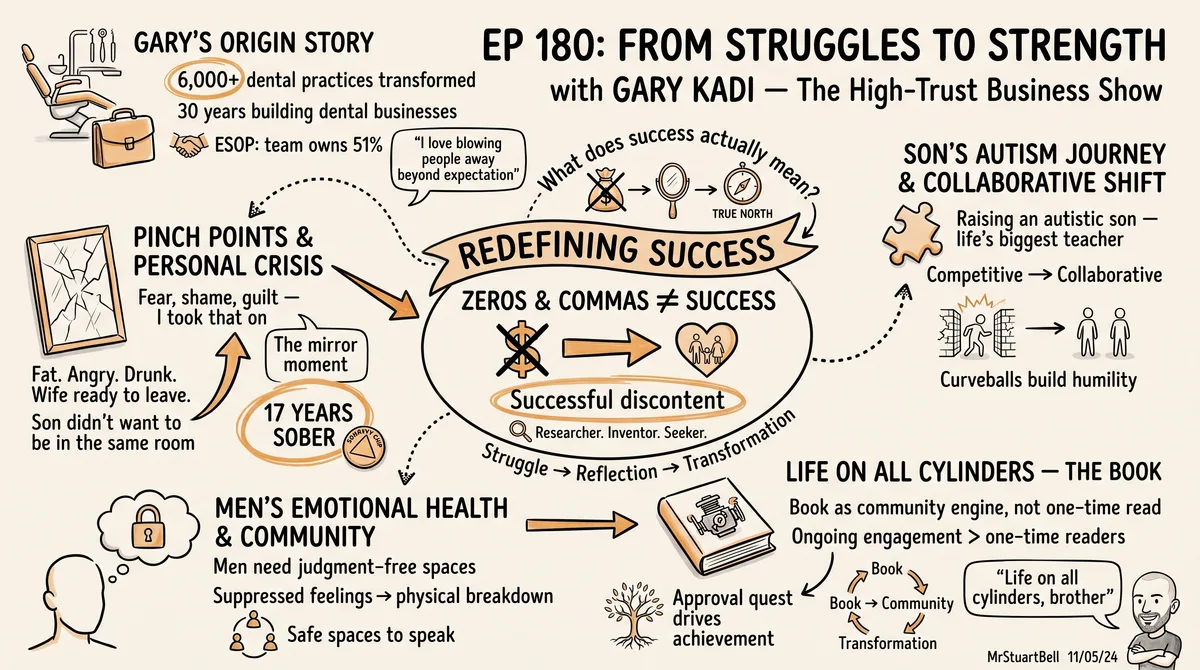
- Pinch points in your life aren't setbacks, they're the moments that force real self-reflection and growth.
- Childhood family dynamics often create a lifelong quest for parental approval that drives professional achievement.
- Your book content works best when it creates ongoing community engagement, not just one-time readers.
- Shifting from competitive thinking to collaborative spirit happens when life forces you to face genuine challenges.
- Men need safe, judgment-free spaces to express emotions before suppressed feelings create physical health problems.
Gary Kadi has spent decades transforming dental practices. Over 6,000 of them, to be exact. But the real transformation happened when he stopped chasing traditional success markers and started building something deeper.
Gary opens up about his battle with addiction, raising an autistic son, and those brutal "pinch points" that force you to look in the mirror. These weren't setbacks. They were the moments that shifted him from self-centered thinking to genuine collaboration.
We dig into how childhood dynamics shape your adult drive, often creating this endless quest for approval. Gary shows how competitive instincts can transform into humility when life throws you curveballs.
You'll also pick up practical strategies for building communities around your book content. Gary breaks down how to create engaging narratives that connect with readers long after they finish your last page.
Transcript
AI transcript provided as supporting material and may contain errors.
"How do you define success? And I was like, you know, getting up there in aging, got a little bit more gray hair and I'm going, I don't think zeros and commas define success. And it's probably why I'm a successful discontent. And so I went to work on that. I'm really, I'm a researcher. I'm, I, I love inventing things and I just, I went to seek out the best support structures for high achieving. Foreign."
Stuart: Welcome back to another episode of the book More Show. It's Stuart Bell here and today joined by Gary, Katie. Gary, how you doing?
Gary Kadi: Oh, man, Stuart, I am pumped to be here. What a ride it's been, brother. What a ride.
Stuart: I'm excited as well. So Betsy, a lot of people listening will know Betsy, she's on the podcast occasionally and obviously all of our clients know Betsy because she's holding people's hands through the process. So Betsy for the last couple of months is saying, oh, as Gary's book gets towards the end, we've got to have him on the show because he's got such great energy and it's going to be one of those shows. So I'm excited to share as well. Why don't we start off by giving people a bit of a background on you and what you do and set the scene for everyone who hasn't met you yet and then we can go from there.
Gary Kadi: Yeah, yeah, yeah. You know, I'm an entrepreneur. I've, my main business for 30 years has been developing dental practices. We've worked with over 6,000 dental practices. As you know, dentists don't know how to run their own business. And I have a soft heart for entrepreneurs and especially ones that don't know what they're doing and they know they don't know what they're doing. So I codified a methodology and we installed it in over 6,000 practices. And we're also rolling up practices, all of our practices that we're in a consolidation in our industry stewards. So we're taking our, we develop practices, we position them for sale and, and then we package them. We, we have our own group and we sell them to, you know, private equity firms and they're getting, you know, multiples that are, you know, well beyond what they can get on their own. So I love serving people and blowing away, blowing people away beyond expectation and have been able to do that in dentistry my whole career. It's been a joy. And my team, I like to take care of my team and I created an esop an employee stock option plan and sold the company to a trust. And my team owns 51% now, which would have never happened. And it's a beautiful play for me because it's a nice exit strategy for entrepreneurs. And. And now I was bored and I wanted to take on something new and something I'm really passionate about. I was fat, angry, drunk. My wife wanted to throw me out. My son didn't want to, you know, be in the same room with me. My team hated me. And so I realized that this is, it was just my fear, deep rooted fear, shame and guilt and, and I just took that on. I'm seven. I'm going to be 17 years sober this year, Stuart. And I'm real proud of that. It's probably my biggest accomplishment. And I didn't do it alone. That was the great part. See, there's so many lessons in pain and suffering. And I lived, you know, here I am an entrepreneur, I'm making all this kind of money, but my wife hates me, I'm fat, I'm angry. You know, all this, I'm like, what the hell is this?
Stuart: Across the board, right?
Gary Kadi: I'm like, what the hell? How do you define success? And I was like, you know, getting up there in age, I got a little bit more gray hair. And I'm going, I don't think zeros and commas define success. And it's probably why I'm a successful discontent. And so I went to work on that. I'm really, I'm a researcher. I'm, I, I love inventing things. And I just, I went to seek out the best support structures for high achieving men. And I couldn't find many. And the ones I found were boring, horrible. It's too complicated to understand. They were all over the place. So I found a guy who taught me about health in a simple way. Sachin Patel is my partner in this endeavor. I lost £50, kept it off. I'm a street kid from Jersey. I don't know how to deal with money. I mean, I knew how to make money in a business, but I didn't know how to keep it because I would spend it all. Panerai watches, 9 11s, you know, houses with long driveways. You know, I thought that was the whole jam, right? And it wasn't. And now have eight figure net worth, which is beyond my wildest dreams. I'm a street came from Jersey who came from nothing, you know, and you know, my wife and I are like, we're like teenagers. And like, that's not Stuart like for me to sit here and have that happen. Like, I can't wait to see my wife. She can't wait to see me. We travel the world, we're global citizens. It's fun. Another big accomplishment was my son was diagnosed with autism at, at 3. And we went to work on this. And this is when I learned everything's possible. In the face of anything that we're dealt with, there's always a solution. If you look for that solution, I believe that too. And he's now off the autism spectrum. And this kid, he was flapping his arms. I was reading Good Night Moon every night, his first. And my wife goes, he's in there. Keep reading to him. He's like, didn't know. He's looking around. He's, you know, looking at bright lights and fans spinning. And one day we're driving home here in Arizona and there's this big harvest moon. Stuart and my wife and I are driving after a night at dinner and all of a sudden we hear, yeah, moen. We're like, what the heck is that? My son's first word. And now that's such a. I mean,
Stuart: talk about a reward for the tenacity of sticking in there.
Gary Kadi: Well, it's interesting thing is we declare ourselves and we become it. See, I was saying my son was autistic. My wife said he was diagnosed with autism. Right.
Stuart: Yeah.
Gary Kadi: See, we start declaring things and become them. And when you do that with yourself and you do that with others, you're doing everybody a disservice. It's like speak to them as they ought to be, as they who they are in the future, bigger. And like once I started separating that, you know, here's my son who was speech delayed at five. Like he, his first word was a five. He's now at the Cronkite School of Journalism going to be a play by play sports broadcaster. He just called the D1 game or
Stuart: Arizona State against not being limited by the other people's diagnosis.
Gary Kadi: And so how often does that happen? Right? How often? And then like breaking the, the patterns that our brain tells us. I call it the, the unexp inner roommate. Stuart. Like, no, I didn't realize voice that's there. And I became that voice. I'm not that voice. I had no clue. I thought that voice was me. And then I learned there's thoughts and then there's my thoughts. And if I buy those thoughts and believe in them, I become them. I'm like, what?
Stuart: Yeah.
Gary Kadi: No, not doing that.
Stuart: That idea that separate out just because the thought is in there doesn't give it any more validity than anything else to take a second to think about the thinking. I wish that was taught in school and allows people to just break away from, or at least even if they choose not or don't feel that they can break away from it, at least be aware that it is not the same thing and that there is an alternative.
Gary Kadi: Exactly. So, you know, I've lived a life of suffering and suffering is an extreme gift. I didn't know the gift of desperation. My wife handing me my walking papers, my team telling my clients to ask for refunds. I had to come up with all the money and these consultants went out and took all the clients and I had to generate ridiculous amounts of cash to pay off all the refund. Like, I didn't know that was me being an ass that created all that.
Stuart: It's interesting that you took it as a wake up call and not double down because I can imagine another person being just reinforced in that idea and not taking it as an opportunity to look for change. Did all of those things kind of happen at about the same time? And it was it one kind of moment of realization that that powered that change.
Gary Kadi: There's pinch points, I call them. And these pinch points are real gifts. Like oh, eight was like a real good, what I call pinch points. It's like a wake up call. It's like everything's gonna happen. Wife wants to give you the walking papers. My son is like 3 years old and like in the midst of his autism and like we're moving from Arizona to New York and I have a lease and all these employees. Before remote working was happening. I'm moving to New York and I can't sell my house in Arizona because they're worth zero in Arizona back, you know, back after, you know, real estate crash.
Stuart: Yeah.
Gary Kadi: And I'm going, you know, it didn't happen to me, which I thought it was happening to me. It happened for me. But it's that little nuance that when we realize. I call, you know, I love pinball, man. Old school pinball. Not the video pinball. But like when you're flipping it up and you're trying to keep the ball up in the pinball, like, and it's too much and life is becoming unmanageable. There's a reason. And I love this. This is my favorite thing. I realize that I am the source of all my problems. I invented every I caused or invented. When you take 100% of responsibility because I was a blamer. I was a denial guy.
Stuart: Yeah.
Gary Kadi: I'm like. Because I was high powered, I mean I kicked ass. I mean get me something to do, you know, I got this book done and start to finish out the door. I hope I beat a record. It was like four months from conception to, to print, you know, I hope I want. Did anybody beat that record because I like, I'm proud of getting done, man.
Stuart: I. The way that you got it finished to the extent you got it finished is. Well, we've had a couple of shorter ones, but they were probably slightly earlier drafts for you to have got it done. Revise to the extent that we're kind of like full print and ready to go. Not just the digital version. Then. Yeah, I think there's some award winning turnaround and focus.
Gary Kadi: Can you tell I'm a little competitive? I like winning the game, I like playing the game. But I also learned about myself like through these pinch points. They're all gifts to learn about what's working and not working. And the big thing for me was I was self centered. I was doing it for myself. I didn't ask for help. I was, I was like, right all the time, self righteous. Like if you're willing and open, like I don't have to be right about everything. See a competitive guy, when you, when I studied Myers Briggs, a competitive guy is autocratic. Under pressure. When you get autocratic, you kill. I was killing people off.
Stuart: Right? Yeah.
Gary Kadi: So you don't learn that if you're not paying, you know.
Stuart: Yeah. And as you say, if you're insistent, not resistant on a particular idea and you've only got your own opinion in there, I mean, how many times have some. It's well known because we're all remote. So it's well known that we have to deal with things remotely. And the office will call me trying to fix some technical problem because they're trying to just get things sorted out. And I say, oh, this is a silly question, I can't believe it. So I said, listen, there's no such thing as silly questions. There's only silly answers because we've all been kind of fixated on our own thing and really believe in the moment that we're correct only to later believe something else. Whether it's we've had a change of heart or the information's changed or the scenario's changed. But being so insistent on something and doubling down on that on the occasion that you write it can work. And people refer to these autocratic leaders like Elon Musk and Steve Jobs. As no, it's my way or the highway. But for the majority of situations, having the humility to take on other opinions and look for other opportunities, it's more likely that you're statistically more likely that you're not correct than you are correct. So, yeah, having that openness to the team and then they don't feel like you're an ass.
Gary Kadi: Exactly. But, you know, when I walked in a room, people were running for the hills. They were like, oh, this, this guy, this guy again. And I really have a big heart and I love people, but I also, I was driven by my identity. My identity, like, that I built up. Like, I have to be successful or I'll die. I have to have money or I will be in prison. I made up all these beliefs at a young age because I had a lot of trauma. You know, my dad beat the crap out of me physically and mentally. Like, if I got an A, I needed to get an. And if. And like, if I was off the rails, I was getting beaten when I got home from the belt. So I was telling myself, like, I have this thing that created in the book, actually for the book, the arc of a man arc. One third of our life, we spend proving to the people that gave us life, keeping the tribe alive. I call it. Like, my dad ignored me. He wasn't at my all star games. He never showed it a baseball game. I was like, dad, see me, please. And I didn't know this, but this is like, I stepped back and zoomed out and figured all this stuff out. Now I put it in a way that men can understand it. So octagon number one is you with your parents one way or the other. Octagon number two is you with your empire. I deal with all entrepreneurs, so it's like you're battling out with payroll and employees and can't hire them. And all the BS that you got to deal with with running a business. And then the last one, which I just, I am in and I cracked a bit of the code, but I'm cracking more every day. And I love being the guinea pig. I love going in there and, like, getting my ass kicked because I know I can always come out the other side. See, I trust that in the past, I would live in, like, impending doom and I would literally think I was dying. The last one is you against your identity. Ego.
Stuart: Right.
Gary Kadi: And. But it was there. All these things are there all the time. Like, if you don't heal the first one, you're working to prove. And it's very Unfulfilling. That's why I was making a shitload of money. But I was very unfulfilled, not feeling good. The middle one, if you don't get that one done right, life goes 20, 30, 40, 50, 60, and then you're taking a dirt nap and you're like, what happened to excuse my language. I don't know. I'm like, life just passed by me and I'm going to be on my deathbed and I'm not going to do the things that I really want to do. And that's the cost of that one. The last one is I tried to get out. I tried to get out of the middle of my business the whole time. I couldn't do it. I didn't realize it. It wasn't because my team wasn't capable. It was because my ego said nobody could do it like you. And the minute I sold and I didn't have to be in the day to day anymore, I panicked because I had no appointments on my schedule. I didn't know what to do to do. It was, it was as scary as drinking.
Stuart: Right.
Gary Kadi: I'm sorry for cutting you off. I jacked up.
Stuart: Not so people are here to listen to you. I'm done.
Gary Kadi: I'm just so excited. I'm stepping on you. I'm so sorry.
Stuart: No, at all. I was just going to say that realization that the, as you said before, the voices in your head and making sure, realizing there's a difference between just an electrical trigger that triggers a thought and an actual thought that you want to hold onto and live with. And then the calendar being filled up and the needing to be right in a meeting and needing to prove something to an unclear entity that you can never actually get validation from. Particularly, I mean all of those steps, it just builds to this thing that unless you address it, and even addressing it has challenges, but unless you address it, I mean, it's just. You're chasing ghosts all the time. So regardless of the bank balance, finding happiness in that is just a game of shadows.
Gary Kadi: Yeah, man, I'm sorry you got me so jacked up, Stuart.
Stuart: Well, and this is the passionate thing about the books that we're helping people write. It's the whether it is an emotionally charged book like yours really trying to make a difference to people's lives. Not necessarily in a day to day business sense, in a nuts and bolts way, but in more of a broader way or it's someone passionate about. Well, take us for example. I mean the scorecard book that I'm using At the moment, the book blueprint scorecard, I'm passionate about that. The eight ideas are in there, make a meaningful difference to people using books. And the scope of that is relatively small. And at the end of the day, I mean, it's probably not going to fulfill a life's passion in quite the same way, but within the scope of what it does, you get passionate about what you're delivering and the opportunity to kind of bottle some of that passion and put it into the pages of a book and get it out there to share that knowledge with other people. It's. It gets people on board the trade and that's exciting.
Gary Kadi: I want everybody to have the book. That's. First of all, I think everybody has a book in them. And then I want everybody to know, like, I think I showed you. Let me show you this. These. I wrote these without you. I wrote these without you. Self published starting in 06. Okay. This thing took me countless hours. Stuart. I was. And I was all on my own. You know, I had some coaching here and there. But like, you know what you did? Like, I, I have three books going with you right now. What you did and what Dean and you and Betsy and your team have done is. It's miraculous to me. It literally it. And. But like, it's not like this thing that got created as a business because Dean needed to do it. But it's like every step of the way, like, I was more interested in your process because I'm like, okay, let me look. Do they really have a structure Process? Dude, I love systems and process because I love consistency, duplication. I like being able to spit out like everything I'm talking about, I put a system to for men. Right, Right. Your process is extraordinary. Like, I literally, I was sitting in Oslo, Italy. I had this idea for a book. I sign up, I speak to Betsy. I sign up. That night, I couldn't stop. Like, she goes, oh, it should take 90 minutes to fill this out. I was so enraptured in the question. You asked the right questions so you can get the right answers for the content. But, but here's what I love about the process. It's all tied to lead generation and marketing because you know how many peloton bikes after the pandemic are sitting there not being used? Right?
Stuart: Yeah, yeah.
Gary Kadi: How many books don't even ever get read? I don't know what the stat is. I'm sure you know, but the thing about it is they buy the idea, raise your healthy deserve level. Then on the back there's 10 things guys suck at and 10 things to do. Feel better today. But we built a funnel for that and it's like richness. I don't have to touch a thing. It's just like they don't even have to read the book and they're already in the funnel. Ranking out, becoming a part of the community. It's masterful in terms of thinking through what is important. Like I used to think like this book is 200 pages. I thought every book needed to be 200 pages. No, here's my new thing. A flight. If I can't do it in a flight. Yeah, like, but as a first time author, I thought I had to have knowledge and figure it out and sound smart and it ends up being fluffy
Stuart: and that's what everyone else says. I think it's the, it's the thing that people forget the most is that the motivators for the publishing industry is book sales. So everything is around that. So if you're selling 200 pages on the shelf next to 500 pages, well, I mean bigger looks better. But that's not the context in which any of this is done. The, the purpose that we're trying to do is get into conversation with people and help them understand that next step. Which goes back to. I'm a huge fan of frameworks as well. Whenever I talk to someone and they mention a framework, that's it. They've got. I can see their book and their funnel and their follow up and their engagement and their onboarding it. It's all there already. It's. And that. And that's what you've got with yours. It's these pieces that kind of clearly articulate the stages and the mindsets and knowing that each person is going resonate with one more than another. But all of them kind of lead towards that next step.
Gary Kadi: Well, I just found out and I love the way you say framework with your accent, dude. That's way better than an American dude saying systems like framework. That's badass. Dude, that, that sells, man.
Stuart: That's take over the world.
Gary Kadi: I want to buy that. And I understand. I, I just found out about this that you actually have marketing on the backside of the book. Like that's what you do. Is that accurate?
Stuart: Yeah, yeah, yeah. That's why, I mean the systems I set in place to create the. Like you were saying before, you love cracking the code. Same for me. The system that I put in place to take someone who walks through the door with the seed of an idea into a conversation starting book that code has been cracked. Now we kind of refine it all the time, but we've kind of cracked that one. So the job of work of what people then do with it, okay, it's built. But now what? Sit back and wait for the door to start knocking? I mean, that's not going to happen. So using those elements of the book and helping people leverage what they've already created without not saying, okay, you've done this one, now here's a whole new world in which to enter. It's okay. How can we leverage these things that we've already done into something that orchestrates that journey? And that's that marketing piece.
Gary Kadi: Can you give me a little piece on that right now? Would you be willing to share that?
Stuart: Yeah, yeah, absolutely. So think about the idea that someone is going to raise their hand is interested. So the life on all cylinders book. So your book, the ideas that engage the people, there's 10 of them. There's 10 things that people did and there's other things as well. But let's just say that the 10 to begin with. So running ads and identifying ads and having pull quotes and having snippets of this video when we talk about it and the book recording in the first place, those 10 things, if you wanted to run ads, that's 10 snippets to start the conversation. Here's piece one. Let us create a little bit of blurb to go around with. It's a little bit more marketing copy to get people to raise their hand. The book is then the obvious opt in for someone who wanted to raise their hand on one of those 10 elements when they opt in. It's the minority of people who are going to take action straight away. So we want to give them a call to action for people to do immediately, those hottest people. But we also know that the others, it will take some time either. I mean, geez, I look at my inbox, there's probably 50 things I would love to do if I had all the time in the world and got around to it. I just fell off the radar. Another email came in and got pushed down. So an autoresponder sequence in the first seven days after someone opts in, that's the opportunity to engage the next 10, 15, 20% of people who are hotter. So let's set up that autoresponder sequence. Okay, now we've got the long haul. After that, we want to keep in touch with people until they're ready. And that might be weeks or months or even years. So from the book, we've got 120 or so pages in the book, 20 or so main themes in there. Let's record something quickly that talks about each of these pieces and that could be follow up material for a weekly email and the call to action in that weekly email. One of Dean's things that a lot of people. No Dean who are listening. So the idea of a super signature. By the way, Gary, here's three ways we can help you. Whenever you're ready, go consume more information on our YouTube channel. We've got some deeper dives into these topics. Join our free community where we're talking about this as a group and actually to personalize it for you, we've got a breakout weekend coming up where we want to. Where we do this first step. So all these things and then there's a million of them of them. One thing that we just started doing with people is the idea of having either an audiobook version or an audio companion version. Kind of two separate things. But having the audio version either of the whole book or have like a fireside conversation where we're doing kind of like the TLDR or the, the initial dive or the fireside chat where we talk about the content and use that audio as a bonus upsell. Opt in like an extra cookie in the cycle because the material's already created. But maybe it's just that thing that someone will say, oh yeah, actually I can't read, but I've got time to read, but I'll listen to the audio. So all of these ideas downstream from the seed that's been created just gives a broad footprint of a broad coverage to lead people into this funnel and, and move them on.
Gary Kadi: Man, I didn't even know about this part. That's pretty amazing. Well, thank you.
Stuart: It's. As you were saying, it's the, it's the separation of the thing from the purpose. So used the example before and keep going back to it because it's such a message that resonates. The separation of the thought from what you do with the thought or the name in which something is given and what you do with that name. The framework that you've got with the dental practices. You talked before about the success you've got because you crack the code with the first couple and then rolling that framework off and there's implementation differences on all of them. But this idea of the thing and what you do with the thing, for us it's the same. The book exists now in a publishing world. That's the end of the journey. Fifteen for A book sale. Let's put it on Amazon. Let's maybe do like a little press tour gig thing, try and get someone, use those. But that's it. We're really just talking about book sales because as a publisher, that's your scope of influence, of interest. But for this, the job of work of this is starting conversations and the maximum amount of conversations that we can start relevant conversations and bring them through a funnel to conversion. Now you've got me going off on one bills, right. And I just noticed how much I talk with my hands. I can see myself in the camera and I'm kind of.
Gary Kadi: Well, it must be the Italian in you.
Stuart: It's. Yeah, right, exactly. Yeah. But this idea. So you're the ideas that you brought together in the book. I always like to ask people because as you said, everyone's got a book in them. But that book isn't necessarily always kind of dialed in. You've got experience of all the books you've written in the past. So there's lots of different ideas. So when you think about the scope of this book and what you wanted to include and what you chose to exclude because it fit better outside of the scope of the book, how did that go? Was that an easy task to kind of dial it into what you wanted, or was it a challenge to either not do too much and not do too little?
Gary Kadi: Yes and no. You know, I did business development for dental practice and we still do. I'm still very involved and to niche in that industry. My first book, this book, Million Dollar dentistry in a seventh edition. This is like almost 200,000. 200,000 since 06 in distribution. That's nuts of a niche business. A niche book, right?
Stuart: Yeah.
Gary Kadi: But it was the nuts and bolts of a model that didn't exist. And it's still. It's like, it's like Led Zeppelin, Stairway to Heaven. It's like you can't. It's like no matter what year, what day, it still sounds relevant as hell. You know what I mean? It's like, yeah, it's so good. The only thing I had to change was how much we paid employees back in the day. You know, like each edition, some of the analogies. But when I. I got to page 69 and I remember I wanted to kill it because I was doing a general book. And what I did learn was I. I was like, there's riches and niches and I know that for a fact. But like the identity part of my brain wants to go to every single human being. All 8 billion people. And so I've learned the lesson Stuart, too. The more narrow I go, the better. Now what I was grappling with was entrepreneurs and C level executives. That's what I got it down to. And it was hard for me to go, like, eliminate the C level executives until I realized that we have, you know, eight cylinders, eight coaching sessions in our community that we built. So the book drives subscriptions. And then you get, for 99 bucks, you get coached by my, the people that help me lose 50 pounds, make eight figures, get off alcohol. Parenting parent. The woman that parented helped us parent an autistic kid. Like, you know, if you can parent an autistic kid, you use her tools to parent, you know, typical kids.
Stuart: Yeah.
Gary Kadi: And you get eight one hour coaching sessions, interactive each month. It's freaking ridiculous. But I'm delivering the fulfilling entrepreneurship exercise and I realized that I don't have the business of talking about C level executives, first of all, because I hate bureaucracy and I was never a C level executive. And I've learned that I should only be coaching things that I've experienced for myself, not like an idea of something. So in, like midstream, I had to extract if you're like I kept saying, if you're an entrepreneur, a C level executive. We, in the middle of the writing, we had to extract all C level executives, you know, and then I was like, I want women. And like, I know a lot of women leaders. You know, by the way, my grandmother taught me Stu, I just called you Stuart. I'm sorry. Sorry, Stuart.
Stuart: I've been called Wes.
Gary Kadi: My wife is Judith, not Judy. So, you know, I've learned my lesson.
Stuart: No, I'm fine. And since moving to the States, I've also lost the fact that it's s t u r t. I'm fine with EW now as well. I let that one go a long time ago.
Gary Kadi: They sell good hot dogs and good French wrinkle French fries there at Stewart. So check it out. It's really good. Anyway, my grandmother said at six years old, she said, find a great woman, do what she says, and your life will be amazing. And so I want to include women. And I found that the book is targeted to men. But I'm going to be going on podcasts for women about their husband, because women make decisions for their husband and they go, here, honey, I got this book for you. Go see this dude. So I'm helping the man, the family and the workplace, but I don't necessarily have to write the book for all those things. And that was A real gift to understand.
Stuart: That's really insightful. One of the framework ideas is this idea of beneficial constraints. It's the seventh one in there and it really talks about there's a couple of constraints. One, as entrepreneurs, which most of us are listening to this we don't. We've got the flexibility of not being told what to do or not really having to be accountable to anyone else apart from ourselves. But with that comes big problems because if something slips, then okay, there's nothing so artificially constraining the time scope is a great benefit because it gives you some guide rails, but also the subject. This idea that a traditional book is 2, 300 pages long and everything has to be in there. And it's the tome, the magnum opus for any subject. It was never the truth in the first place and even less now when there's so many auxiliary sources for information. But one that I hadn't really thought about before or heard people describe is that one that you just mentioned. And to reiterate what you said, because I think it's very worthwhile for other people is writing the book for the target audience, but knowing that the audience might not necessarily be the target, but you still have to be specific in the first place for that second degree group to realize the relevance. And that I think is because had you tried to include women in there, at worst it would have been inauthentic or wrong. And at best it would have been a bit kludy and trying to put too much.
Gary Kadi: Well, I actually was going to have my wife. I was going to inter interview my wife and include her perspective. So yes, I could have done it right and. But I was like, I am. Because here's the thing I want. The number one thing is no judgment for men. Here's the thing. You know, Howard Schultz, this is my vision for this. Howard Schultz said, I'm going to create a place between work and home. Created Starbucks. That's why people go there. Because there is no place to go in between. This is a place to go between. You know, like being a monk and living life full out. There was. But there's no place for no judgment. See, men don't like. I did. I researched men. I was the first research project. We don't like raising our hand and asking for help. We definitely don't like therapy. We definitely don't like being told what to do. We don't like kibitzing with the boys. Let's go. Let me share myself with the boys. No, we go get drunk, we go. We bowling Softball. It's like we get our aggressions out that way. Yeah. Talk about we're not going. I am really sad right now. No, but guys need to do that. I needed to do that. I didn't. I couldn't declare the emotions sad. You know what it showed up as anger. See, anger squashed my sadness. I was really just sad. And it came out as anger. And you know why anger worked? It was the same. Anger and alcohol are the same things, by the way. It's all adrenaline rush to numb the body out from the pain that we're living in. That stuff down. And then when you stuff it down, the reason why women outlive men is because we stuff down. And I believe in, you know, psychosomatic issues where the body gets the hit
Stuart: levels and nothing else. If nothing else, I mean, that's exactly.
Gary Kadi: And I had no idea, dude. I had no idea what parasympathetic was. I was in fight or flight. I was in sympathetic. I. My. I was like, I was. I woke up in the morning, threw my armor on, threw my mask on. I gotta go to work. I got what fine hell you know am I gonna run into today? I got my guns, I got my bear. I'm loaded for bear. I'm gonna take out like. And I had. Now, if you asked me to articulate that, I'd be like, I gotta go to work today.
Stuart: If. If we get nothing else from this podcast, I'm going to share these last two minutes with my wife. Because she'll be saying, yeah, that.
Gary Kadi: Well, no, they know, but we don't listen to them. No, they do. You know how many times women send men to their man to me, like, that's how this all came out. I have 20, 20 something year olds. Their moms send the kids, the young guys to me. And I have like, my friends, 80% of my friends are suffering needlessly.
Stuart: Yeah.
Gary Kadi: And their wives are sending them to me. I'm like, okay, I gotta put this in a book. I'm sick of saying the same thing over and over and I'm not this
Stuart: first and then come back.
Gary Kadi: Well, you know what it is? I don't have all the answers. I just. I got sick and tired of suffering.
Stuart: Right.
Gary Kadi: And I just go, who the hell knows more than I do? And then how do I put it all together in one place? And that's how this thing got built.
Stuart: Yeah.
Gary Kadi: I'm an accidental expert on. I hate pain and I'm sick of suffering. And guess what? I'm not going to be on my Deathbed, Stuart, going, I wish I had more pe. You know, I wish I would have done X, Y, and Z and had more peace, everybody. I walked five of my closest family members to heaven over the pandemic. Every one of them did the same thing. They reconcile at their bed.
Stuart: Yeah.
Gary Kadi: Every single dude. I am not reconciling at my bed. You know what I'm doing? I'm running in at 100 miles an hour. Going in sideways, going. Yeah.
Stuart: Jumping across the finish line. Yeah.
Gary Kadi: And. And saying, I live with no grats, no shame and guilt. None of that.
Stuart: Yeah.
Gary Kadi: And I was like. And like, once I realized that's possible for me, I go. My job is to give it away. Is too many. As many men as possible, and I'm gonna do it to 50,000. I don't know how I'm gonna reach 50,000. I know with your marketing in this book, I got a better shot at it. In fact, I'm pretty confident that I know I'm going to reach a lot of men with this message because they're silently suffering. I know the guys that get straight with me and open up to me, I help a lot of guys get sober, too, Stuart, and they start opening up to me because they know I'm safe. See, the number one thing is no judgment zone. That's what I'm creating in this community. I'm gonna offer one thing to guys, they don't even need the answer. The fact that nobody's judging them and they can say what they need to say, that's worth it alone right there, in my opinion, because I know I didn't have a spot like that. I go to my wife, she'd be like, what are you complaining about?
Stuart: Right. Yeah. There's not. Even if people don't see it as judgment, it's still taken as it's not comfortable or it's not. I don't want to use the word safe because I'm not a fan of the word safe. But for want of a better word, it's not safe for whatever that means. But to have that it. To be able to say out loud, it has to be the first step in even addressing it. Because the little voice that you described before is in with all of this other stuff to be able to. Like I did. You were talking about Tony Robbins before we started recording, and a friend of yours. I was. When did the UPW program in London? 22,006, maybe. And then was on staff for a couple of years afterwards. And the process that he's got there, I Forget what the exact process is called, but this idea of overwriting the message with an E message, and it's just. It's ingrained in, and you have to understand that it's just habit. It's just track. It can be overwritten. So to have a space where you can start that journey and say things out loud and then react and respond to those things in a kind of conscious, thoughtful way, I mean, that's something that people need the ability to go through.
Gary Kadi: Yeah. And let me just give you one tool today that, like, I learned, because now I'm not. All these thoughts because I'm. My wife brings something to me, and I want to go fix the problem immediately. Like, I don't even hear what she's saying. Like, it feels so uncomfortable for me that she's uncomfortable that I just start doing. Right.
Stuart: Yeah.
Gary Kadi: So we created this thing called HHH Principle. She starts talking to me, and I could tell she's having a hard time. Do you want me to hear you? Do you want help or do you want a hug? Here, help. Hug. And I go, I just. I never asked that question. You know what I would do? I would go, hey, you know what you should do?
Stuart: You should.
Gary Kadi: We're going to do this, and they're not going to do that to you. And I'm going to do this, and we're going to do that. And she didn't want any of that.
Stuart: Yeah.
Gary Kadi: Nada. Nothing. Zero. Zilch. You know what? She wanted me to hear her nine out of 10 times. She just wants me to hear her at the end of the day and I come home wasted from. From slaying dragons all day at work, like.
Stuart: And, oh, by the way, fired up.
Gary Kadi: I'm on my phone. You know what her love language is? Quality time. And you know what I'm giving her acknowledgments and Gucci shoes. And she doesn't care about any of that stuff.
Stuart: Yeah. Yeah.
Gary Kadi: None of it. Zero. Not a zilch.
Stuart: Such a challenge. And for you to brought together some of this knowledge into something that people can start that journey to announce a resolution or a change of perspective, at least it's. I'm excited to be along for the journey and see those 50,000 people respond and eyes open and take that next step. Time always goes fast on these podcasts. We definitely need to follow up with another one. But in the meantime, where can people go to get a copy of the book, which, I mean, I can only come recommend it enough.
Gary Kadi: Yeah. Life on all cylinders. Dot com. You made sure that I got that. That was part of the system and the strategy. I wrote a book and you were giving me marketing tools on the front end. Like I couldn't find it. I couldn't had it. I had to go buy it. It was worth every. Like you told me how important that was to have Life cylinders. The name of the book match the name of the URL and like I had to grapple with it. I would have given up. Yeah. But I wasn't doing any of that because that alone I go, these guys are worth every penny. By the way, I think you should raise your price after I'm done doing my 10 books with you. Then raise your price.
Stuart: You're way too countdown.
Gary Kadi: You're way too cheap. No, it's. Your price doesn't match the value. Sorry. It's just not even close. And I bought a pro one and it. I would have paid 10,000 for that. Seriously?
Stuart: Yeah. Thank you. It is something, especially when we look at the competition, it's something we struggle with all the time.
Gary Kadi: But I didn't even know there was competition.
Stuart: It's. Well, they're less good. It comes to the right place. But like you within the program that you've got, it's difficult separating yourself from the passion of wanting to do it versus the all of the commercial other stuff.
Gary Kadi: Anyway, I also want to. I also want to give my email out, Gary, at Life on All Cylinders because I want to hear from people if anything like resonated if you're struggling. Like I. I have time so I like talking to people and you know, most people don't reach out and that's fine. But that's why I offer my personal email, Gary at Life on All Cylinders and I want to hear like, hey, if I can help you with your book because I help a lot. I've already probably referred you to 20 people already because I can't believe it. Like, you know my other companies as well using it.
Stuart: Yeah.
Gary Kadi: And you know, just because it's like it's insane on the value that you're creating and the structure that you give people. Especially if you've never been published before, like, you know, that's. If you've never been published, your. The guidance that you give on what's truly important, that alone is worth the investment.
Stuart: Yeah. I joke sometimes saying, when I was back in the uk, I imported a car from Japan, a little Mitsubishi fto, a little sports car, imported it from Japan. And it was a hugely painful experience. I had to jump through stupid hoops that the Second time I did it. If I were to ever do it again, it would have been so much more seamless because I knew what all of the potholes were in the catches. And so I liken it to this. I never imported another car when I moved to the U.S. but books, if I can help you avoid some of those potholes or some of those retests or some of the unnecessary costs, then that's a win.
Gary Kadi: Here's what I'm sorry, go ahead.
Stuart: I was just going to say I'll make sure that in the show notes on the podcast player and on the website, the links to the email and the website are both going to be there. So just one click away for people.
Gary Kadi: Love it. I want to leave people with this. I'm a street kid from New Jersey, you know, I'll save you, like, you know, trailer park. When I tell people trailer parking, working a Corporation for 50 years and missing teeth are like my ancestors. And God love them, they did the best they could with what they had. But I want to share this story and I humbly share it because it just gives people possibility. I think, Stuart, we forget to dream. And part of our process is you have to write down 100 dreams. And you know, there's difference between goals and dreams. Goals are, I want to weigh 175 cholesterol. Those are goals. Those are like achievements to get to. Dreams are experiences that we have, right? So one was catch a salmon in Alaska and with my family and we cook it at night, at sunset. And we did that. My son goes, when's the next dream? And like, it manifests itself like. And my number one dream is, is to design a 911 convertible Porsche, go to Stuttgart and drive it on the track and drive it on the Autobahn and then get a ship back. And I am going to live my number one dream. I'm leaving next week to do that. And I share this with people just because you can do it too. You know, my. Right here, this says whether you think you can or you think you can, either way, you're right. And yeah, Henry Ford, he's like the guy that started all the cylinder stuff. And you know, life on all cylinders is possible for, for all men and families and workplaces that they impact.
Stuart: Yeah, yeah, I'm excited. Like I say, 50,000 people are impacted by this. It's going to be a meaningful difference. And there's a lot of stuff that people can pick up on. Whatever their starting point is in the journey, anchor onto that and then go further. Thanks again for your time. It always goes fast. We'll definitely have you back on and do an update. Everyone listening? Check out the links in the show notes so there'll be a link to the website and to Gary's email address. I highly recommend reaching out. Like he said, he's got the time to answer, so grab him while you can. Gary, thanks again. And everyone, thanks for tuning in. We'll catch you all in the next one, Okay?