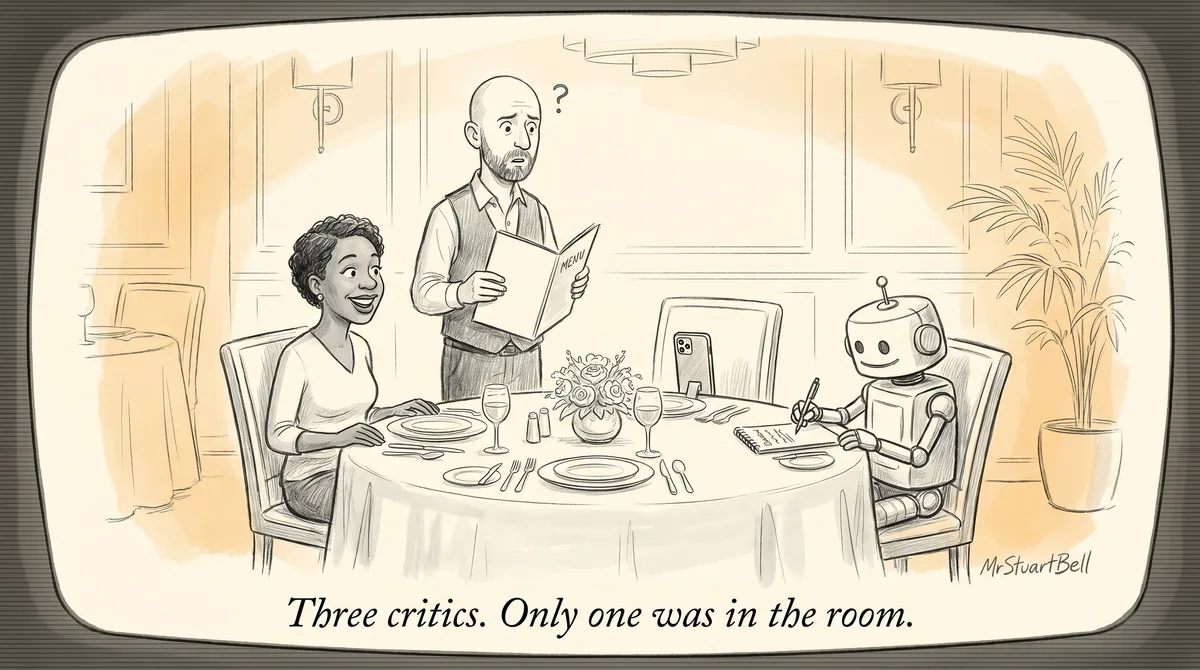
The experience you design now has three audiences: the person, their phone, and their AI.
Pine and Gilmore published The Experience Economy in 1999 and have since updated it with more contemporary examples. Their core argument, though, remains the same: businesses compete by staging memorable experiences, not just selling goods or services.
Starbucks was the poster child. Eleven cents of coffee beans, sold for a dollar-fifty because you're paying for the chair, the music, and the barista who knows your order. The coffee isn't the product. The feeling is.
They were right about the principle. But their model had one audience: the person in the room. Since 1999, that audience expanded twice. And the second expansion is one most businesses haven't caught up to yet.
The principles haven't changed. The audience has.
| What Pine & Gilmore wrote (1999) |
What customers changed |
What AI is changing now |
| Charge for the experience, not the commodity. |
Prospects compare your experience across hundreds of reviews before spending a dollar. The premium has to be visible at a glance. |
An AI agent reads those reviews before the prospect does. If your experience doesn't survive a three-sentence summary, you don't make the shortlist. |
| Design every sensory detail deliberately. |
The most-photographed corner of your space does more marketing than your ads. You're designing for sharing. |
AI pulls review photos into search overviews. Your design choices get evaluated by algorithms, not just people with phones. |
| Employees are cast members following a script. |
Conversations happen on text, email, chat, and social. Customers screenshot the bad ones. |
The first interaction is increasingly a chatbot or AI assistant. Your "cast member" might not be human. The experience still needs to be. |
| Eliminate negative cues. |
A sloppy detail becomes a photo with a snarky caption posted to thousands of followers. |
One unresolved complaint shows up in every AI-generated summary of your business. Negative cues compound across every channel simultaneously. |
| Personalize to make it feel unique. |
Software remembers what each customer ordered, asked, and complained about. Memory became automatic. |
The customer's AI remembers you too. It knows what they paid, what went wrong, what they liked. Both sides have memory now. |
The stage got bigger. Twice.
In 1999, you designed the experience for the person standing in front of you. A memorable dinner stayed in someone's head and got mentioned to maybe a dozen people over the following year.
By 2010, that changed. The person in front of you had a phone, a camera, and a social media account. That memorable dinner became a post or a review that worked continuously. The businesses that figured this out first didn't chase virality. They just designed experiences worth documenting and got out of the way.
Now there's a third audience. Before a prospect books a consultation with a financial advisor, before they schedule a remodeler to look at their kitchen, something has already read every review and scanned every photo. That something isn't a person. It's an AI agent acting on the prospect's behalf.
They said experiences generate memories, and memories are what people pay for. They couldn't have predicted that memories would become structured data an AI reads in milliseconds.
The screenshotted space problem got bigger
Pine and Gilmore wrote about eliminating negative cues. Anything inconsistent with the experience you're staging. That was always good advice, but the blast radius when you miss is just different now.
A mid-sized hotel chain found that 60% of their negative Google reviews mentioned the checkout process, not the room. The room was five-star. The paper receipt at a slow printer wasn't.
In 1999, a few guests grumbled on the way out. In 2026, that frustration is a pattern visible to every AI agent summarizing your reviews.
Here's the thing. When a prospect asks their AI to find the best hotel near the conference venue, the AI doesn't just count stars. It reads the text. It weighs patterns. 60% of complaints about checkout is a pattern the AI doesn't forget about by next week.
The principle is exactly what Pine and Gilmore said. Eliminate negative cues. The audience for those cues now includes something that never stops reading.
Your experience has three audiences now: the person in the room, everyone they tell, and the AI that evaluates you before the person ever shows up.
Personalization runs both directions now
One of the more ambitious ideas in the book was that the best experiences feel made for exactly one person. In 1999, that took either small scale or enormous staff. A restaurant that remembered your anniversary. A hotel that knew you liked extra pillows. Genuinely impressive because someone had to write it down and remember to look.
That part of the vision came true. A two-person dental practice can flag that a patient hasn't visited in six months and send a note referencing their last treatment.
A financial advisor's CRM surfaces what every client asked about on their last call. The memory is automatic. What isn't automatic is deciding to use it warmly instead of transactionally.
But personalization now runs from both sides. Your system remembers the client. The client's AI remembers you. It knows what they paid, what went well, what didn't. When they ask their agent to find an alternative or confirm you're still the right choice, their AI increasingly starts with everything they've already experienced.
For any business where the client has to talk to you before they buy, this is the new dynamic. Your experience isn't just evaluated once, by the person who had it. It's stored, summarized, and used as evidence by an AI working on behalf of the next prospect and the returning one.
The staging theory didn't need updating. The stage did.
Pine and Gilmore's core claim holds. Commodities lose on price. Experiences don't. If you sell something a client can get elsewhere, your margin lives in what surrounds the transaction.
What's changed is who's watching. First it was the person in the room. Then it was everyone they'd tell. Now it includes every AI agent that reads a review, scans a photo, or summarizes your online presence before a human ever makes contact.
The businesses that get this right won't game algorithms or chase virality. They'll do what Pine and Gilmore said all along. Design an experience so good it's worth remembering. The only difference is that "remembering" now includes a record that never fades and an audience that never sleeps.
Put it to work
My business is one-on-one. Nobody's photographing my office.
Reviews exist somewhere. Google, Avvo, Healthgrades, Houzz, Yelp. The "screenshotted space" isn't just a physical room. It's every touchpoint a prospect or their AI can evaluate. Look yourself up. See what the third audience sees.
How do I design for an AI I can't see?
You don't design for the AI specifically. You design an experience so consistently good that when the AI reads the evidence, the summary is clear. AI agents are pattern readers. Give them a clean pattern.
What's the first thing to fix?
Find your checkout moment. The part of your experience that happens after the core service. That's where most negative cues hide, and it's the last thing the client remembers when they write the review the AI reads tomorrow.