The Content Marketing Institute asked 42 experts what's coming in 2026. The consensus was clear. AI has flooded every channel with educational content so fast that generic expertise became worthless almost overnight. The irony is that this AI glut is making people value real human expertise more than ever.
That's the prove-it economy. Your prospect doesn't care what you know. They care that you understand them, their situation, their specific problem. And you've got to show them that, not just claim it.
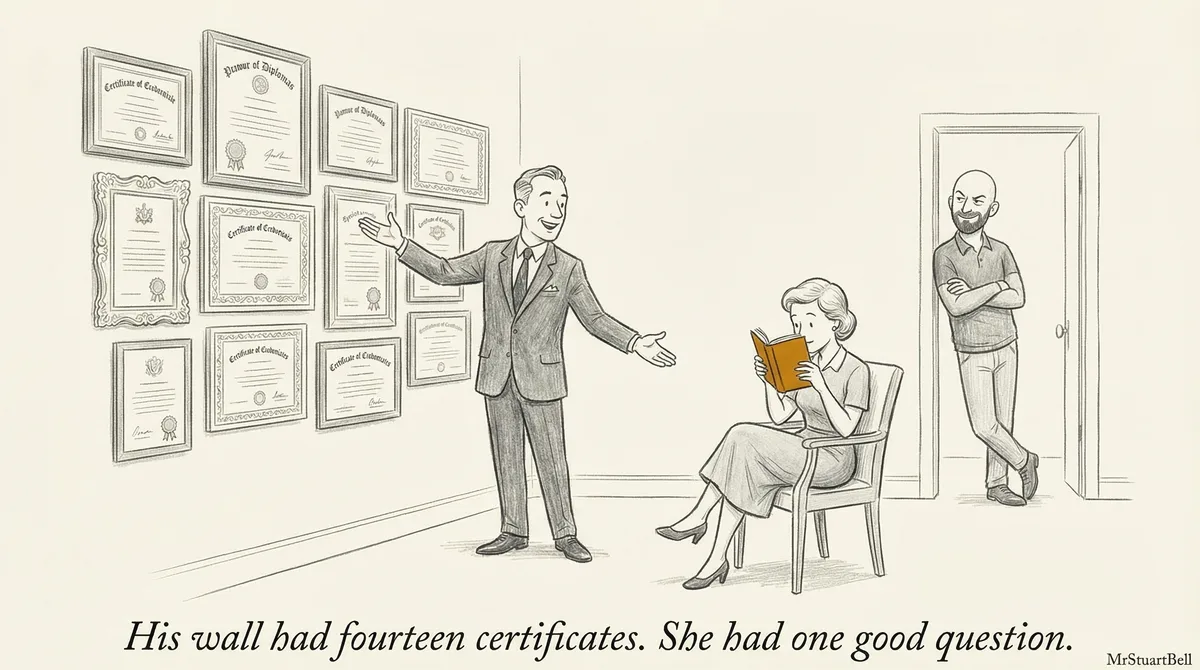
Your MBA won't do that. Neither will your certification, your license number, or your twenty years in the industry. Those got you permission to play. They didn't earn you trust.
Credentials Cancel Each Other Out
Here's the thing. Every financial advisor is certified. Every attorney passed the bar. Every contractor is licensed and insured. When a prospect is choosing between you and three other people with identical qualifications, your credentials become invisible. They're table stakes, and the most qualified person in the room rarely wins the client because of it.
AI made generic expertise worthless. The professionals who win now are the ones who can prove they understand your specific problem, not just the general topic.
What breaks the tie is proof that you understand their specific situation. Not a credential that says you studied the general topic. Evidence that you've thought deeply about the exact problem keeping them up at night.
That's why CMI's experts keep coming back to the same point. When AI can generate competent-sounding advice on any subject in seconds, the bar for earning trust shifts. You don't prove yourself by knowing things anymore. You prove yourself by showing how you think about the things your specific audience cares about.
Visibility Isn't Proof
So you post on LinkedIn. You share articles. You comment on things. That's activity, not evidence.
Most professionals are broadcasting to everyone and resonating with no one. They're creating content for the algorithm instead of for the one person who needs to hear it. And in a market flooded with AI-generated content that sounds confident and says nothing, more activity just adds to the noise.
Being visible to the right people means something different. It means when your ideal client asks their network for a recommendation, your name comes up. Not because you posted three times this week, but because someone held your thinking in their hands and remembered it.
Your Book as Proof Asset
This is where the conversation starter philosophy earns its keep. Your book isn't the product. Nobody cares about your book. They care about fixing their problem. The book bridges the gap from "never heard of you" to "I need to talk to this person."
And the parts that matter most aren't what you'd expect. The cover and title are seen by everyone. The back cover is almost always read. The table of contents shows your prospect the journey you're about to take them on. The actual content ranks below all three. Most people focus on getting the words right and forget that their prospect is making a trust decision long before they read a single paragraph.
That's because the book's job isn't to educate. It's to create enough trust that someone raises their hand.
In the prove-it economy, that trust is the scarcest resource you've got.
Cold Outreach Is a Symptom
If you're chasing people, playing the numbers game, and wondering why nobody's responding, that's not a sales problem. It's a proof problem. People aren't coming to you first because you haven't given them a reason to. You're leading with credentials instead of demonstrated thinking.
CMI's 42 experts are all pointing at the same shift. The AI flood didn't just change content marketing. It changed what it takes to be believed. Generic authority is dead. Specific, demonstrated thinking is what earns trust now.
Put your best thinking into something people can hold. Then let it do the proving for you.