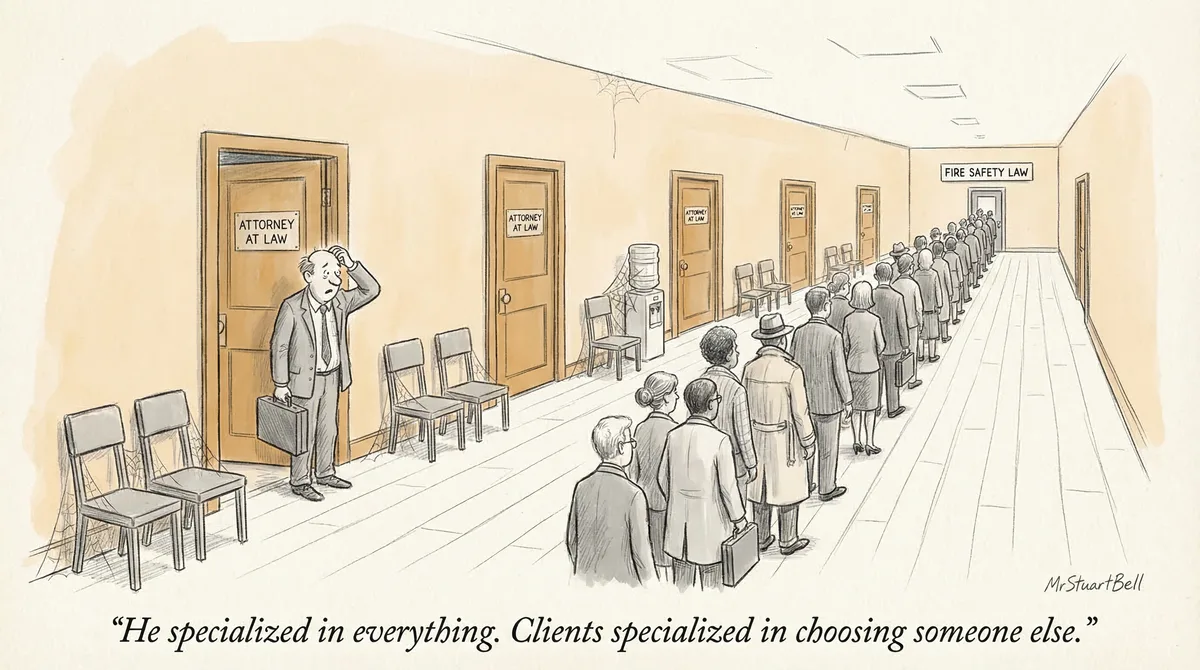
Nexa Law published a case for specialist practices that should make every professional sit up and pay attention. Boutique firms are outperforming massive ones. Not by spending more. Not by hiring bigger marketing teams. By being specific.
And the examples are wild. Barry Sanky, a commercial real estate attorney who only works with science and tech parks. His clients call him "Mr Science Park." Jonathan Jacobs built an entire practice around legal issues for dental professionals. Roy Carter, an ex-firefighter, became a regulatory lawyer focused exclusively on fire safety. And Sackers, a pensions boutique, has the smallest headcount of any firm in the UK's top 100. Ranked number one in their category. For years.
None of them are trying to be all things to all people. That's exactly why they're winning.
Referral failure isn't a relationship problem. It's a tools problem. People want to refer you. You've just given them nothing specific to say.
Generalists Get Compared. Specialists Get Chosen.
When you say "I'm a lawyer," you're standing in a line with a million other people. When you say "I'm the fire safety lawyer who used to fight fires," there's no line. There's just you.
This is what I mean when I talk about beginning with who, not what. Every one of these attorneys started with a specific person they wanted to serve. Science park developers. Dentists. Building owners worried about compliance. They reverse-engineered everything from that one audience. Picking a smaller audience doesn't limit your opportunities, it focuses them.
The big firms can't do this. They're structured to be broad. Their websites read like menus at a diner that serves breakfast, lunch, dinner, and also fixes your car. A small firm that picks one thing and goes all-in on it will always look more credible to someone searching for exactly that thing.
The Referral Test You're Failing
Here's something most professionals don't think about. When someone wants to refer you, what do they actually say?
If the best they can manage is "I know a good lawyer," you've already lost. That's not a referral. That's a vague suggestion. But if they can say "You need to talk to Roy Carter, he's the fire safety guy, used to be a firefighter himself," that referral practically closes itself. It's something I wrote about in why everyone wants to refer you but nobody knows how.
Referral failure isn't a relationship problem. It's a tools problem. People want to refer you. You've just given them nothing specific to say. No handle to grab onto. No story that sticks.
A book solves this instantly. Not because it makes you look smart, but because it gives your referral sources something concrete to hand off. Something that says exactly who you help and what you know, before you ever get on a call. It's a conversation starter, not a credential.
Three Things. That's All You Need.
You don't need a rebrand. You don't need a new website. You need three things: a title that makes your ideal client think "I want that," content that delivers on the promise, and a way for the prospect to get it.
That's the minimum effective dose. Barry Sanky didn't build a media empire. He picked science parks, became the go-to name, and let that specificity do the heavy lifting.
Sackers didn't try to cover all of finance law. They picked pensions and owned it so completely that being small became irrelevant.
After helping create nearly 1,200 books, I can tell you the ones that work aren't the thickest or the most polished. They're the ones where the title is so specific that someone in the right niche thinks "I want that" before they've read a single page.
Pick Your Thing
You already know your version of science parks or fire safety or dental law. Sometimes the niche finds you, like a Paralympic snowboarder who built an entire prosthetics company around one gap nobody else was filling. It's the type of client you enjoy most, the problem you solve best, the work where your domain expertise is obvious.
The only question is whether you're going to own that space or keep competing in the generalist line where nobody can tell you apart from the person standing next to you.
Small firms. Narrow focus. Beating the big names.
You don't need to be bigger. You need to be more specific.