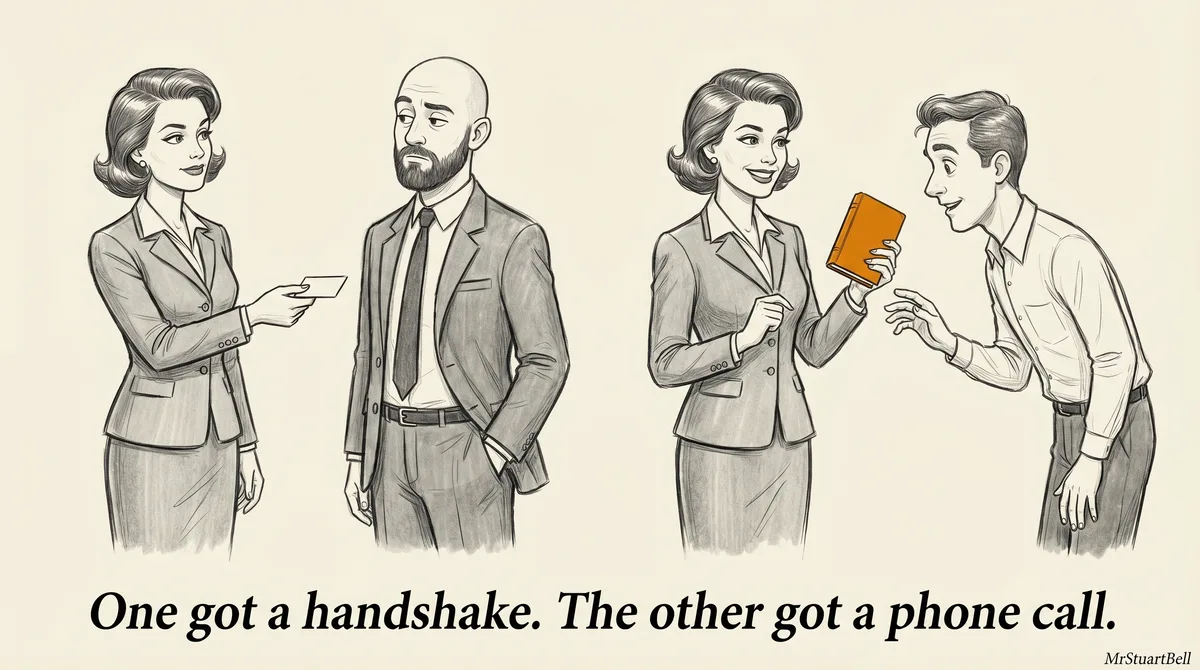
The words you use in the first ten seconds decide whether you get a polite nod or a follow-up call.
Picture two people at the same networking event. Same credentials. Same experience. Same room.
Sarah walks up to a group and says, "Hi, I'm Sarah. I'm an estate planning attorney."
The group nods. Someone says, "Oh, that's nice." The conversation moves on. Sarah exchanges a few business cards that end up in a drawer.
Now picture Sarah walking up to a different group and saying, "Hi, I'm Sarah. I wrote the book on what happens to a family business when the owner dies without a plan."
Different reaction. Someone leans in. "Wait, really? My business partner and I were just talking about that."
Same person. Same credentials. Same event. Completely different outcome.
The first introduction is invisible
Here's the problem with "I'm an estate planning attorney." It tells people what you are, not what you do for them. And what you are sounds exactly like every other estate planning attorney in the room.
It's not that the title is wrong. It's that it's forgettable. There's nothing for the other person to grab onto, nothing that triggers a specific situation in their own life.
You've given them a category, and categories don't start conversations.
The second introduction is a conversation starter
"I wrote the book on what happens to a family business when the owner dies without a plan."
That's not an introduction. It's a trigger phrase that paints a specific picture. It names a specific problem. And it positions Sarah as someone who's thought deeply enough about that problem to write an entire book about it.
You're not trying to impress anyone. You lead with the book because it reframes the entire interaction from "let me sell you something" to "let me help you solve a problem." In a prospect's mind, attorneys are commodities. Authors are experts. Same person, same knowledge, radically different positioning.
This is the contrast that matters. One introduction puts you in a mental filing cabinet. The other puts you on a mental shortlist.
What the listener actually hears
When someone says "I'm an estate planning attorney," the listener hears: another professional service. File it next to the three others I've met this year.
When someone says "I wrote the book on what happens when..." the listener hears: this person knows something I might need to know, and a frame that's recognizable.
The difference isn't credentials. It's specificity. The second introduction gives people something to grab onto when they're trying to remember you next Tuesday.
The book isn't there to sell copies. It's there to change how people hear your name.
You don't need a bestseller for this to work
This isn't about having a 300-page masterpiece. It's about having something that sets the stage before you say a word. A short, focused book that frames the problem you solve through the lens of someone who's lived in that world for years.
The book does the heavy lifting before you even show up. When you introduce yourself as someone who wrote the book on their specific problem, you've skipped past the "what do you do" small talk and landed directly in a conversation that matters.
Every professional in that networking room has credentials. Every one of them is qualified. But only one of them gave the listener a reason to follow up.
That's the only introduction that counts.
Put it to work
What if I don't have a book yet?
You can still use the structure. Instead of "I'm a [title]," lead with the specific problem you solve and the specific person you solve it for. "I help family business owners figure out what happens to the business when they're gone" is still better than "estate planning attorney." The book just amplifies it.
Does this work outside professional services?
Same principle. "I'm a remodeler" gets a nod. "I wrote the guide to whole-home remodels for families who don't want to move" gets a conversation. Specificity beats category every time.
What if someone asks about the book and I haven't written it yet?
Then you've just discovered your strongest marketing asset is something you haven't built yet. That should tell you something about where to spend your next few weeks.