The professionals who never compete on price aren't better than you. They've built something you haven't.
I spoke with an estate attorney a few months ago who couldn't figure out why a competitor in the same city, with half her experience, kept getting referrals from the same CPAs she'd cultivated for years. She had 18 years of practice. She'd written articles. She spoke on panels. She showed up at every local event.
The CPAs kept sending cases to the other guy.
When I asked what she knew about him, she pulled up his website. He had a framework he called the Wealth Transfer Window. He wrote about it every week. He'd built a short guide around it. The CPAs weren't just sending referrals. They were sending the right clients, with the right problem, at the right moment. The clients already knew who he was before the first call.
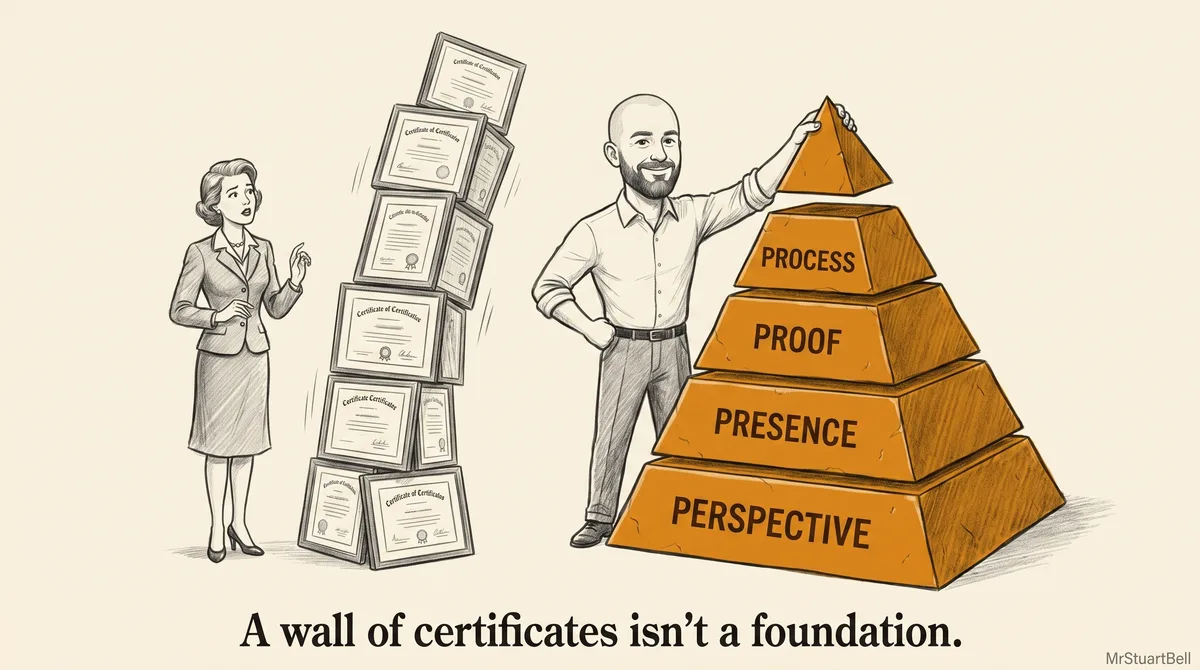
That's not a visibility advantage. It's the four layers of the High-Trust Hierarchy™ in action.
The layer most people skip
The foundation is Perspective. What you believe about the problem you solve. Not your process. Not your qualifications. What you believe.
The attorney's competitor believed that most wealth transfer plans fail at the family conversation, not the legal stage. He said so clearly, consistently, everywhere. Clients who'd been through a failed estate handoff found him immediately. The CPAs knew exactly who to send and why.
The attorney had strong opinions too. She'd just never said them in a way that accumulated anywhere. As the Prove-It Economy has reset the rules, your credentials are table stakes. They got you permission to practice. They don't tell anyone what you stand for.
A broad listing of services tells people you're available, not that you're the authority on anything specific. Business owners who are specialists themselves already sense this. They filter for it.
Perspective is the amplifier. Without it, you're adding volume to noise.
Presence without a point of view
Presence is where you show up consistently. Not on every platform. Consistently, in the places your specific audience actually looks.
Most high-trust professionals try to establish Presence before they've locked in Perspective. They start posting without a point of view. They send newsletters that cover everything they do. They attend networking events without a clear angle.
They're visible. They're not memorable.
When Perspective is clear, Presence becomes a multiplication exercise. Every article adds to an accumulating body of evidence that you've thought deeply about one specific thing. When it's not clear, Presence is just noise with your name attached.
Presence without Perspective is just noise. The algorithm rewards people who say something, not people who say everything.
The proof that confirms what they already suspect
Proof is what others see that confirms your expertise. Not your credentials. The thing that makes a prospective client think, "Someone like me has worked through this with someone like them."
Case studies. Client outcomes. A book that demonstrates you understand the problem at the depth only someone who's been inside hundreds of similar situations can. The 18-year attorney had plenty of proof. But without a Perspective to attach it to, her proof floated free. It confirmed competence. Not conviction.
This is what the most qualified person in the room gets wrong. Credential accumulation isn't proof. A wall of certifications says you're qualified. A chapter that names the exact conversation a client's family had before an estate transfer failed says you understand.
Proof confirms a suspicion the prospect already has. Without Perspective, there's no suspicion to confirm.
The layer almost nobody builds
Process is the system that connects everything. The way your book leads into your scorecard leads into the discovery call. The follow-up sequence that keeps conversations active while you're focused on client work. The mechanism that makes sure the right clients find you at the right moment.
Most high-trust professionals have some version of the first three layers. Almost none of them have Process. They rely on timing. The right person sees the right thing at the right moment and calls.
Sometimes that works. Sometimes it works for years. It always stops working eventually.
Two accountants who niched into specialty tax credits didn't just have a point of view on an obscure corner of the tax code. They had a system that made sure the right CPAs thought of them first, every time. That's Process. And that's why they stopped competing on price.
Start with the weakest layer
You probably have some version of all four. The question is which one is weakest.
Most high-trust professionals I talk to have moderate Proof, inconsistent Presence, weak Perspective, and almost no Process.
Start with Perspective. Not because it's easiest, but because it's the foundation. Weak Perspective means your Presence is directionless, your Proof doesn't accumulate to anything, and your Process has nothing to convert.
Find the one belief about your client's problem that you'd defend in a room full of peers. Something someone might actually push back on. Write it in one sentence.
Start there.
Put it to work
How do I know which layer is actually my weakest?
If you can't state your point of view in a sentence someone might disagree with, it's Perspective. If you're showing up inconsistently or spreading across too many channels, it's Presence. If prospects can't find evidence of outcomes for people like them, it's Proof. If referrals only convert when timing lines up by luck, it's Process.
Do I need all four before anything works?
No. A strong Perspective alone makes everything you're already doing more effective. Start there and the other layers follow. Don't wait to fix everything at once.
How do I test whether my Perspective is strong enough?
Ask yourself: would a peer in your field disagree with it? If the answer is no, it's a platitude, not a perspective. Strong Perspective takes a position. Platitudes don't.