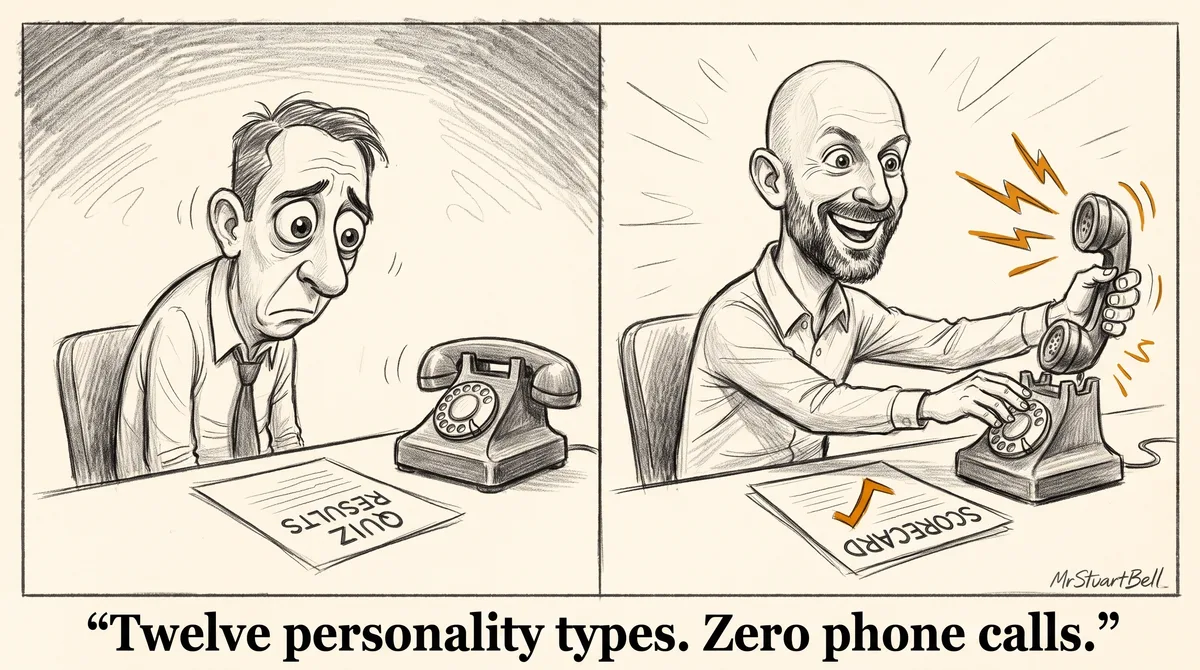
A quiz collects email addresses. A scorecard starts the conversation your prospect was already looking for.
Someone on your team searched "best quiz tools for lead generation" last month. You found a dozen options. ScoreApp, Typeform, Interact, Outgrow. Good software, all of them.
So you picked one and built a quiz. "What's your marketing personality?" or "Which growth strategy fits your business?" Something fun, shareable, easy to complete. People took it. You got email addresses.
Then nothing happened.
The follow-up sequence went out. Open rates were decent. Replies were not. The person who found out they're a "Strategic Visionary" barely remembers the questions they answered.
That's not a software problem. It's a framing problem.
"Quiz" and "scorecard" are not the same thing
They get used interchangeably. They shouldn't.
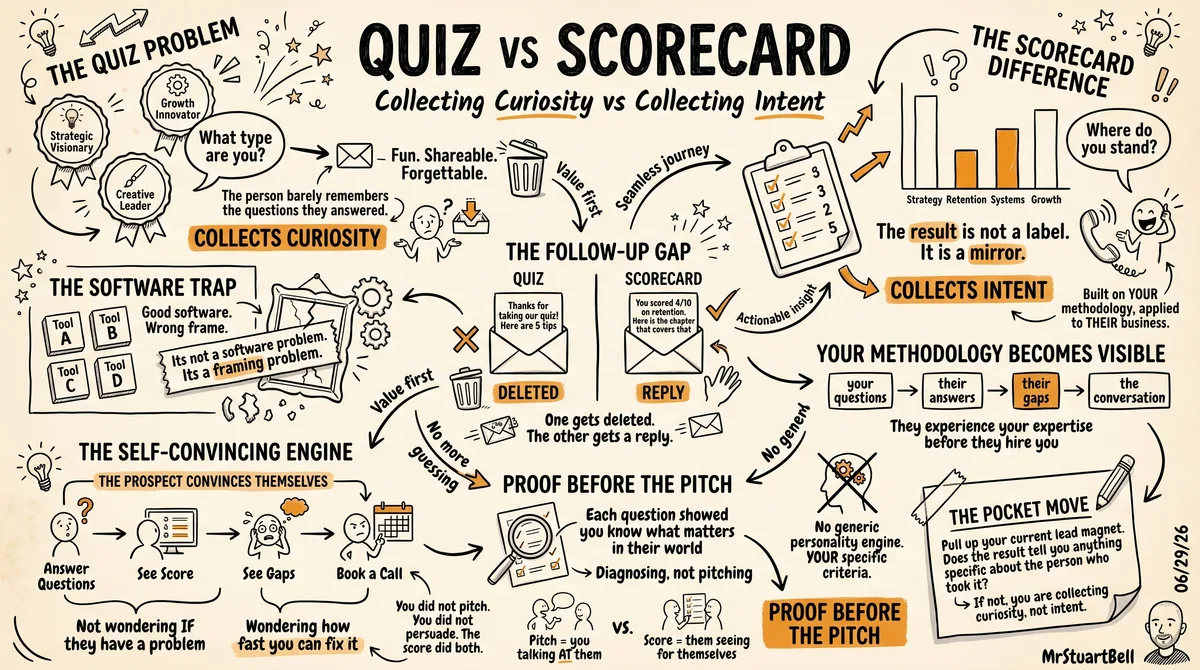
A quiz entertains. It sorts people into buckets. What personality type are you? Which strategy fits your style? The prospect had fun. They moved on.
A scorecard diagnoses. It scores the prospect against your framework of best practices. Not "what type are you" but "where do you stand." The result isn't a personality type. It's a map of strengths and gaps, built on your methodology, applied to their business.
One of those people opens your follow-up email. The other one unsubscribes.
A quiz asks "what type are you?" A scorecard asks "where do you stand?" Only one of those leads to a conversation worth having.
Scorecards start more conversations. Here's why.
A quiz result is generic. You're a "type." You're in a "bucket." There's nothing individual about it, and nothing that makes you want to pick up the phone.
A scorecard result is personal. You scored a 4 out of 10 on client retention. You're strong on positioning but weak on follow-up. That's not a label. That's a mirror. And it's specific enough that the prospect can't shrug it off.
And they got that number from your framework. Not from a generic personality engine. From the specific criteria you use when you evaluate a business like theirs.
The prospect does the convincing
This is where the real difference lives.
With a quiz, you collect an email and then you pitch. You're the one doing the work in the follow-up, trying to convince them they need help.
With a scorecard, that work is already done. They answered your questions. They saw their score. They know which areas they're weak on. By the time they hit "book a call," they're not wondering if they have a problem. They're wondering how fast you can fix it.
That's proof before the pitch. The scorecard let them experience your methodology before they ever talked to you. Each question showed you know what matters in their world. Each section of the results showed you can diagnose their situation without ever meeting them.
You didn't pitch. You didn't persuade. The score did both.
Your follow-up changes when you know the score
A quiz gives you a name, an email, and maybe which of four personality buckets they fell into. There's nothing personal about it. Good luck writing a follow-up sequence around that.
A scorecard gives you everything you need for a real conversation. You know which pillars they scored low on. You know where the gaps sit. You know what they care about, because they just told you by answering twenty meaningful questions about it.
So your follow-up isn't "Thanks for taking our quiz! Here are 5 tips for growing your business."
It's "You scored a 4 out of 10 on client retention. Here's the chapter that covers exactly that."
One of those gets deleted. The other gets a reply.
Put it to work
I already have a quiz on my site. Should I scrap it?
Look at what it's actually producing. If it's generating conversations with qualified prospects, keep it. If it's collecting email addresses from people who never respond to your follow-up, it's doing entertainment, not diagnosis. Rebuild it as a scorecard with your methodology as the framework.
What makes a good scorecard question vs. a bad one?
A good question reveals a gap the prospect didn't know they had. A bad question confirms what they already know. "Do you have a website?" is useless. "Does your website include proof elements that a prospect can verify independently?" makes them pause.
Can a scorecard work without a book behind it?
Yes. A scorecard stands on its own as a conversation starter. But a scorecard plus a book is stronger than either alone. The scorecard gets them engaged and scored. The book deepens the relationship and gives them something to hold, share, and refer.