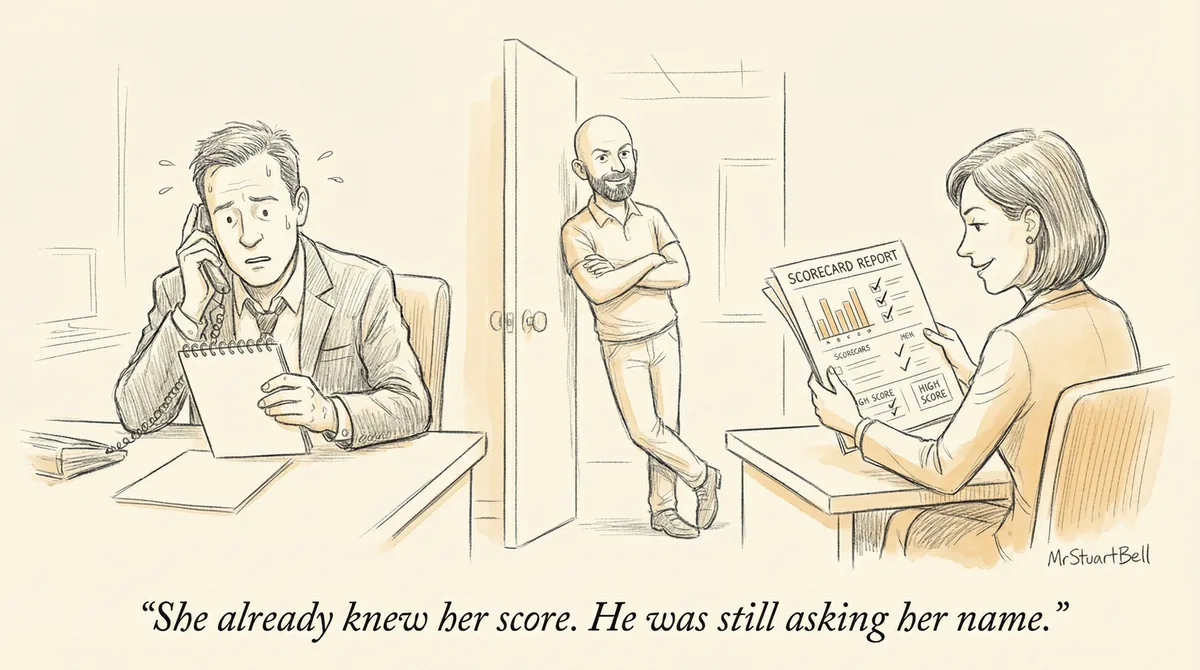
I had a call last week with an estate attorney. Good firm, solid reputation, steady referrals. He told me his biggest frustration wasn't getting leads. It was the first five minutes of every call.
"I spend the whole time just figuring out where they are," he said. "What they know, what they don't know, what they think they need versus what they actually need."
Every call started from scratch.
That's not a conversation problem. That's a funnel problem. Because the tool that brought them in didn't do any of the heavy lifting before the phone rang.
Most lead magnets collect a name. That's it.
Someone downloads your guide, your checklist, your PDF. You get their email address. Maybe a phone number. And then you call them and start the same discovery process you'd start with a stranger on the street.
A scorecard works differently. Your prospect doesn't just hand over their contact info. They answer questions. They score themselves against your framework. They see where they're strong and where they've got gaps. By the time they're done, they've spent ten minutes thinking about their problem through the lens of your methodology.
That's not a lead. That's a pre-sold conversation.
By the time you pick up the phone, they already know their score, their gaps, and why they need to talk to you. The scorecard did the selling.
The data backs this up
Assessment-style lead magnets convert at roughly 50%, compared to 20-25% for standard downloads. That number comes from platforms like ScoreApp and Evalinator tracking thousands of assessments across industries. The reason isn't complicated. A PDF sits in a downloads folder. A scorecard makes the prospect do something. They engage. They see a result. They care about what happens next.
The quality of the lead is different too. Someone who's scored themselves low on "Proof Before the Pitch" or "Follow-Up That Builds" doesn't need you to explain why they have a problem. They already know. The conversation starts at "I saw your score. Let's talk about pillar 3."