Every business owner I talk to eventually asks the same question. "Should I put my book on Amazon?"
And every time, my answer is the same. Yes, but then immediately forget about it if you want it to actually do something useful. We put books on Amazon. We just don't care about the sales.
Here's what people typically think. Publish on Amazon, chase bestseller status, get the credibility badge, use the ranking as social proof. It sounds smart.
It's also the fastest way to kill the one thing your book is supposed to do.
Amazon gives you a sale. It blocks the conversation.
When someone buys your book on Amazon, you get a royalty. A few dollars, maybe. What you don't get is their name, their email, their phone number, or any way to follow up. Amazon keeps all of that. Your reader becomes an anonymous stranger who paid you $12 and disappeared.
Compare that to giving the book away. Someone visits your landing page, types in their name and email, and requests a copy. Now you know exactly who they are. You know they're interested enough to raise their hand. And you can start a conversation with them the same day.
Give your book away and you get a prospect. Sell it on Amazon and you get a stranger.
One path gives you a transaction. The other gives you a relationship. That's not a close call.
The price-as-filter myth
The argument for charging usually sounds like this: "If they won't pay $15, they're not serious." It sounds logical. It's backwards.
When you charge for the book, you're asking people to prove they're serious before you've given them any reason to trust you. You're filtering at the wrong end of the process. The people who would have become your best clients, the ones who are curious but cautious, never make it through the gate.
Filter later, collect now. Get broadly interested people into your world for free. Then let your follow-up sequence do what it's designed to do: sort the curious from the committed, and convert tomorrow people when their timing catches up.
Two paths, side by side
The Amazon path looks like this. You publish, you promote, a few hundred people buy the book. Some read it, most don't. You never hear from any of them. Your royalty check buys lunch.
The give-it-away path looks different. You put up a simple landing page. You run a few targeted ads or mail copies to your top 100 prospects. People request the book and land in your follow-up system. Some book a call that week. Others stay on your list and come back months later when their situation changes. Your book keeps starting conversations you'd never have had otherwise.
Same book. Completely different outcomes. The only variable is whether you treated it as a product or a tool.
The real metric
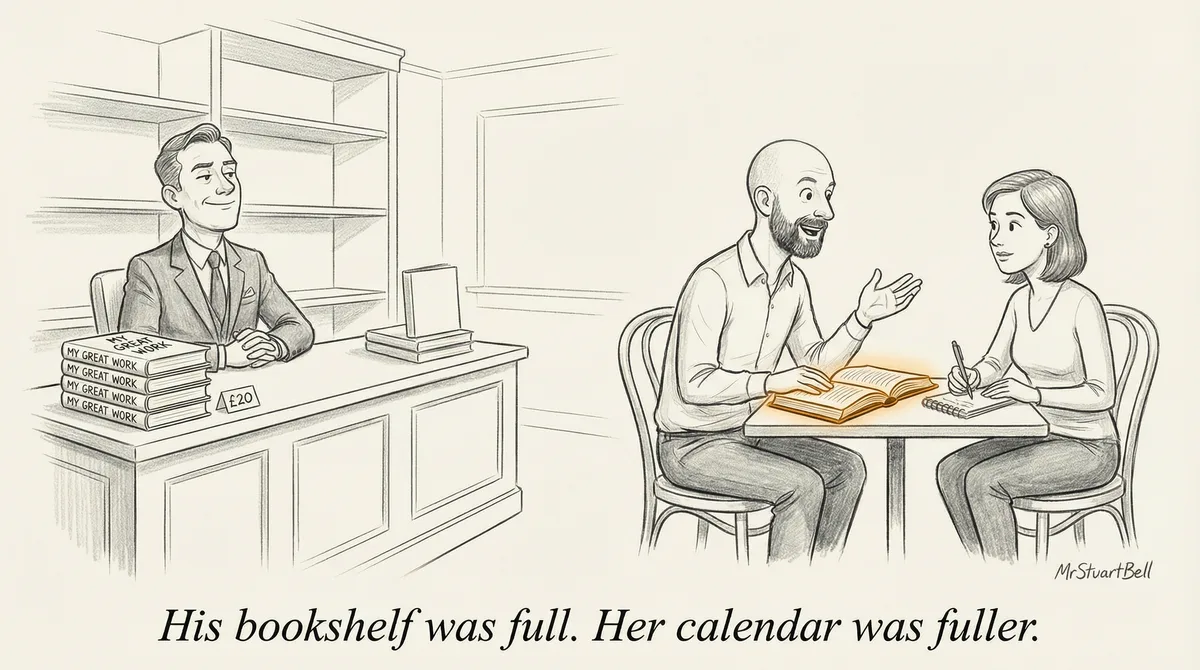
Having helped business owners create over 1,200 books over the last 15 years, I can tell you the people who measure success by copies sold are always the most frustrated. The ones who measure conversations started are the ones filling their calendars.
Your book isn't a revenue line. It's a conversation starter. The moment you put a price tag on it, you've told the world it's a product. And products sit on shelves. Conversation starters sit on kitchen counters for five months until someone's mother has a health scare and they finally pick up the phone.
Stop thinking like a bookstore. Start thinking like someone who wants to talk to the right people.