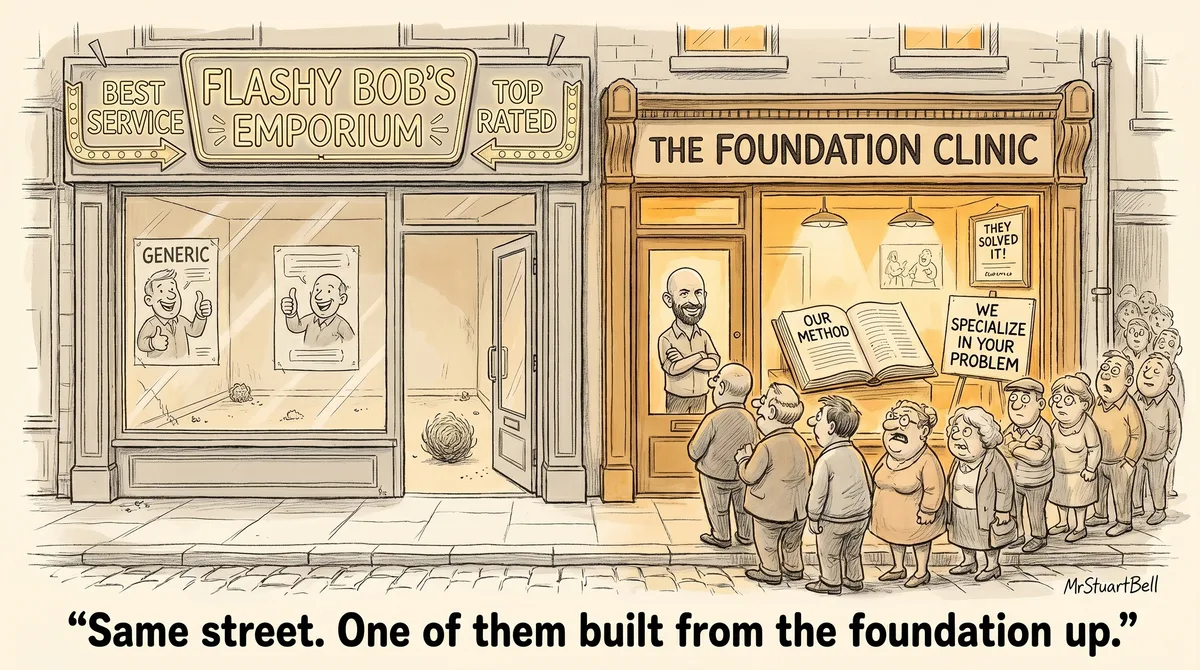
Every lead generation tactic you've tried failed because you built it on the wrong layer.
I talk to professional services firm owners every week. Financial advisors, attorneys, accountants, contractors, consultants. Most of them tell me the same thing: "I've tried marketing. It doesn't work for my business."
They've run ads. They've posted consistently. They've gone to networking events. Some of them hired agencies. The efforts may have failed, but the reason has nothing to do with the tactics.
It has everything to do with the context.
Why Most Traditional Marketing Fails for High-Trust Businesses
The marketing advice professionals get is typically borrowed from a completely different world. SaaS growth playbooks. E-commerce funnels. Social media volume strategies. All of it optimizes for reach. Get in front of more people. Cast a wider net.
But professional services don't work that way. Nobody hires a lawyer because of an ad. Nobody picks a financial advisor because they showed up in a feed three times. Professional services are the textbook High-Trust Business™. Your client doesn't evaluate your service without evaluating you. The purchase runs on trust, and trust requires a conversation, even if the initial contact is an ad or a post.
Lead generation for professional services isn't a volume game. It's a trust-building game. Most firms are playing the wrong one.
The High-Trust Hierarchy
The High-Trust Hierarchy™ is a stack. Four layers. Each one builds on the one below it. Skip a layer and everything above it wobbles.
It starts with Perspective. Your documented point of view on your work, your industry, your clients, and their problems. Not the generic information repeated on thousands of websites, but your experience. Your way of explaining things. The insight you've built over years of doing this work. This is the foundation and the most important step in standing apart. It sets the tone for who you want to work with and why they'd want to work with you.
Above that sits Presence. Where you choose to show up and how you show up in those places. LinkedIn, speaking, networking, referral channels, content. When presence is built on a clear perspective, every appearance reinforces the same case. The language you use reflects your clients' language. The pain points you describe are the ones they recognize. The results you talk about are the ones that matter to them. That's presence that compounds instead of evaporating.
Then Proof. Testimonials, case studies, results, white papers, your book, a scorecard. The assets that demonstrate you know what you're doing. When proof is anchored to your perspective, it does something credentials alone can't. It speaks to the specific person reading it. It reflects their situation and recognizes their challenges right now, not in the abstract. The most qualified person in the room rarely wins the client because qualifications build a tie. Proof that reflects a clear perspective builds a preference.
At the top is Process. The system that ties it all together. When process supports your perspective and presence, it becomes a continuation of the same conversation. It keeps people engaged because every touchpoint helps them right now, moves them to the next step, and makes the gap between "I'm interested" and "let's talk" feel natural. That's different from a drip campaign that's efficient but impersonal.
Where Most Firms Get Stuck
Here's the pattern I see constantly.
Most professional services firms have Presence. They network. They post. Some run ads. They have scattered Proof too. A few testimonials on the website, maybe a case study buried in a PDF.
But they have no documented Perspective. And they have no Process.
They're missing the foundation and the connective tissue. That's why their lead generation feels like pushing something uphill. They invest in the middle layers without anything holding the stack together.
The firms that have all four layers don't compete on price. They get chosen before the meeting starts.
When you have a clear perspective, your presence informs what you write, the language you use, the pain points and results you describe, all in the language your potential clients actually use.
When your proof reflects their specific situation and speaks to where they are right now, prospects feel like you already understand them.
When your process moves them forward and handles what comes next because it's helping them right now, not just following a sequence, the right people find their way to the conversation without you chasing them.