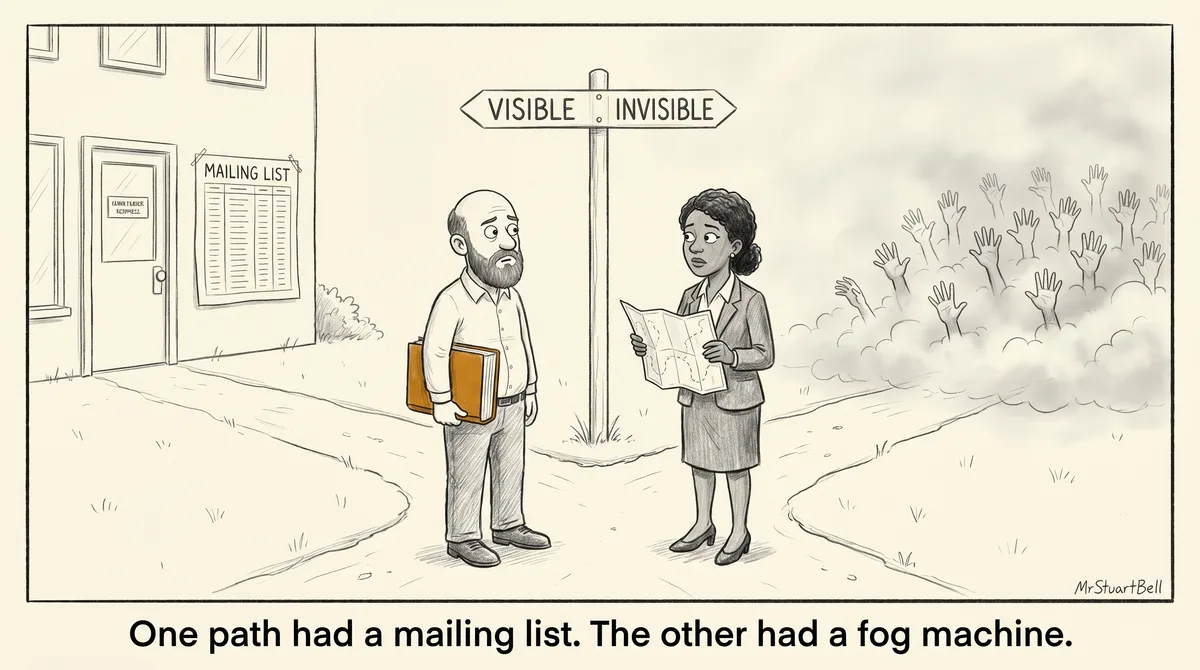
The first decision shapes every chapter, every title, every call to action, and every distribution choice you'll make afterwards.
Most people start their lead-getting book by asking "what should I write about?"
That's the wrong question.
The right question is "who am I trying to start a conversation with, and can I see them?"
This one decision shapes every chapter, every chapter title, every call to action, and every distribution choice you'll make afterwards.
There are two kinds of prospects in the world.
Visible prospects
Visible prospects are the ones you can put on a list. Estate planning attorneys in Florida. Dentists in a 50-mile radius. CEOs of manufacturing companies doing $5-20M. You can name them, find them, and mail them directly.
Your book becomes a door opener you put in their hands, on purpose, one at a time.
Invisible prospects
Invisible prospects are the ones you can't list. Homeowners thinking about a kitchen remodel sometime in the next year. Business owners quietly wondering if it's time to sell. Parents starting to worry about their teenager's anxiety.
You can't get a list because the trigger is internal. Your book becomes the thing that gets them to raise their hand so you can find each other.
Same book idea, different book
The same book idea can go either way. Different audience, different book.
If your prospects are visible, your book leans toward credibility and details. The chapter titles read like the questions they'd be too embarrassed to ask out loud. The cover is designed to look serious on a desk. The distribution is direct mail, hand-delivery, and follow-up after a meeting.
If your prospects are invisible, your book leans toward curiosity and self-recognition. The chapter titles read like the headlines that make them stop scrolling. The cover is designed to work in a Facebook ad at thumbnail size. The distribution is paid media, postcards into the right zip codes, and landing pages that convert traffic into raised hands.
Most book projects stall because people try to write something that works for both. The message gets confused because your prospects are in different rooms, listening for different signals.
So before you write a word, get clear on which kind of prospect you're after.
If you can list them, your job is to give them a reason to read.
If you can't list them, your job is to give them a reason to identify themselves.
That's the whole game. Pick one and start there.
Your book gets dramatically easier once you've stopped trying to talk to everyone.
Put it to work
How do I know if my prospects are visible or invisible?
Ask yourself: could you build a mailing list of 100 ideal clients by name, right now, using LinkedIn or a purchased list? If yes, they're visible. If you'd have to run an ad and wait for someone to respond, they're invisible.
What if my business serves both kinds?
Pick one for this book. You can always write a second book for the other group later. Trying to split the difference is what kills most book projects before they get finished.
Does the visible/invisible distinction change how long the book should be?
Not really. Both can work as short, focused books. What changes is tone, chapter structure, and how you get the book into hands. A visible-prospect book might be 10 chapters of deep expertise. An invisible-prospect book might be 10 chapters that mirror the reader's internal conversation.