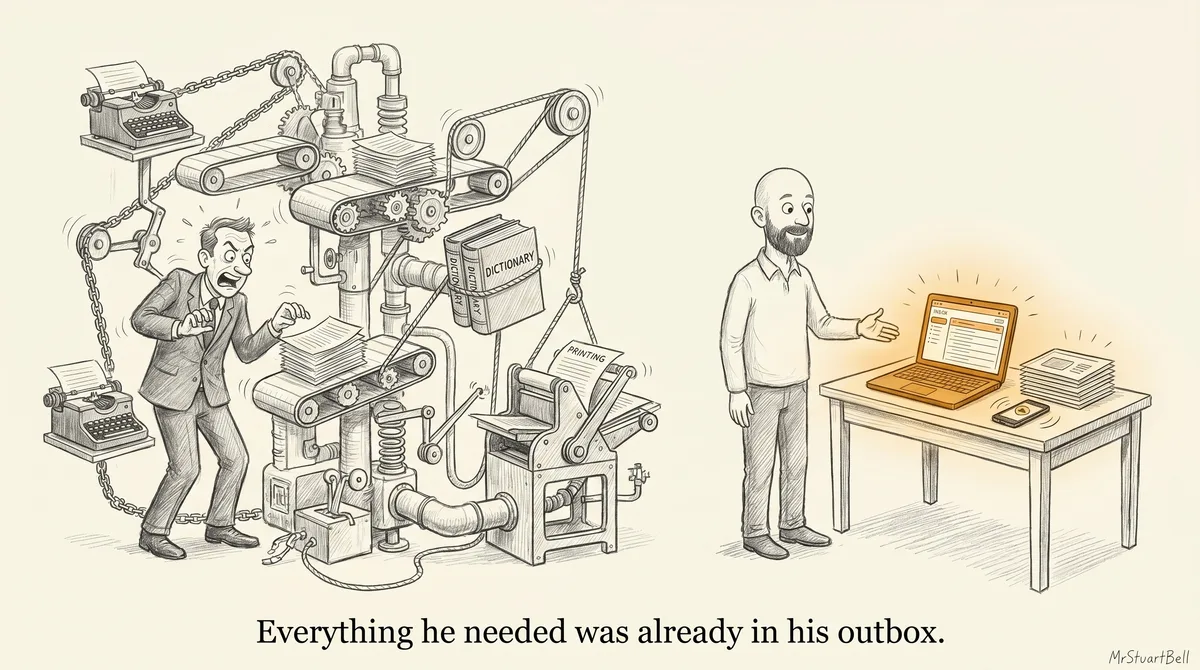
The book isn't missing. The capture system is.
"I don't have time to write a book."
Every week I talk with business owners who want a book, but think they don't have time to create one. I get it. You're running a business. You're serving clients. You're putting out fires from 7am until whatever time you finally close the laptop. The idea of sitting down and writing 30,000 words sounds like something from a parallel universe where you have nothing else to do.
But after more than 1,200 books, I can tell you the pattern doesn't change: you've already said everything that needs to be in yours. You just haven't captured it yet.
You've been writing your book for years
Think about the last email you sent to a new client who was nervous about getting started. The one where you explained how the process works, what to expect in the first 30 days, and why most people's fears don't play out the way they think.
That email? That's a chapter.
Think about the presentation you gave last quarter. The one where three people came up afterward and said, "That was exactly what I needed to hear." Those slides, and the stories you told around them, are two or three chapters of proven content. Proven because a real audience already told you it worked.
You've already said everything that needs to be in your book. You just haven't captured it yet.
Now think about the questions you answer on every initial call. The ones you could answer in your sleep. "Is this really something I need to worry about?" "What should I be doing first?" "How do I know if I'm making the right choice?" You've answered those questions hundreds of times. Each answer is a chapter, and every version has been refined by real conversations with real prospects.
Four places you're already writing
When someone tells me they don't have time, I walk them through a simple exercise. We look at four places where they're already creating content without realizing it.
Your email archive is the first. Every reply where you explained something to a client or prospect, every FAQ you've typed out, every "great question, here's how we handle that" response. Those are drafts. They're written in your voice, tailored to real questions, and tested by the people who matter most.
Your presentations and talks are the second. If you've ever stood in front of a room and talked about what you do, you've got content. The stories you told, the examples you used, the points that got heads nodding. You didn't read from a script. You talked about what you know. That presentation is already a book.
Your client conversations come next. The things you say on calls, in meetings, over coffee. The way you explain your approach when someone asks, "So how exactly can you help?" If someone recorded your best client conversation and transcribed it, you'd have half your book done by lunch.
Finally, the stuff you've already posted. LinkedIn comments, social posts, emails to your list. Short-form content you created in minutes because you were reacting to something real. Individually they're fragments. Together they're an outline.