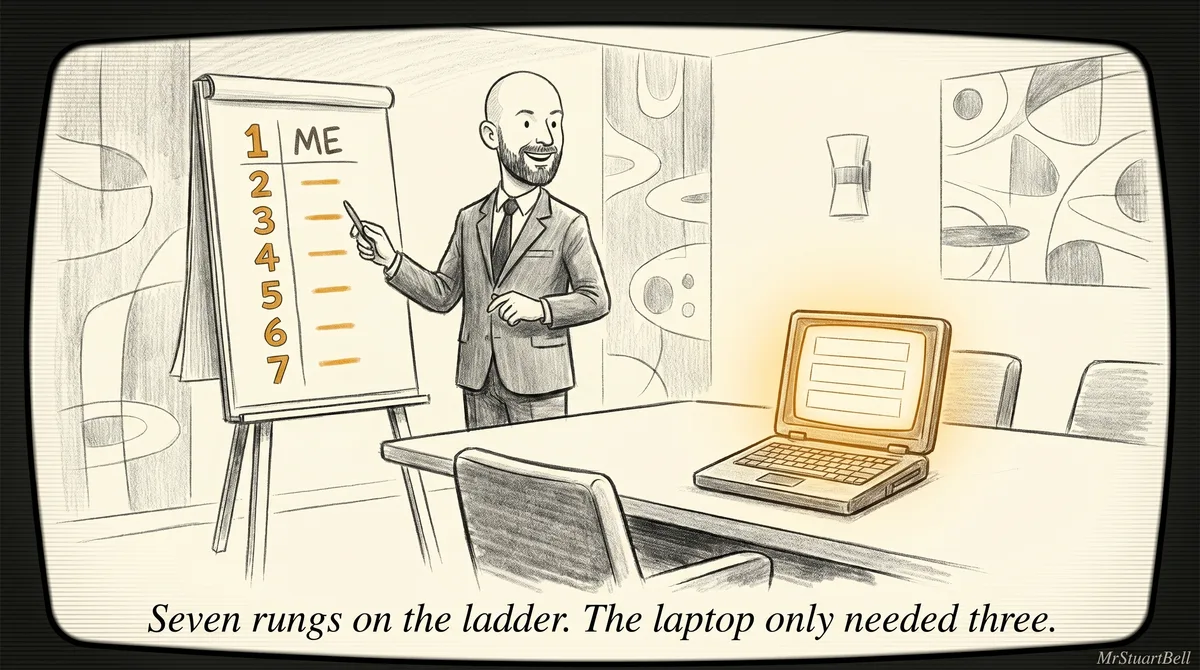
The fight for your prospect's mind isn't over. The mind just hired an assistant.
One of the most interesting books to re-read with a 2026 lens is Positioning by Al Ries and Jack Trout.
The argument is simple enough to explain over coffee: you don't win by being better. You win by owning a spot in your prospect's head that nobody else occupies. The mind is overcrowded. Most categories already have a leader. Your prospect's brain organizes brands on a ladder, and your job is to figure out which rung you're on. If you're not first, create a category where you can be. Avis didn't beat Hertz. They reframed themselves as the underdog who tries harder. 7-Up didn't outsell Coke. They became the Uncola.
The framework still works. What changed is who does the filtering.
The mind Ries and Trout described had room for maybe seven brands per category. The mind your prospect uses today outsources that work to a machine. Every review, every comparison, every alternative, summarized in three sentences before they've finished their coffee.
"The basic approach of positioning is not to create something new and different, but to manipulate what's already up there in the mind, to retie the connections that already exist."
The principles haven't changed. The gatekeeper has.
The opportunities are greater with everyone's fragmented attention.
| What Ries & Trout wrote in 1981 | What that looks like in 2026 |
|---|---|
| The mind holds about seven brands per category. Anything past that gets ignored. | Prospects outsource a lot of this thinking to AI assistants that hold every brand and surface three. The shortlist isn't drawn from memory. It's drawn from whatever the algorithm decides best matches the prompt. |
| Be first into the prospect's mind. If you can't, create a category where you can be first. | Be first in relevance and reviews. If you're not, you need a position so specific the AI returns you when nobody else fits. |
| Own one word. Volvo owns "safety." Federal Express owned "overnight." | Own a phrase your prospect actually types. Not "experienced advisor" but "fee-only advisor for dentists in Texas." Specificity is what makes you the answer. |
| Reposition the competition. Tylenol made aspirin sound dangerous without naming it. | Repositioning happens through reviews, comparison content, and the patterns AI tools surface. You don't attack a competitor. You give AI a cleaner reason to recommend you instead. |
| Avoid line extension. A name that means everything means nothing. | AI tools group you by what you most recently published. Drift across three niches and AI describes you as a generalist. The prospect moves on, if they describe you at all. |
Be first in the prompt, not just the mind
Ries and Trout said the easiest way to own a position is to be the first one there. That hasn't changed. The door did.
In 1981, "first in the mind" meant being the brand a prospect thought of unprompted. In 2026, the unprompted thought is the prompt someone types: "Find me a fee-only financial advisor who works with veterinary practices."
The first businesses surfaced become the working shortlist. A solo CPA who's spent three years writing about veterinary practice tax issues will show up. The generalist who serves "small business owners" won't.
Being first in AI's version of a category isn't about being early to market. It's about being the most recognizable answer when somebody describes their exact situation in one sentence.
Own the phrase, not the word
Volvo owned "safety" because they spent decades reinforcing it. Owning a single word made sense when ad inventory was scarce and messages had to survive television and print.
Today the constraint flipped. There's infinite space and zero attention. One word isn't enough because AI matches prompts, not slogans.
The new version is owning a phrase narrow enough that when someone describes their exact situation, you're the only match. Ann Arbor estate planning attorney for blended families. Kansas City fractional CFO for SaaS companies under five million in revenue.
My favorite niche example is my good friend Dave Spray. He runs Export Advisors out of Houston. His entire business is one corner of the tax code called the IC-DISC, specifically for scrap metal exporters. That's not a word. That's a sentence. And it's the reason he shows up when nobody else does.
The professionals who win at this aren't trying to be famous. They're trying to be unmistakable to one specific person describing one specific problem.