A 2025 Artios analysis of 3.1 million US business leaders found that 43% say thank-you follow-ups are the most effective message type. Not urgency campaigns. Not promotional offers. Not countdown timers or limited-time deals. Thank-you messages.
That should tell you something about how far off most follow-up has drifted.
Most follow-up sounds like a company wrote it
Here's a quick test. Open your last five follow-up emails and read them out loud. Do they sound like you talking to one person across a table, or like a marketing department broadcasting to a list?
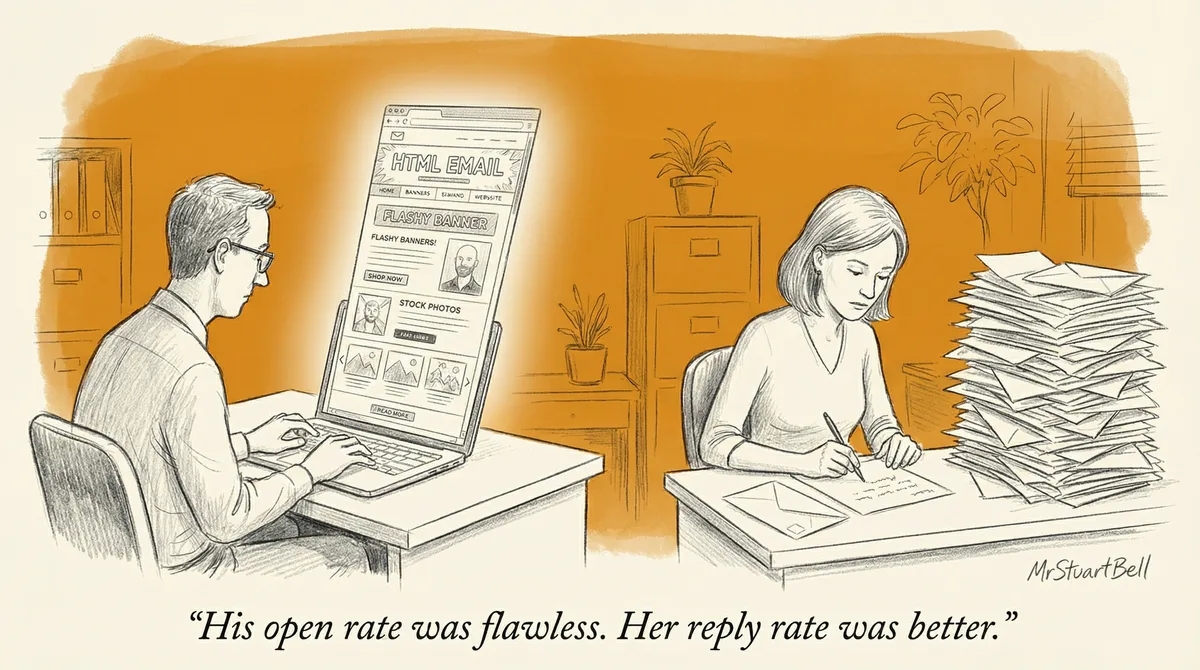
If your emails are HTML templates with banners and buttons, you've already lost. If your subject lines read like ad copy, they're getting skipped. If you're writing to "valued clients" instead of using someone's name, you're not following up. You're blasting.
The best follow-up doesn't feel like follow-up. It feels like a conversation you'd actually want to continue.
The data backs this up. Thank-you messages outperform because they don't ask for anything. They acknowledge a human interaction. That's the opposite of what most automated sequences do.
Dean Jackson's 9-word email works for a reason
Dean Jackson built one of the simplest re-engagement tools I've ever seen. Nine words. Plain text. No formatting. Something like: "Stuart, Are you still looking at homes in Georgetown?"
That's it. No link. No offer. No signature block with seventeen social icons.
It works because it sounds like a person checked in. Not a system that triggered a drip. I've talked about the mechanics of this approach before, and the principle hasn't changed. Simple and personal beats polished and automated every single time.