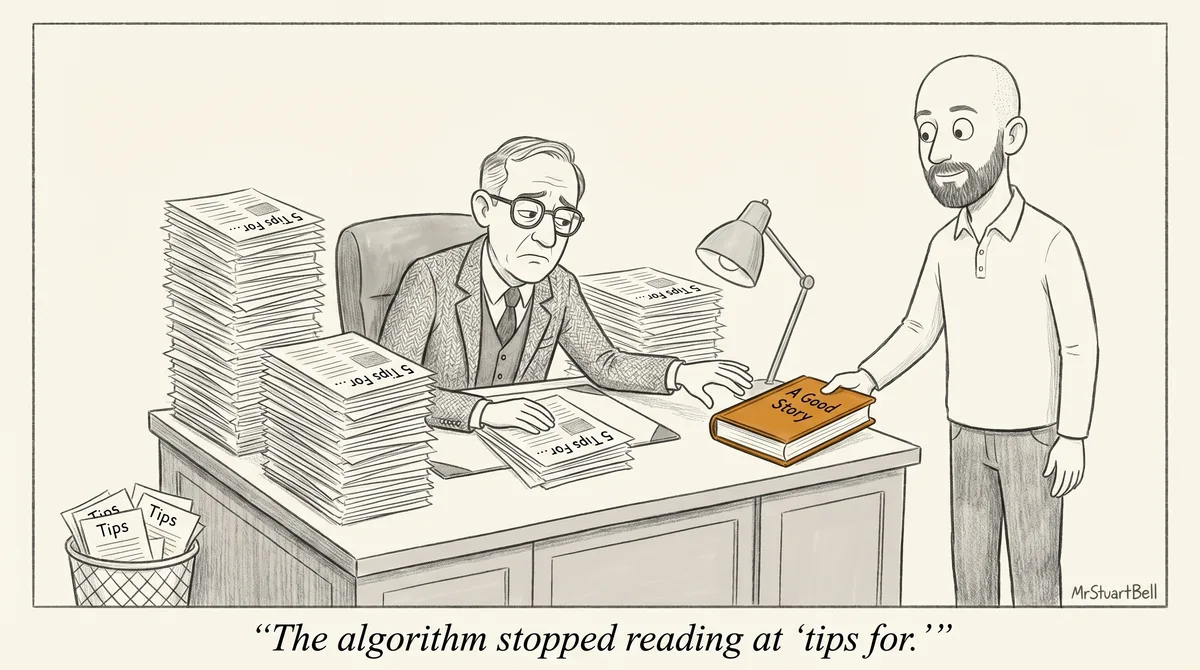
A book is the one authority signal Google's algorithm can't manufacture and AI can't replicate.
A CMO Alliance analysis of B2B thought leadership made a claim that's a real opportunity for high-trust business owners. Google now measures something called "Information Gain," a signal that ranks content based on how much original insight it adds beyond what's already out there.
In plain language, that means every AI-generated blog post, every recycled "5 tips for" article, every piece of content that says the same thing as the ten results above it? Google is actively pushing that down. The algorithm is looking for content that adds something new. Something a machine couldn't have assembled from existing sources.
And that's exactly what a book does.
The content flood created its own problem
The piece draws a line between content marketing and thought leadership that most people miss. Content marketing answers common questions. Thought leadership reframes how those questions should be understood.
Think about that distinction. Most of the content being produced right now, by AI or by agencies, is chasing the latest algorithm hack. That means cramming in citable Q&A pairs, FAQ snippets, and AEO-optimized answers to narrow questions, all designed to get picked up by AI search results. It's the 2026 version of listicles and keyword stuffing. Same instinct, different decade.
Here's the thing. Google and every AI search service actually want to serve users the best content, not the most optimized. And a book, with your perspective, illustrating your unique approach to the question, give these services exactly what they want, and more importantly, gives the user a better answer. It's the difference between a networking event where your competition recites the same old stats and you're sharing depth, nuance, and a real point of view.
You're reframing how your ideal client thinks about their problem. That's a fundamentally different kind of content.
Your book isn't just a sales tool anymore. It's becoming your most important piece of search infrastructure.
60-70% of the decision happens before they call you
The same article cites a figure that changes the way we think about the prospect's journey.
Between 60 and 70 percent of B2B buyers are already through the decision process before they ever engage with a vendor.
It means the trust-building isn't happening on your sales call. It's happening while the prospect is researching, reading, and evaluating, mostly without your knowledge. The question isn't whether you're good at what you do. The question is whether the content a prospect finds adds original insight or just repeats what everyone else already said.
Here's the problem. If you're relying on a website bio and a few testimonials, you're competing with every other professional racing to do the same. Your competitors aren't better, they're just more visible. Your book changes that equation entirely.
A book can't be faked
Google's Information Gain signal rewards three things: original insight, credibility built on experience, and audience specificity. Those aren't just nice qualities. They're the exact definition of what your book delivers.
A blog post can be written by ChatGPT in thirty seconds. A social media carousel can be templated and scheduled by an intern. But your book that walks a specific type of client through your methodology for solving their specific problem is domain expertise made tangible. It can't be faked, it can't be templated, and it can't be commoditized, because it's uniquely yours.
The CMO Alliance article puts it this way: thought leadership shortens sales cycles, increases buyer confidence, and reduces perceived risk. A book does all three before the prospect ever picks up the phone.
This is getting more valuable, not less
Every week, more AI-generated content floods the channels. Every week, Google gets better at spotting it and deprioritizing it. The Information Gain signal is Google's response to the content tsunami, and it favors exactly the kind of deep, experience-based, audience-specific thinking that a published book represents, and it's only a matter of time before the other services prioritize the same signals.
If you're a financial advisor, an estate attorney, a remodeler, or any professional whose clients need to trust you before they hire you, this isn't an abstract SEO trend. It's a structural shift in how Google decides who shows up.
After more than 1,200 books, I can tell you the pattern. The professionals who publish specific, niche-focused books don't just get more referrals. They show up differently in every channel, including the one that matters most: the search your prospect runs before they ever call you.
Stop waiting for Google to find you through recycled content. Give them something original.
Put it to work
What if I already have a website with content on it?
Check whether your content adds original insight or just restates what's already ranking. If your website says the same thing as your ten closest competitors, Google's Information Gain signal won't reward it. A book forces you to go deeper than surface-level content ever could. And if the perfectionist habits from school are stopping you from publishing, remember: a useful, imperfect book beats a perfect blog post that says the same thing as everyone else.
Does this mean I should stop blogging?
No. It means your blog should be drawing from a depth of perspective that only you have. A book creates that foundation. Once you've articulated your methodology in book form, every piece of shorter content you create naturally carries more original insight because it's rooted in something substantive.
I'm not trying to rank on Google. I get clients from referrals.
Your referrals are searching your name before they call you. The question isn't whether you want to rank on Google. It's what Google shows when someone your best client just referred types your name into the search bar.