There's a story that caught my eye this week. Not the kind that dominates the news cycle. The kind that quietly proves something most business owners get wrong.
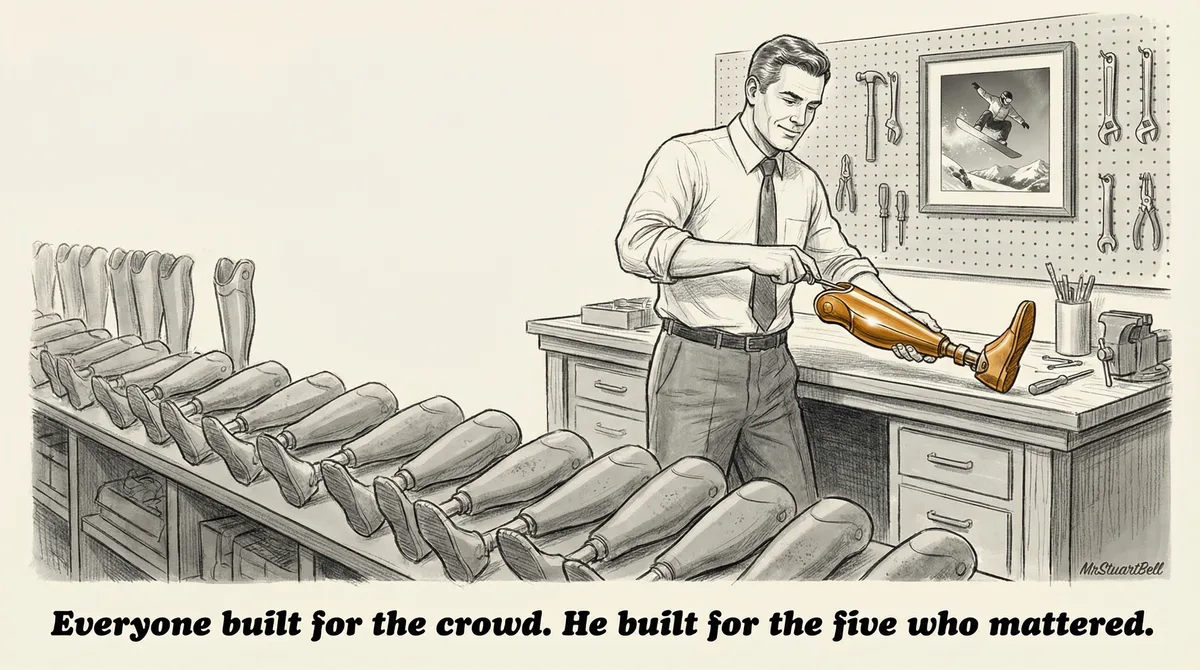
Mike Schultz is a Paralympic snowboarder. He lost his leg and went looking for prosthetics that would let him compete at the highest level. They didn't exist. Nobody was building for athletes who wanted to push their bodies to the limit after losing a limb.
So he built his own.
He founded a company called BioDapt and started designing lower limb prosthetic components specifically for para-athletes. Not for the general prosthetics market. Not for everyone who needed a prosthetic leg. For competitive athletes who refused to accept that their best days were behind them.
This week, the entire US Paralympic snowboarding team will be wearing his prosthetics. And Autodesk, a company with the resources to partner with anyone, chose him to help scale production.
He didn't get there by being the biggest. He got there by being the most specific.
The Micro-Niche Advantage
Most professionals look at a market and try to serve as much of it as possible. More people means more opportunity, right?
It doesn't work that way.
Schultz could have tried to build prosthetics for everyone. General-purpose legs for everyday mobility. That market is massive. It's also crowded with established companies that have been doing it for decades.
Instead, he picked the smallest viable audience. Athletes. Competitors. People whose needs were so specific that nobody else was paying attention.
He didn't need to convince the world he was the best. He just needed the right people to know he was the only one who truly understood their problem.
That's how he ended up with an entire national team. Not through marketing. Through specificity.
Your Lived Experience Is Your Credential
Here's the other thing about Schultz. His expertise didn't come from a degree or a certification. It came from being the person who needed the thing that didn't exist.
He understood the problem because he lived it. Every day.
That's the kind of expertise most business owners undervalue in themselves. You've solved problems for clients that nobody taught you how to solve. You've developed approaches through years of doing the work, not years of studying it.
That experience is more valuable than any credential. But only if people can see it before they meet you.
A book does that. It puts your lived experience into a format that the right prospect can hold in their hands and think, "This person gets it. This person has been where I am."
Being Multiplied by Others
The most interesting part of Schultz's story isn't that he built a great product. It's what happened after.
The US Paralympic team didn't just buy his prosthetics. They became proof. Walking, competing, medal-winning proof that his approach works. Every race, every podium finish, every interview is a referral he never had to ask for.
And Autodesk didn't just write a check. They brought manufacturing expertise that'll help him reach athletes he could never reach alone.
That's what happens when you become the recognized authority in a specific space. Other people carry your message. Other people bring their resources to you. Your growth stops depending entirely on your own effort.
It's the difference between hustling for every client and having the right people come to you because your reputation arrived before you did.
Your Flag in the Ground
Schultz owns his space because nobody else can claim what he claims. He's not borrowing credibility from a textbook or a certification body. He built the thing he needed, proved it worked on himself, and then proved it worked for the best in the world.
That's a flag in the ground that nobody can pull up.
Your version of that story doesn't need to involve prosthetics or the Paralympics. It just needs to involve one specific group of people, one problem you understand better than anyone, and a way to share that understanding before the first conversation ever happens.
The world needs more people building things right now. Especially specific things.