There was a story in the news recently that perfectly illustrates something I think about a lot.
A major AI company had a contract with the US military worth $200 million. The contract included two specific restrictions on how the technology could be used. Both sides agreed to those terms.
Then the government changed its mind. They wanted the restrictions removed. The company said no. Within days, they were banned from every federal agency and labeled a national security risk.
Here's the part that matters for us.
Within hours, a competing company swooped in and announced their deal with the same government department. With the exact same restrictions the first company was fighting for.
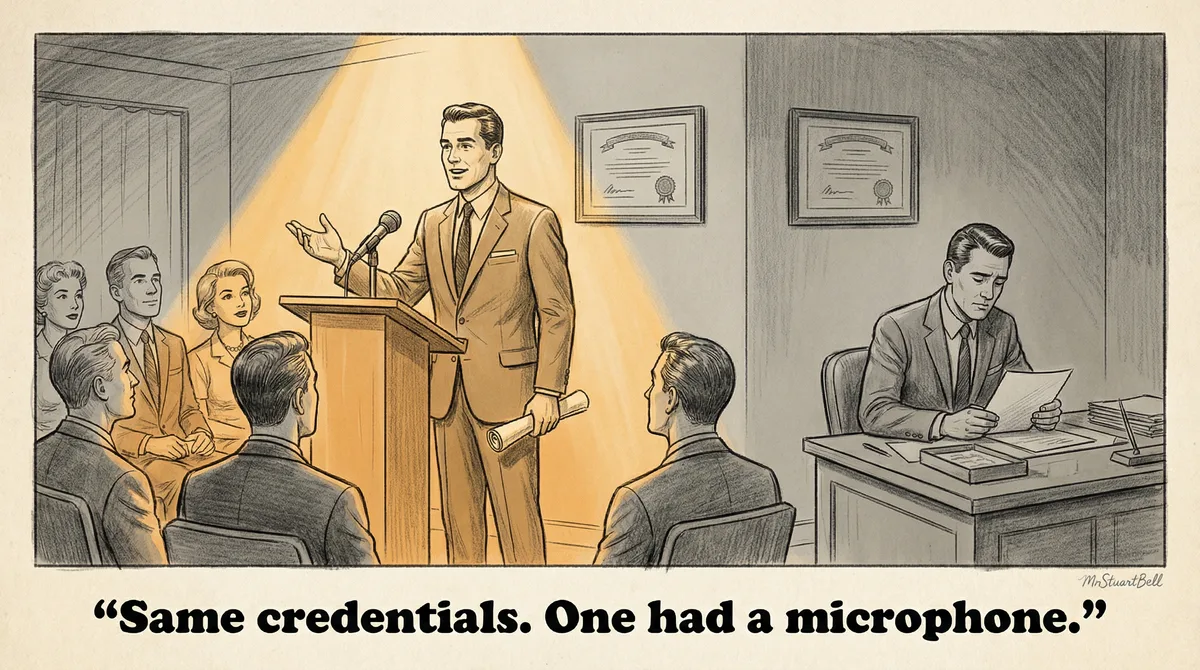
Same terms. Different narrative.
One company is a national security threat. The other is a patriotic partner. Same product boundaries. Completely different story.
The actual details of the dispute were incredibly narrow. Two specific use cases out of thousands. But the narrative that took hold was simple, emotional, and had nothing to do with the details.
And that's exactly what happens in your market every day.
Your Competitor Doesn't Need to Be Better
Your competitor doesn't need to be better than you. They just need to be louder. They just need to be the one shaping how your shared audience thinks about the problem.
And it's not just competitors.
It's your prospect's spouse saying "do we really need to spend money on this?" It's the voice in their own head saying "I'll figure it out myself." It's the generic AI-generated blog post that showed up on page one of Google last week with advice that's technically correct and completely unhelpful.
Every one of those is a narrative competing with yours.
Quality Doesn't Speak for Itself
Most business owners like to think that if they're good at what they do, the right clients will find them. That quality speaks for itself.
It doesn't.
Rational markets aren't rational. People make decisions based on who they've heard from, who they trust, and who made them feel understood. They go with the person who framed the problem in a way that resonated. Not the person who had the best solution sitting quietly on a shelf.
Your competitors can copy your marketing. They can't copy your perspective.
If you're not actively owning the narrative in your space, someone else is owning it for you. And they might not even be doing it on purpose. They're just there. Talking. Being visible. Filling the vacuum you left.
Pick Your Single Target Audience
So what do you do about it?
You can't own every conversation. It's too noisy out there. You can't be everywhere, say everything, reach everyone. Trying to is the fastest way to say nothing meaningful to anyone.
Pick your single target audience.
One group of people. One specific problem. One clear message that says: "I understand exactly what you're dealing with, and here's how I think about solving it."
That's what a book does.
Not a book that tries to be everything to everyone. A book that draws a line in the sand for one specific audience and says: "this is what I believe, this is how I work, and this is why it matters for you specifically."
It's a narrative you own. Permanently. In a format that still carries more weight than a blog post, a social media update, or an AI-generated article.
Your competitors can copy your marketing. They can't copy your perspective.
The Noise Is Only Getting Louder
The noise is only getting louder. AI is making it trivially easy for everyone to produce content. The baseline of generic advice is rising every day.
But the baseline of real human connection isn't.
Your book isn't about publishing. It's about planting your flag. Establishing your narrative before someone else fills that space with theirs.
Because the real battle is never about the details. It's about who's telling the story.