Chapters
Show Highlights
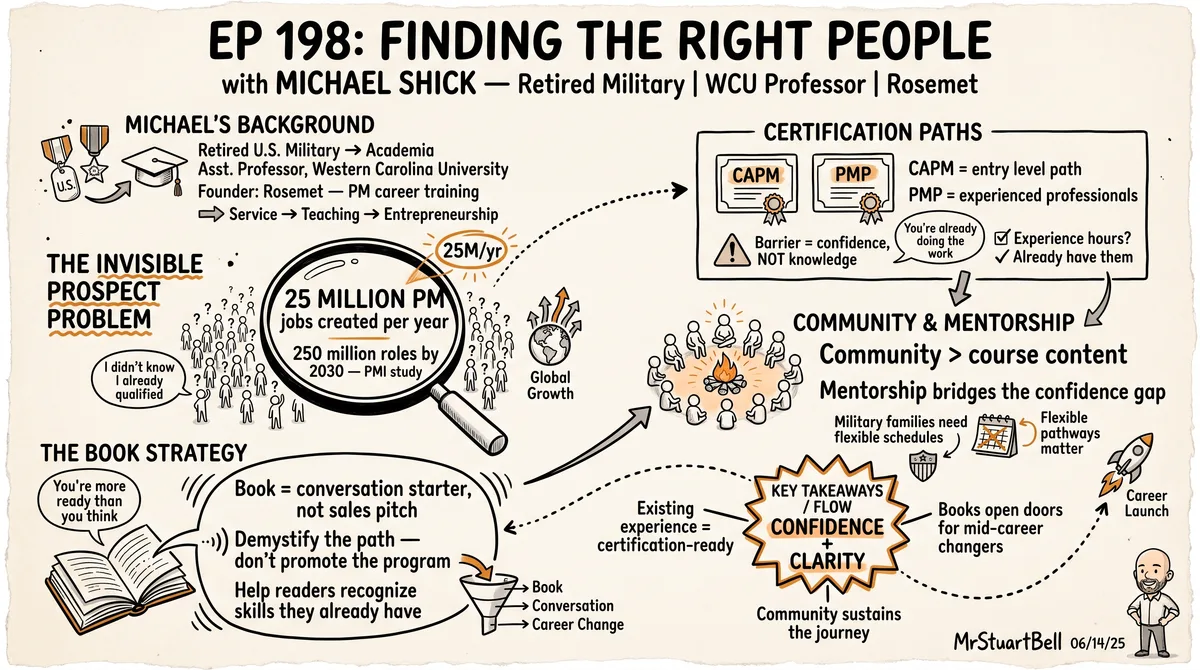
- Most qualified project management candidates don't realize their existing work experience already meets certification requirements
- Community and mentorship matter more than course content when helping working professionals change careers
- Books work best when they help people recognize skills they already have rather than teaching completely new concepts
- The biggest barrier to project management certification isn't knowledge but confidence in your existing experience
- Military families and career changers need flexible pathways that acknowledge their unique scheduling constraints
- Your book should demystify the path forward, not just promote your program or services
I talk with Michael Shick, a retired military leader who now teaches project management at Western Carolina University and runs Rosemet, a business helping people break into project management careers.
Michael's dealing with a fascinating problem: there's massive demand for project managers, with 25 million new jobs being created globally each year through 2030. But the people who'd be perfect for these roles don't realize they're already qualified.
He explains how many professionals are doing project management work without knowing it. They have the experience for certifications like CAPM or PMP but lack the confidence to make the leap. His approach combines practical training with community support, especially for military families and career changers.
What caught my attention is how Michael uses his book to start conversations with people who never saw themselves as "project managers" but are already doing the work. His focus isn't on selling a program but on demystifying the path forward. The strategies apply to anyone trying to reach a mid-career audience that needs confidence and clarity more than just information.
Transcript
AI transcript provided as supporting material and may contain errors.
"So Project Management Institute ran a study in 2020 or published in 2020 that forecasted 250 million project management jobs to be created from 2020 to 2030. Now we all know in 2020 there is a little bit of a global issue, but. And so those numbers, you know, I would argue probably haven't changed too much over time, but that essentially equates to 25 million project management jobs each year being added globally."
Stuart: Hey everyone, welcome back to another episode of the book More Show. It's Stuart here and today you're joined by Michael Chicken. Michael, how you doing, buddy?
Michael Shick: Hey Stuart, thank you so much for having me.
Stuart: Real pleasure. Do you know we've spoken a lot, but I've just realized that I think that's the first time I've said your surname out loud. And I suddenly had a moment of mispronunciation, panic as I said it. Is it shick?
Michael Shick: It is chick.
Stuart: Okay, perfect. It's not a silent chic or anything like that. It's so funny when you get to know people and you talk a lot and you have maybe an online connection first and then you see say something out loud for the first time. It's almost reinforcing point that so many of our relationships and conversations that we start with people are in like a digital text format first. You don't necessarily get introduced in the same way. So it's. Yeah, it's funny that you get these real world reminders of how conversations really go in in such an online based world. So I don't know if you ever feel the same.
Michael Shick: Well, I do. And you know, it's funny that you should bring it up, Stuart, because when you said my name I was like, I think that's the first time I've heard him say my full name. So. And it came off great. So please rest assured it was all good.
Stuart: Perfect. If there's any problems with that, I'm just going to blame the accent or just say it fast so that it just goes by quickly.
Michael Shick: Or it could be like when I was a younger person and you know, you could get yelled at because somebody misheard my last name, so.
Stuart: Right. Yeah, there's always that. Which I'm sure was lots of opportunity to, to say that as well. Yeah, we've known each other for a little while. It's always great to have podcasts like this with people. I know because I always feel like there's a little bit more value that we can deliver because we really, there's not so much of the broader explanation we can cut to the a little bit quicker. But I'm also conscious that the audience doesn't know you yet, so why don't we start with a quick intro and share with everyone where you are and what you do.
Michael Shick: Certainly. So Michael Schick I I've been fortunate enough to serve in United States military or retired at the end of 2022 and when I transitioned and retired I moved into academia where I am now an assistant professor of Project Management at Western Carolina University. I also own a project management business called Rosemat. And that's it's been fantastic because within Rosemat we focus on creating content on project management. So templates, examples, trying to help people understand project management. Large we also do training on Certified Associate and project management as well as training for the Project Management Professional or PMP certification. And the goal is not just simply to teach the exam, but actually teach people about project management. And so depending on where they are on their journey, whether they're aspiring or new project managers, earning a Certified Associate in Project Management is that great place to to start. But when you're looking at the pmp you have somebody who's typically has a minimum of three years of project management experience. And so now it's taken it to the next level and being able to meet people where they are, help them achieve their goals in moving into project management or elevating their career is certainly an amazing approach. Now on the assistant professor side, I teach undergrad students, but predominantly teach graduate students in project management. So these are people with years and years of project management experience. They may have a PMP already and now we're trying to professionalize them in a manner of saying all right, yes, you understand the tools and techniques now, understand the team dynamics of and how to motivate teams, create trust within teams and then we certainly get into advanced tools and techniques. But we're trying to elevate people to move into the C suite type of roles. So take those experience project managers and and take them to the next level whether it be in the program management or portfolio management. Project portfolio management, not the finance side of portfolio management or project management office, pmo, directorship type, those type of things.
Stuart: That academic course is that entirely the students entirely going through project management B or program management based course or is it one module as part of a broader business management type program?
Michael Shick: Great question. So it's project our degree is a Master of Project Management so it's a deep dive into project management for project managers. In fact, our our slogan, if you will, is a legacy of Leadership and a program built for professional PMs. So how you know, where we go from a legacy of leadership? Western Carolina University was one of the, if not the first accredited program in the world for through pmi. So the Project Management Institute Globally Global Accreditation center, we were accredited in 1983 and we've held that accreditation all the way to today. And so being the first one United States, again we argue in the world that was accredited by pmi, we've shown a track record of success and this is a deep dive in to project management. We don't pull in any other type of classes. Everything is centered around project management and it's, it is depth from day one. And you know, when there's often times I've had this conversation and forgive me, Stuart, if you just give me a quick second, you know that people are certainly proud of their PMP and as they should be. That's a challenging exam. I don't ever want to take it again. But you know, it's a challenging exam. But this is an assessment on what you know. Okay. Through a Project Management Institute lens. All right. There are several different bodies. As you know, you being from the UK, you have PRINCE2 the Project and Controlled Environments 2 certification, which is, you know, its own framework and methodology. There's other, you know, programs and opportunities throughout the globe. This just happens. The PMP is towards the Project Management Institute. So people understand that framework and they may or may not even use it within their organization.
Stuart: Right.
Michael Shick: This, our Master's in Project Management at Western Carolina University is, you know, more of a broader focus and we bring in peer reviewed research. Myself and the other faculty, we're all terminal degree holders, we all do research and project management. So we're pushing the, the discussion forward through our research and you know, we'll go to conferences and we'll give talks and things of that nature. So that is more of a transformative type of experience. So it's taking people who know the systems, they know the processes, which is what the PMP validates. Now we're taking that and transforming them into executive leaders that can bring everything together and not just be focused on one particular set of processes and frameworks, but more globally, universally in a sense.
Stuart: Right. It's interesting, isn't it, that extra time you've got with your bigger program, the breadth of experience of the different people, the fact that the success criteria or the measurement criteria is more about broad application in real world situations rather than just answering the questions for the purpose of the test at the lower levels. Because you're really going from a introductory level all the way through to the highest academic level that it is. For that real world breadth of the degree program or the master's program. It does add a layer of color and real world application to it. Broader than just the certification, 100%.
Michael Shick: And we've seen from our alumni moving up into the senior positions, going to conferences, being keynote speakers at PMI events globally. So exactly how the program is structured and geared is achieving, you know, the results that we're aiming. And I got to say it's in large part, I would say, is the faculty before me. I work with an excellent group of individuals. You know, vital. For example, he's, he's literally written the textbooks on project management that a lot of programs use. You know, Nathan, Todd and Yang, the, each one of these folks, they come with the PMP certification, they all have their doctorates, they consult on the side. They're involved in the field with PMI and with other organizations. And so you have folks that are practitioners and scholars and you know, they've really done a fantastic job building and continuing the legacy that the of project management that Western started with in the 80s.
Stuart: Yeah, I think the, the other element that that brings in getting to know you over the last few months a little bit more and the expertise that you bring into it that translates and feeds down to then the more the entry in the middle tier programs of the certificates that people can get as they're looking to get into the industry or progress in a career with the industry. I think the benefit that that working with you has is that you bring this large. It's not just kind of the execution on the study guide to get you through the course, it's the broader discipline of project management. And for this particular exercise we need to get you through the course, through the certification. So talk a little bit about this, these ideal groups. So obviously as people are listening, there's a broad set of businesses and different industries represented. But I think this is a good use case for anyone thinking about creating a book to address that audience, to start a conversation with the audience of people who they want to talk to. So we did some work to identify who that group is. Let's talk a little bit about those people and then where they are on their journey. Then we can talk about the book a little bit more and hopefully as people are listening, then they can substitute their scenario for yours.
Michael Shick: Well, 100% and first and foremost. Thank you Stuart, you're too kind in your words. But yeah, the. So we also Have a journey that we're starting on. Right. So part of the reason that I started Rose Met was so I could help people get into project management. I call me what you will, but I love project management. And the reason that I love it is because you get to create something. So a project is something that is, it has a definite start, definite end is complex, unique, and interconnected. And so when we, when we look at business, now my doctorate's in business administration. Unless your job is to, or your business is to go out and purchase other companies and then break them up and sell them off, you know, generally you want to go into perpetuity, right? You want to continue to create products and services and sell those. Well, from a project management perspective, it's a change manager mechanism. It's for innovation. It's creating something that's unique, that individual organizations identify, something that is of tangible value, that, you know, their customers and clients are asking for. And now you are trying to bring it together and deliver it on time, within budget and scope and the quality that's associated with it. And so by being able to take that idea, that has never been done before, certainly maybe not by that organization or by the project, have a framework around it and be able to go through the processes to actually have it realized, and then say, hey, this is what you asked for. You've seen it create along the way, and by the way, it's in budget and you're getting it on time and you're getting it, you know, within your specifications. Talk about something cool to, to help organizations push forward on the side of men and women who are trying to get into this career field, you get to create those things you need to. You get to be that change mechanism that depending on the organizational structure and on how much flexibility and authority you have as a project manager, but you got to start someplace and then be able to grow into the position to be able to deliver that change for those organizations. And so, you know, you've got the overall operations and admin side, which is certainly important, but then you have this microcosm of an innovative organization within it that needs to have many of the same principles and interconnective tissue to move forward. So Project Management Institute ran a study in 2020 or published in 2020 that forecasted 250 million project management jobs to be created from 2020 to 2030. Now, we all know in 2020 there's a little bit of a global issue, but. And so those numbers, you know, I would argue, probably haven't changed too much. Over time. But that essentially equates to 25 million project management jobs each year being added globally.
Stuart: Right.
Michael Shick: And so the Certified Associate in Project Management or otherwise capm, at least within the United States and North America. Forbes ran a article that PMI also has on their website that suggests a somebody who has a Certified Associate in Project Management annual salary is around $72,000 US dollars per year. Then now that when you look at the pmp, the average salary, now this is a little more squishy because you'll see a few different sites like Glassdoor and you know, PMI and all everything else, but you're looking right around 122,000 on average. And that's somebody you know that by the time that they get earn their PMP, that that's about what they're going to be serving. And that can go all the way up into the 250,000 plus range depending on your role. But ultimately for those who are interested in having that opportunity to affect change, to be able to create something, be that driver within an organization that is able to take something finite and have strategic change, that is what is particularly interesting and what we want to help people achieve. And so yeah, we, we have those certification courses but just to be a mechanism for this, Stuart, we also started a free community where people can download resources, they can come and ask us questions. Myself and I have another five individuals on our team that have their PMPs as well. And then we have a couple of team members that are earning their CAPM and a few more that are earning PMPs. So our organization is all centered around project management, but all of us are engaging in this platform and answering questions, holding office hours so people can ask questions, they get video content, things of that nature that we're just trying to get out and get the message out to folks so that way they can achieve what they are driving towards, which is a career that you know, that has value, that has purpose. I would like to think rewarding, but I'm biased. But you know, you have experience in project management. If I remember correctly, you started off as a project manager, didn't you?
Stuart: Yeah, it's funny, it's a flashback. As you talk about things, I'm kind of halfway. If my brain is listening to what you're saying and paying attention and being a good host and the other half is thinking, man, this is. I used to know all of this off the top of my head because I was involved in it for so long. So with the UK background like you say we were Prince two So the. I forget the name of the introductory exam, which is the equivalent of the CAPM. But then the Prince 2 practitioner was the PMP equivalent. Yes, and that. But my actual background was more on service delivery and service transition. So we had the itil, the ITIL framework. So again, when you're in that career and you're thinking about as a career, there's lots of opportunities to add certifications and more frameworks to the list, to the resume. But then it's the real world application that makes the difference. And I think that from a project management perspective is also to a certain degree what insulates it from potential AI changes. Obviously AI is going to impact everything in the kind of PMO type roles, the more execution type roles on making sure that all of the dots are dotted and T's across all of that type of thing might get more AI'd. But the discipline of project management is dealing with the soft squishy edges of things that make it out of scope and out of budget and out of time and all of the reasons why it isn't just going to plan like it should be. So that transition from people who have got that, that skill set or that interest or that drive to see a project through, I think this career is really open, is a really good match and can open a lot of doors for people 100%.
Michael Shick: And you know, I love the fact that you brought up AI, that one of my research areas is artificial intelligence. Now I'm not talking about, you know, the programming side of large language models. It's just more looking at it from a, you know, rationality versus bounded rationality and just to give a quick snippet without really going too great a depth and boring. Everybody is, you know, we're all, we're only capable of making decisions on the information that we have available to us and what we know that's objectively true or you know, your subjective perspective. But when we start bringing in, we started seeing the change within the Internet be and organizations like Google that, you know, can index and catalog all this information. So when people go out and do a search, they're able to pull back that information. And to the extent that they can retain the information and apply it, then, you know, you can make decisions on that. Now if you're grabbing AI and pred, providing that the AI is built on objective, you know, truth rather than injecting certain perspectives, you are, because then that turns into a garbage in, garbage out type of scenario. But regardless, it's going to get you closer to having more of a fully rational decision making because you're pulling the arguably as it advances into a more the wisdom of the world type perspective. So you can see those dynamics. Now here is where it's really important, whether it be on project management or decision making writ large, is the human wisdom of it to be able to discern, okay, it as these models tighten. Yeah, I can say, all right, here is the project that I'm working on. These particular, what would be called a work package. And that's just a smaller structure of something that needs to be performed. What do you say, you know, possible risks are for during this particular segment, this work package that it's being worked on, well, it can help you brainstorm, all right, but you're going to have to add the variables into it and say, well, no, that doesn't apply because of this reason, that one, or it will apply because of XYZ and being able to discern and then connecting with the other humans that are actually either A, doing the work or B, you know, handling their segment of the work to be performed. And so project managers, yes, AI will be useful in my opinion, to help, you know, tighten in and making sure that you're staying more on schedule and help you with ideation and things of that nature. But it's the human that needs to be on the loop. It's the human that needs to make the decision and it's the human that needs to have the wisdom on what is true and discern, you know, what's nice and fits an algorithm versus, you know, what's what may not necessarily fit or apply. There's an oath saying that, you know, don't let the tail wag the dog. AI is an enabler. You can't, you know, just because AI says it doesn't mean everything else needs to adjust because of it. I'm often reminded of the office, if you've ever seen the office, when Michael Scott is driving with Dwight and GPS told him to take a right and. And Michael's like, no, take a right. And it was into a boat launch with like a half a block up. It was a, you know, the stop sign, you know, and he insisted on. It's one of those that, you know, AI things like project management will I has to be protected. And part of that is because of the scope of project management. I can't tell you, Stuart, maybe you've experienced this, but the amount of people that I talk to about project management, like, yeah, but what's that mean? Because you have Agile framework, you know, so software Development, those iterative changes you can do hybrid or predictive, which is, you know, the more traditional. So you can build construction buildings and you're going to have trades people doing that type of work. You'll have carpenters. AI is not going to take over carpentry, at least not in the foreseeable future. Maybe when we get some robots out there or what.
Stuart: But you're right, it's all of the. It's the squishy bits around the edge that aren't quite so black and white that really makes a difference. And I think anyone who's manage the project, whether it's officially under the umbrella of project management or even try to plan going out for dinner, it rarely does. What's the other saying? No plan survives contact with the enemy or everyone's got a plan until I punch you in the face. That might Tyson one, but it's the soft, squishy edges that make a difference. So when we think about the people, and I think this is where it's going to get really meaningful for listeners. We think about there's an audience of people out there who are the perfect fit, whether they know that they are or not, whether they've been exposed to the potential of project management or not. So there's an audience and then there's the. What you do. And the visible prospects are those ones who are kind of going around and looking for project management information. And the invisible ones are those ones who are ideal candidates, but maybe they just don't know. So what I like about the book approach and the approach of Rosemary overall is that it's really trying to serve the visible audience because obviously these are the people knocking on the door. But it's also looking to engage the invisible audience, the people who don't yet know. And I think the majority of businesses out there have the same. There's people who are raising their hands and one step away from doing something, and then everyone else where it's a much longer conversion process or a much longer journey that they need to go on until they're ready to raise their hand and take that step. So talk a little bit about that group of people, the ones who are the perfect fit, who maybe have thought about project management but have been turned off by the idea that it's more studying what are we doing to engage, to share with those people what the potential is and kind of demystify the path.
Michael Shick: Yeah, no, I appreciate that. So the way that we start off with the book is we talk about what project management is and identify, identify you know, how people can find their way into it. I mean, for example, that certified associate in project management, your high school graduates and you know, you sit through the course and earn your certification. And now don't get me wrong, it's not for the faint of heart, it is a challenging exam. But just by adding that credential, it shows that you're committed to getting into project management. And then there are plenty of jobs. In fact, I did a kind of a white paper type article where I looked at the demand for certifications and within North America and PMP was number one, followed by certified Scrum Master, which is an agile type of certification. Then it was capm. So the top three, two of which were CAPM and your Project management professional certification. And so people who leverage the book are able to say, hey, is this the right fit for me or is this something that I'm really looking at doing? And for those people that have more work experience, I'll tell you, projects is one of those things that, that not all industries necessarily use, but just about any and every industry. So it doesn't use that lexicon, it doesn't use that verbiage, but there, it's there. So those people, unless you're in a formal project management type role that leverages PMI's framework, if you have, you know, five, six, seven years experience in, whether it be in the restaurant industry, if you're, you know, maybe revamping or renovating and bringing in a new kitchen, or you're opening a new store, or you're, you know, even finishing a basement in, in your house, these skills are practical for everyone. And once you have that firm understanding of what a project is, which the book at a basic sense, this is for those people to create under understanding and awareness. But once they, they have an understanding, then they can choose which path makes the most sense for them and really, you know, take a new vector in their career, if that's the lens. And then I would say from a business owner perspective, you know, you and I have seen this, we've talked about it, you know, at length. But organizations, sometimes they get so used to the way that they've gone about it, looking at slight tweaks can find efficiencies in the way that they go about bringing change with their own organization. So whether they see it as useful for their organization or for their employees to bring on these experts or get these people trained to become experts in project management, all to save them money over the long term, because now they are able to take a systematic approach with technically and tactically proficient understanding into their organization of. To keep things on time and on schedule, or on schedule, on budget, within quality parameters, focusing on risk, you know, all of the things that are important to business owners.
Stuart: Yeah. So that idea of the cost of a project overrun, I mean, I think everyone has experienced it to some degree, but it's, it's really quite dramatic once you start looking at the numbers. And there's again, I mean, even going back 15, maybe 15, I don't know, 15 years or so, when I was involved, there was still case study after case study of the difference that management, both in terms of the staying on budget and the deliverable actually being deliverable and the quality of it doing what it wants. I mean, there's really some bad stories of long projects running expensive projects, and then the deliverable just being scrapped effectively because it's just not fit for purpose. So I think from a business owner's perspective, again, having that having an awareness of the discipline is super powerful. The idea that people are maybe, maybe they've got a concept that project management is out there. They might be in an industry that recognizes it as a discipline and there's people in those roles. Maybe they've heard the stats about the jobs and the demand that this, it really is reliable career path going forwards. Some of the ways that you've got to start the conversations with them, as we were talking in previous calls, is around this idea that there's. They've got skills, they've got some experience, but they're turned off or reluctant because they feel like there's an overhead in the certification side of things. So they're kind of scared by that. Yeah, do something to demystify or take the terror away from those types of things. Talk a little bit about that and people's experience of it as they're coming in.
Michael Shick: Yeah, no, and that's a real concern because the, the exams are difficult. You'll hear people who sit for the exams that they say they're never going to let those certifications slide. They're going to continuously keep up with their professional development units, which are essentially continuous learning, because they don't want to have to take the exam again or if they're not going to do it, they're just not going to do it again. So. So we looked at it through a lens of. All right, one, how do we, how are we able to meet people where they are, get them trained and also fit within their schedule? So we certainly will do asynchronous, but we offer an asynchronous approach. So in other words, rather than like you and I are having a conversation right now, virtually, you know, it's on demand so people can view the course, but then we hold office hours. So people who come in and have questions and they're trying to study for this exam is they can ask us questions, they jump on. They have touch points with me, they'll have touch points with other of our PMPs, which, you know, they come from chemical engineering or civil engineering, it, project management and so educational background. So all they come from various different areas. But we're able to answer questions because the methodology is structured and broad enough to fit within, you know, nearly every industry with touch points and tailoring to go in, whether it's going to be an agile or adaptive model versus the traditional addictive. But so we have those touch points and we have blocks where within our community where people can ask questions, we respond to those questions as well. So you're not looking at it simply from, hey, I get an on demand course or on demand experience without anybody to answer my questions. No, we're engaged with those particular students and their success is our success. If they don't succeed, we, you know, that's our failure. It's not necessarily the individual's failure. And then we've also created these test simulations that I would argue, you know, are harder than the exam themselves. So if they can pass our exams, the intention is they go in and they ace the exam. I say ace because there isn't, you know, the Project Management Institute doesn't grade it like a B's and C's and
Stuart: any of that stuff.
Michael Shick: It's a pass or you didn't. But ultimately our goal is for everybody to come in, not only understand the material, but walk away with the exam. So, so we're meeting people where they are, that we're helping them to learn project management and get ready for the exam by having touch points and then also give them the flexibility to study when it's convenient for them because, you know, whether it's a military member, you know, station overseas deployed, or, you know, their spouse who's got to move every couple of years, or, you know, somebody who's at home with a bunch of kids and, or, you know, has to work 60 hours a week to support
Stuart: their family life coming in.
Michael Shick: Yeah, I mean, life happens. So to be able to have the flexibility throughout the week to have those touch points while also studying when it's convenient for you, we're blending both approaches.
Stuart: Yeah, I think as we were talking about book titles when we were going through the setup stage. There's that idea that there's multiple touch points. We'd already kind of dialed in who the core group was we wanted to talk to. So again, to make it applicable to other people listening, in your world, you've got existing people who are certified and looking to develop that career and new people coming in who know they want the career and people who don't know that they want the career but would be perfect fits for it. So those three groups, you already identified that group as that middle group. The group of people who were kind of were aware of it, but moving forward but then thinking more about where their pain point is and what the challenge is. So dialing in this idea that we went through a couple of iterations. One that we were talking about just before we started recording the, when we did the, when we were on the first call to get the back last year sometime, we were looking at the group of people who didn't necessarily know that they would be a good fit. So this was the Deployed to employed. It was the demobilizing or the end of career forces. People who are perfect fit for project management. So deployed to employed as a, as a book title resonates with those people because they don't know that project management is the thing. But this is introducing the idea. Now know the group of people who are the academic ones who are really deep in their career are probably going to find you anyway because it's more of a known world. But that middle group of people, their pain point, the challenge that they were having for a lot of them is around this idea of the fear and they know the stuff, but they don't really have how close they are. If only they did a little bit more. So.
Michael Shick: Right.
Stuart: The whole idea of dialing in the single target market and then focusing really on what the pain point is, what the starting point of the conversation that will get them to raise their hand. It's a really useful exercise. Whether it's a book or an email that you're sending out, it still works 100%.
Michael Shick: I will say, you know, thanks to you and your team for the help with the, the book and really dialing that in for the, you know, helping these people because ultimately that's what it's about is, you know, I'm passionate about the career field because I've seen all the goodness that has come from it. I've been in and around project management for nearly 25 plus years. And do you know, for people to Understand that they actually do project management, you know, they just didn't realize it in the name, you know, if you ever have a boss that comes up and says, hey, I need you to figure this out and now you're like, well I guess I'm just okay, I got to deliver this thing, you know, and you know, you by having a set of inputs, tools and techniques and to create outputs, create having that framework, you know, the book that you helped us with was fantastic in you know, creating that avenue to educate people of where they're at and where they understand what needs to be done or what, what is within the realm of possibilities, I should say with a little bit of, you know, sprinkling in of some project management knowledge but ultimately looking towards that career progression. So starting with, you know, I'm dipping my toe in the water and seeing if project management's where it's at. All right now I'm mid career and now how do I transform into an executive leader folk motivation and change. And so you know, it's, we're, you know, it's been a fantastic journey thus far, Stuart.
Stuart: Yeah, it's exciting to see it come together in like the final stages now of wrapping it all up. One question I always like to ask is the ideas of using it and getting it out there to people. When you first started the project and thought about a book as an opportunity to have that way of engaging people, do you have particular ways of using it in mind? Do you think, okay, I want to use something in this context and a book is the right thing to do or was it more coming from point of view that I know a book is going to provide value and then I'll find the specific ways to use it later.
Michael Shick: Well, from my perspective I, you know, being an academic, I was kind of looking at it from an academic perspective. And let me be clear, the book is not an academic piece. It's not a peer reviewed article, you know, journal article. This is meant to, you know, create understanding and broader commercial type value type of approach. So this is to fit a need for individuals. And so because you know, I hearing the conversations from service members to people that are interested in project management, trying to figure out how they get into it. I saw a particular gap, if you will, that was present and so I wanted to create something that, that created awareness for the broader field. Now whether they take my book and know, go out and you know, work with any of the project management organizations out there, great. You know, this is all about creating that, that understanding about the career field, if they end up with us, great. I mean that's perfectly fine as well. But it is more about having people create the understanding, understanding what the realm of possible is. You know, technology, you know, we're at in a fantastic time where just about ain't, you know, a lot of things are possible that were only dreams years ago. Now how do you harness human capital and the strength of human beings and the experiences. And I'll center that towards achieving what it is that you're trying to set out to do and do it in a manner that is appropriate and effective, efficient and effective. And so that's from my perspective that is the approach and why I decided to pursue the a book particularly on, you know, the arts and science of project management and demystifying, you know, what the, you know, Certified Associate in Project Management, the Project Management Professional certification is because quite frankly, you know, going back to that article that I did about a year and a half ago now, was looking at the most in demand certifications and two of the top three are both from Project Management Institute.
Stuart: Yeah, it's interesting as well, isn't it? I think so many times we think about doing marketing activities as the short term we're going to take an action and we want to result immediately. And if there are results down the line that we don't attribute it to this action in the first place. It's very much a kind of an ad based approach of hanging and running ad and see what the return is in the next 30 days and after that it goes away. Whereas the reality of most of the real world business that we do and books as a marketing methodology is that return comes over the long haul. The conversations that we have with people, the introductions that we make, the presentations that we do, all of that typically results in business years out in into the future, not days out. And the book's very much the same. So even if someone is introduced to the idea and it's not for them today, a book's probably going to live on their shelf for a longer period of time and in two years time the timing might be right for them. Or maybe they'll read what you write and take the certificate with someone else. But then when they come to do the PMP or maybe later the master's level course again, you've got started that conversation and added some value early in the process. So there's more of a likelihood that something will come from that. Even if it's not the immediately attributable stuff that we often spend too much time thinking. About.
Michael Shick: Well that's exactly right. And ultimately, you know, you're looking at a transactional to go back to, back to your ads discussion. That's a one shot and you know, you may recycle it a year or two from now and maybe clean up a little bit of the imagery and send that out out again and push another campaign. But where a book is, you know, especially if it's, there's a digital option and you know, you could have your hardened soft cover versions as well, that's gonna, that's gonna live beyond its years and the organic nature of it.
Stuart: Right.
Michael Shick: You know, and I'm thinking of this through an organic search and Internet AI seeing that, you know, it's pulling in at data and all that text has got to come from somewhere. Right. So to be able to attribute it back to business leaders and their thought leadership and researchers like me that, that take some of these actions and then analyze it empirically and show where there's value that comes from it. All of those come back to the writings and the books and, and the long term approach. So that's my long winded way, I'm sorry Stuart, of saying yes, no, I fully agree. The organic side of things that comes with a book has staying power and
Stuart: so strange from birth not to break books or tear them up or throw them away. There's an outsized value to them just because of the way that it's packaged that we get to take advantage of a little bit. I always remember we did a, a podcast a couple of months ago now with, with Lee Ramey. It's back in the feed. But he was talking about taking his books and putting his sticker on the back of it with his contact details. And they are, if I remember the details correctly, I'm pretty sure they're a mould remediation company, that type of indoor air quality type place. So he would take some of the books and leave them in doctor's surgeries just on the, in the waiting room like on the tables. And they would just put his contact details, details on the back because his premise was they're going to live there for a long time because people are sat there reading and people who are in doctor surgeries are also probably good candidates for being worried about indoor air quality because of the, the nature of that cohort. So I said, I asked him, oh well, did you have some relationship with the doctors? Were they okay with you doing that? He said I didn't ask, I just walked in and sat down and put it on the desk. And then stood up and walked out again and just do a circuit every couple of months and put another one there if it got taken away. So anyway, this idea that there's an organic longevity that beyond anything that we can measure is. Yeah, it's super interesting that, that, that
Michael Shick: would be an interesting case study to see how many clients he got from doctor's offices.
Stuart: Right? Yeah. And then a backwards study of like cause and effect to see if there was some kind of medical condition in that local community that was then causing more of an indoor air quality issue that, that kind of spiked the results. But yeah, it's so interesting.
Michael Shick: Part of me is wondering about, you know, maybe you should partner with Joe Polish and you know, with his old carpet cleaning side of the house and you know, going with the carpet cleaners and. Yeah, and, and having those handed out as well because hey, you know what?
Stuart: Yeah, yeah. And that we call it, I refer to it as complementary non competing businesses. The idea of these complementary businesses who have your clients but they're not competing because they're doing a different thing, but the carpet cleaners to the mold remediation, I mean that's a perfect match between the two because again, complementary, non competing. So I think whenever you're thinking about this idea of organic growth and let's go to the, the second degree influence circle of people where you can add value to the conversation. Again, all of us in business have those relationships or those opportunities, but it does take a minute or two to get to that point of being able to think about it because we're so consume with the day to day stuff first. But, but yeah, 20 minutes of sitting down with a pencil and thinking about who those people are. It really gives you a good organic, organic kick that's broader than the initial.
Michael Shick: Yeah.
Stuart: I always seem to wrap up every podcast by glancing at the clock and realizing that time's flown by. So again, the same's happened. I want to make sure that people can reach out and find out more about what you do, either if they're interested in project management specifically or that they just want to connect with you to talk about the ideas more. Where's a good place to send people? Where's a good place for people to go?
Michael Shick: No, thanks for asking. There's a couple of spots, obviously via LinkedIn. I'm there. My last name is spelled S H I C K. You know, shik is often conflated with the razor, which is not spelled the same way but. Or our website which is www.rosemet.com. that is R O S E M E T.com and then as you and I were talking, certainly welcome people in into the community and take a poke around, shoot us a message and you know, we'll are happy to help you out or answer any questions about your own projects if you're stuck or you know, how you should engage with your stakeholders or any risk type of discussions or what have you. That is a free community that we have access and you can get that from our Rosemat page or you want to, you know, send me a message via LinkedIn. I'll get you set up. It's pretty easy.
Stuart: Perfect. And I'll get the link to that as well and make sure that the three links to your LinkedIn, the homepage and the community page, I'll put all of those in the show notes so as people are listening or watching along, just one click and they can get straight through. So yeah, that'd be a great resource I think as well. Not just for project management as a discipline, as a project manager, but also just to be able to ask those questions. It's yeah, super useful.
Michael Shick: Excellent.
Stuart: Fantastic. Well, thanks for your time. It really has flown by. Let's circle back later in the year maybe once the book's been out there for a little bit longer and we've been using it in certain ways and we can maybe do a follow up episode and share some of the stories about how it's, how it's engaging those people that we're trying to engage.
Michael Shick: No, that's great. Maybe we can go over the case study or what, whatever, you know, comes from that. But either way, Stuart, unsurprisingly, you know, our conversation's always fantastic and like you, I looked up, I said, oh, we're a little bit over.
Stuart: Well, again, appreciate it. I'll let you go for sure. Everyone, thanks for listening. Make sure you check out the show notes for links directly through to Michael's stuff and we'll catch everyone in the next one.
Michael Shick: Thanks, Stuart.