Chapters
Show Highlights
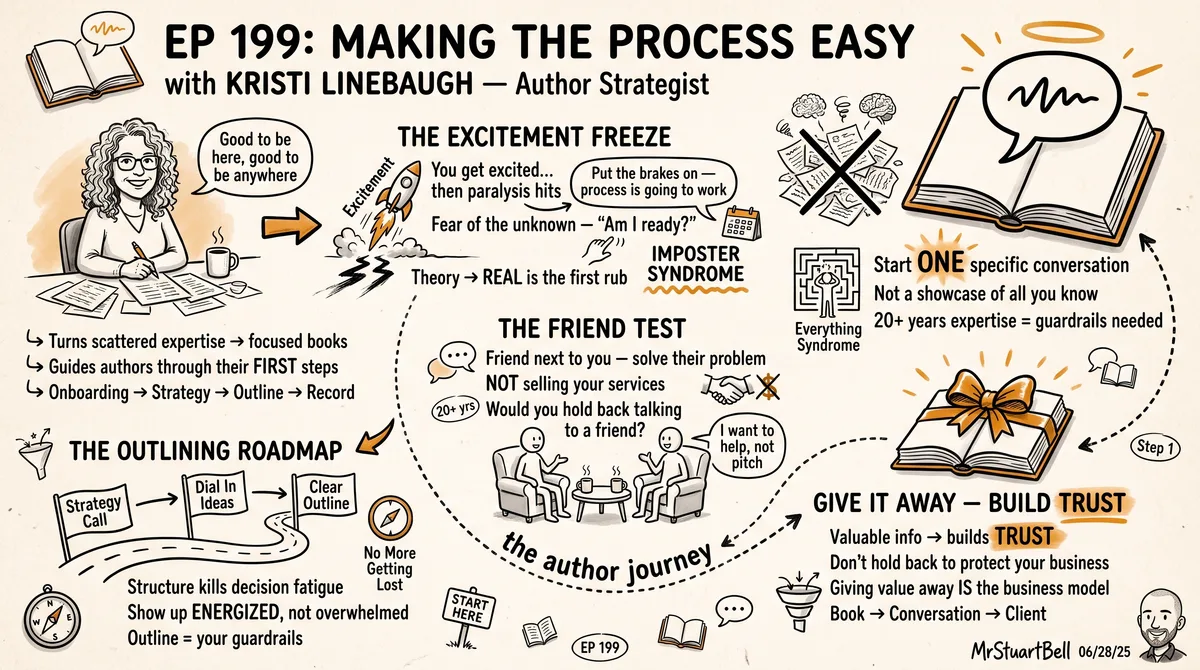
- Your book works best when it starts one specific conversation, not when it tries to showcase everything you know
- Imposter syndrome kicks in hardest right after you get excited about your book idea and have to take the first real step
- Focus on solving your friend's problem, not selling them your services, when deciding what goes in your book
- People with 20+ years of expertise need guardrails to avoid getting lost in the weeds of what they could include
- A structured outline eliminates decision fatigue and lets you show up energized instead of overwhelmed during writing
- Your book should give away valuable information that builds trust, not hold back to protect your business model
I talked with Kristi Linebaugh, who's been guiding new authors through their first critical steps for years. She's the person you'll work with to turn your scattered ideas into a focused book that actually starts conversations with the right people. Most business owners come in wanting to write about everything they know. Kristi helps them narrow it down to the one thing that'll move the needle. She walks through why people freeze up after getting excited about their book, how to beat imposter syndrome, and why trying to include everything kills your book's effectiveness. You'll hear how she guides authors from 'how can I talk about all my expertise?' to 'how can I start one specific conversation?' She also breaks down the outlining process that gives you a clear roadmap, so you show up prepared instead of overwhelmed. If you've ever worried about what to include in your book or felt stuck at the starting line, this conversation cuts through the noise with practical steps you can use right away.
Transcript
AI transcript provided as supporting material and may contain errors.
"So why I really encourage people to look at it is just focus on your passion for helping people. You know, this is really simply boils down to a conversation that if your friend was sitting next to you and you really wanted to help them and you had information that would be very valuable that they know that would be very helpful for them, you wouldn't be trying to sell them on your services, you would be trying to solve their problem."
Stuart: Hey, everyone, welcome back to another episode of the book More Show. It's Stuart Bell here today. Super excited show because we've got a behind the scenes peek into our process. So joined by Christy Lambo. Christy, how's it going?
Kristi Linebaugh: Hey, Stuart. Good to be here, good to be anywhere.
Stuart: It's. We just saw each other yesterday, the day before. So it's always a bit, a bit funny doing that bridge from real life into Zoom land because no matter how good Zoom is, there's still a little bit of a satellite delay sometimes. So it's, it's good to get this conversation recorded though, which obviously is a little bit less practical to do in real life. So I'm excited to share this.
Kristi Linebaugh: Definitely. It's good to be here. I've enjoyed the process and I'm excited to get into it.
Stuart: Yeah, it's so some people who are listening will know you and some people won't. So let's start by sharing what you do with the people who don't know you. So you've worked with us for a number of years now, probably longer than we both care to remember, but really dealing with onboarding the new people, extract the ideas, help dial in the outline for them, and then do the actual recording. So you're really integral to that first piece and people will spend a lot of time with you as they come through. So that was my description. Why don't you describe it in your words?
Kristi Linebaugh: Yeah, absolutely. So as I first coming in, that first bit is really kind of connecting, getting on my schedule, making that first leap, which is kind of funny because people get very excited, excited about doing the book and then they're like, okay, I got a book. And then that kind of like hit that first rub right there of going to my calendar. And so once they get on there though, I always say, you know, sometimes I have to remind them a little bit like, hey, remember, we're starting the process. I think it's just that timidity of being excited about the idea, but then like, oh, put the brakes on because process is going to work, you know,
Stuart: hits the road and it's going from kind of like a theory to real.
Kristi Linebaugh: Yeah, absolutely. But once they book that first appointment and then we meet for the strategy call, it really kind of puts a lot of people's mind at ease because it is that fear of the unknown, of what to expect. Am I ready? I get that a lot of I don't know if I'm ready, what if I don't, you know, what all do I need to bring to you? And I think it's that boundary again of what's behind the curtain and being uncomfortable. They don't feel prepared. The imposter syndrome kind of thing kicks in. But once we start to talk, I really, I can see kind of everybody start to relax a little bit because really it is just that very first call is seeing where you're at in the process. A lot of people have wanted to do a book for the past 20, 30 years, or have had stacks of papers that they have wanted to write a book about, or have had so many ideas that it has kind of taken it and built a mountain where they feel like they're not going to be able to do it, you know, and so that's so much good stuff. So once we really start diving into that first meeting, it's really very straightforward of, you know, what ideas are you thinking about? Let me help you kind of dial it in, put some guardrails up. And I think that's a big thing too. When you're working with people who have expertise 20, 30, 40 years, they have a thousand ways they can help people and it's so easy for them to get off into the weeds. So it's really kind of that first. You don't have to be nervous about that. That first recording is really just kind of getting some guardrails up, seeing where you're at in the process, kind of whittling down your ideas, getting comfortable with the idea of just. You don't have to put everything in the first book, you know, you can save some for other books.
Stuart: Right? Well, I mean, there's so many things to unpack there just in those first few sentences. But I always remember Dean has a. Has an example which people who listen to the Mortgages Whiskers or Out of Marketing podcast might have heard him talk about before. This idea of a turbulence email that, that they used to send out in one of the business units. We do it to a certain degree, but maybe not quite explicitly enough, or the fact that people are overwhelmed by emails these days a little bit, so maybe don't consume everything, but this Idea of the turbulence email, of almost being like. As you get on board a plane, really, you run through all of the details. The camera crew will show you to the seats. No matter how many times you've been on the plane before, they'll come out and check that you're buckled.
Kristi Linebaugh: They'll.
Stuart: They'll explain the process that's going on as they're taxing, they'll tell you to turn everything off if there is turbulence. They'll tell you to fasten your seatbelt as you're landing, they'll prep you again. So it's this idea of, hey, someone's going to have an experience of doing something. But really don't worry, we've done this. I mean, for ourselves, we've done this almost 1200 times before now. So we've got you just turn up enthusiastically bringing caffeinated, switched on brain and then we can take it from there.
Kristi Linebaugh: Absolutely.
Stuart: The point that you were saying about people's helping dial in their ideas, I think this is part of our process that people sometimes forget or don't necessarily think that we're going to do that for them. So as people come in and they could write about anything because as you say, if you've been in business for 20 years, there's probably a thousand ways that you could help someone. But we'll really help dial in that idea to what is the most effective book that's going to serve the job of work. And the job of work is identifying leads and helping people raise their hand to start a conversation. So talk a little bit more about that. This what people typically come with and how we walk them through really dialing it in. So it's the most effective tool and not just a book for the sake of creating a book.
Kristi Linebaugh: And I do see that a lot because I think there's so many. Like what? You know, there's podcasts, there's YouTube, there's emails, there's coaches. And so many times people want to jump on the latest thing. You know, they there. For a while I went through authors that wanted to use the F word in their titles. It was like, you know, it was. And I'm like, wait, no, that's. Wait a minute. Let's back the truck up a little bit. This is something that is fashionable at the moment, but. Or people would want to just have like a one sentence or a one word title, you know, boom, pow. You know, and it's like, well, those are kind of in the moment things that are really hot. And so I see a lot of that where people are coming in, trying to jump on a trend and not realizing that, you know, this is. That we want to get into conversation. This is not a traditional book where you're just there to. For ego or just to kind of try to get noticed. You're actually trying to get into conversation in their head. And so I do sometimes will see people that have copious amounts of notes, but they're on like six different topics or six different things that they could approach it with. Or sometimes I see people wanting to talk specifically about their program, but they've named it something that once you're internal into their program, you would be familiar with it. But, you know, going out and being in public and, you know, zenith, pinnacle process, you know, well, that doesn't really mean, you know, it's a cool name once you're in there. But so I think sometimes people are coming at it, and a lot of times of just. And we're all human, so we all do it coming at it, looking from our own eyes. You know, what do I want to talk about? What am I excited about? What or what am I passionate about? And that really is flipping that switch. But I can always see it happen, you know, as we're talking, because they start to. The language starts to change. They start to get more will. They'll talk about the problems that their clients are having. And that's really that flipping of that switch, getting into what their problems that their clients are having.
Stuart: Yeah, and that actually is such a great point because, I mean, we've got half an hour really, for podcasts today. We could be talking about this in three hours and still going through the nuance and the details because it's so individual to a person. But that's the benefit. I mean, working with anyone who's done it a number of times before, that's the benefit of clients working with you. As you're thinking about writing a book yourself, as you listen to this and think about writing a book, this is the benefit of them doing it with you rather than by themselves, because you can bring all of this wealth of experience. So that idea that writing a book named after your program or including a F word or something obscure because it's of the moment, but if that adds in any grains of sand or grit or confusion to the person raising their hand, it's doing it's not as effective as it could be. On the other hand, if you suddenly decide, or not suddenly, if you come deciding that the job of work of your book is purely to convert people who you're already talking to. So you don't want to use it for cold traffic at all. You're only going to use it physically in person, in a meeting. When someone comes in the door and you're walking through your program and you want to give this to them as a takeaway, then naming it the Zenith Pinnacle program might make perfect sense because the use case and how you actually where the tool sits in the overall thing that you're trying to achieve is different. But so many times I think people come with book as a thing that they want to do, and that book fits into whatever predisposed notions they've got in their mind, whether it's a traditional book and trying to include everything in there or a media hypey naming thing that they're just trying to jump on a bandwagon. If that's disconnected from the job of work, then it really makes the whole thing less effective. So this idea of job of work, so a book can do many different things, but this idea of what is the job of work that you're trying to do in this particular project, is that something that you find you have to not explain because it's a difficult concept, but explain in the sense that people haven't thought about that before?
Kristi Linebaugh: Absolutely. And I think that kind of the nuance of it as well is that I think there's so much hype, you know, about being a bestseller. There's so much hype around that that they are putting a lot. A lot of clients coming in are putting a lot of pressure on themselves as well. And I think that's throwing sand in their process of like, oh, this has to be the very best there is, and I have to be a bestseller. But once we start really talking about it and getting very granular into who they're writing to, because that's another hurdle that people are not necessarily realizing that they need to make a choice about of. Many times I talk to people and when I ask them who they're writing to, they say, well, this is for this and this person. And I'm like, well, those people are very. They may be in the same company, but they have very different and desires, you know, and so I think that's a big thing too of this book's job is to get into conversation with that person who is. Whether they're the decision maker or they're having. They were, you know, appointed the decision maker for that particular job. Maybe they need to go find new insurance for the company. You know, their questions and their conversations are very different than the CEO, you know, so it's like totally different. So, yeah, making that leap of kind of taking the time to say, what is the. What is it that you want from this book? And we're kind of skipping to the end. And that's surprising a lot of times because when I'm asking people, what is it that you want to accomplish? They're like, oh, I haven't thought that far yet. You know, they're like, wait, I'm in the beginning. You know, we have to start from the end. And I work our way back.
Stuart: This is. We were recording another book for ourselves yesterday, so that will be out there at some point. But it was talking about some of these ideas. So it's funny that it's. Or maybe we're talking about it a little bit because it's fresh in our minds. But it very much is the case that people think book and think traditional book and want some of the benefits that come from that traditional book. Which is good because a book, no matter what it is or who wrote it, I mean, there's fact that they exist and it's out there in the world, definitely carries a lot of that authority. And that's certainly a reason to do it. Yeah, exactly. But it's not the main reason to do it. The main reason to it is from given the opportunity for one person to respond to you in one particular way. And a book is just the mechanism that facilitates that. And then you could do it at scale because book you can use in lots of different places. But rather than, hey, I've got a hammer. What can I do with this hammer? And start looking for things to hit instead. Say, okay, I need to hang this picture on this wall in that place, in that material. And the picture weighs this much. Therefore I need to pick this hammer, not that hammer. That's the much more effective way of thinking about it. It's much easier because the scope is constrained. You know exactly who you're talking to. So it's not ambiguous what you're including or not including. It's more efficient because you don't have that waste of trying to fix it in post or creating something that is just not really effective for that group of people, even down to the same subject. I mean, the. If you own a ad tracking SAS company message I got from a friend just before we jumped on the call. That's what they do. Facebook ad tracking. Well, any ad platform tracking software, but software as a service. So the people in their world are going to be end clients who are trying to sell a product but have got no interest in the ads at all. There's going to be media buyers who are trying to dial in their expertise of how they're buying and facilitating those ads. And then there's going to be C suite people on both parts of the organization who aren't really interested in the nuts and bolts but are just interested in those high level numbers. But they might be the decision makers, they might be the people who are pushing the message down rather than receiving the message coming up. So even for Andrew and that company is called Cerebro, well worth checking out if you're in that space. But even Andrew's world, it's all about ad tracking. But those three, the language that you would use and the targeting for those three people, very different. And not that one thing couldn't be used for the other two groups, but by picking the one main group first and creating something specifically for that, the whole writing project is just much more orchestrated and easy to do. So I guess the takeaway from this piece is that idea of choosing the single target market first, knowing who it is you're writing for, why you're writing it, what you want the outcome to be, and then using the language that resonates with the who and achieves the why. Far more effective and straightforward.
Kristi Linebaugh: And I think too that's such a great way that you distinguish that too because so many times like, and I've written, self published, you know, co written three books too. And it's so easy when you're doing it there and you're in that little silo like you had said the other day, you know, you're off in the woods with a candle and you know, and candlelight, trying to write. It's very easy to stray your focus. And so you start off maybe talking it to the business owner and you're starting to talk about their problems. Very easy when you're an expert to start getting into the, you know, how we do it. And so now they're going way into the how we do it. And now you've left the person who has the problem going, I still have the problem. I don't know, I don't want to know. I need this problem fixed and super easy to stray.
Stuart: Yeah, yeah. Which just makes it more difficult because then you've got either a something that you need to fix later or you find yourself having to write yourself back towards the path because you've gone off on a tangent or you've created 20% more stuff than you need to create in the first place. Yeah. Much more efficient. And again, it's another benefit of working with someone to help you keep that on track. I mean, it's. Even if. Where are we now? Like May 2025 as we're recording this. And of course everyone thinks that, oh, I'll just press one button on AI and it will create a whole thing for me. It will create something. And that something may or may not be good enough, but the likelihood of it being very dialed in and bit for purpose. I mean, our process is designed to really take about 90 minutes of your time. It's very difficult to get an equivalent outcome with the same amount of input because even with, even with some automatically generated stuff, there's still a lot of fixing in post. We use AI all the time. We've got pretty robust processes built around it. But it's amplifying the stuff after it's extracted, not trying to get it to do the extraction job, because that's not what it excels in. So that takes us through the. The beginning. Like we're really helping people to find the purpose and the pace of the book and make sure it's as effective as possible. Because, I mean, really there's lots of opportunities there to write something. But unless it's really dialed into a purpose, then this idea of fantasy project, which isn't the end of the world, I mean, if you want to, if you want to do, that's fine, but at least just understand what is a business building book, a conversation starting book, something very specific and what we're really dialed in to help create. So the onboarding, the setting up, the understanding, the what and the why kind of leads next to the outline. So we've really got two main stages. Then the outlining process and then the recording, the capture process. Let's talk a little bit about their outlining because for me, at least I know when I'm outlining my own books or talking with people that this really is the secret. Like just turning up and trying to wing it and do something is difficult for most people and adds some of the stress that you were talking about. So the outline really allows you just to turn up on the day. And then almost having done all of the hard work.
Kristi Linebaugh: Yeah, absolutely. It is such a. It's kind of a magic moment, you know, when our authors get their outline back. Because, you know, I've created the outline, I've gone through everything that they've sent us and I've looked through everything. We've kind of had that back and forth. If they've had any questions, but it's so streamlined, you know, it really is kind of coming out of their brain, coming over to my brain, and then this outline is created. It's not a process of now you're going to hire me as a ghostwriter and a year and a half from now and 95 hours of recording are going to be distilled. Not like that at all. So that is like super magical for people when they get back this outline that I've put together for them, that they're like, wow. Because it's really is going in there and finding the most value of what they have sent over to me. And it's not that, you know, it's not that they're sending me these volumes of notes or anything like that. I mean, we've really got a process down where, you know, they send me one thing and I'm able to go through and from, you know, our conversation and the worksheet and everything together really helps keep them from getting off on scenic paths. And they know, you know, there we got the guardrails up, no scenic overlooks, that it really helps them stay focused. And they know that I'm going to be asking them for story examples and things like that.
Stuart: So that outline process is then the back and forth. Because what we want is to make sure that everyone's on the same page and that's signed off before we actually do the recording. I know that a lot of times as I'm talking to people, I'm really using this analogy of compare it to delivering a speech from stage. We've said, hey, we can bring together a room full of 100 ideal clients. We know who those ideal clients are. So now let's talk about what their pain points are, what would motivate them to take action, what's really delivering them some value. So it's starting that relationship well. And then we'll work with you in this process to outline what the slides are. And the heading on the slide is the chapter title. And the content of the slide or the speaker notes is what we'll talk about. And then you're there as their friendly moderator to make sure that they deliver their best words possible to this group of people who are interested and making sure that. Making sure that all they need to do is turn up on the day best prepared to deliver the information they already know is the information they're going to deliver. So excuse me. So as we think about moving from the outlining stage and we've agreed what this slide deck is sticking with the analogy to turning up on the day to present to the audience, and obviously the audience is only you and the recording device, or you and Zoom, rather. But what. What trips people up or what energy works well for people to bring, how do you kind of get people settled into that experience?
Kristi Linebaugh: And that's such a good way that you said that too, because it really is kind of getting settled in, kind of leaving behind the preconceived notion of I'm nervous or what if I misspeak or I don't know how to. And it is just as soon as you make that first step, though, everything really kind of starts to fall away. So the way I really encourage people to look at it is just focus on your passion for helping people. You know, this is really simply boils down to a conversation that if your friend was sitting next to you and you really wanted to help them and you had information that would be very valuable that they know that would be very helpful for them, you wouldn't be trying to sell them on your services, you would be trying to solve their problem. And so I think that is sometimes, you know, when people have been in business for a long time, they know they can help people and they're very good at getting to the point of selling themselves for the solution. And so once we kind of get that understanding and then they're able to make that shift in their mind of, okay, this is not going to be a sales recording. This is going to be a helpful recording for somebody who needs the solution that I can present. That kind of settles them in a little bit too, because it kind of strips away all of the. I have to be, oh, I have to pick spot, speak. Like, I can't even talk. Speak, sprout, speak properly. You know, sometimes people think they have to write the book in their words, and it's really not like that. And at the same time, it's not chit chatty either. We're not just having a visit. We really are, you know, looking at me as a friend that you can help with your solutions. That really kind of sets the tone for it and the vibe of the recording.
Stuart: That's why I love this metaphor now that we've got of thinking of it as a kind of a presentation in a room of friendly, willing people being guided by a friendly, willing moderator. We used to use the analogy of podcast pretend that say to people, imagine that you're just going on a podcast and delivering the message. But the difficulty there is, like you say, it does still set that certain amount of Pressure on. Okay. The individual words that come out of my mouth in the order that they come out are critically important, which is. That might have been the case a few years ago, but definitely isn't the case now. So really, this. We've identified that there's a group of people who are going to be interested in what you say. That's the COVID of the book and the work that we did in the first call. So now we've got the attention of these people because they raised their hand. Now we need to deliver them some information that's useful and compels them to take the next step. And we've already decided what that is in the outlining process. And now it's just turning up to share that best information that you can share, knowing that someone friendly is guiding through the outline. So you don't need to worry too much about where's this going. You can pass that responsibility to us. We're going to guide it. You just need to turn up and really focus on delivering what you know is the best answer without, as you say, falling into that pitchy sales mode. It's. Yeah, it's such a more relaxed process.
Kristi Linebaugh: Yeah, I was gonna say, you can kind of see people start to go off that cliff, too. And that's, I think, one of the really powerful processes of working with me in person, you know, and working with us as a team of I can grab you before you go over the cliff, you know. And so it is, if you're by yourself, you. It's so automatic to sell yourself because that's how you make money. It's. It seems a very natural next step, but in the prospect's mind or the ideal client, they don't want to be sold. They want to be helped, you know, and so that's one of the cool things that I'm able to do, is pull them back on the edge, you know, before they go into selling the processes and talking about their techniques, you know, in the middle of the book.
Stuart: That's actually a great point as well, because I think some people. We were talking earlier about this kind of bestseller idea. People have this. What we. What I. At least I'm quite clear at saying is a nonsense idea, because when we think about what bestseller really means and why people want it, I think the majority of people want it not because they're authors and they're looking for some kind of literary recognition of the work that they've done. That's not the audience here. Instead, they're thinking about it as a silver bullet. I forget that means I can sit back and people are going to start knocking on the door because of this magic label or magic bag, magic badge. It's the same with the automatically going into pitch mode. We think in. I think oftentimes people think that the job of work of the book is to sell a client on the surface. And it's not that at all. It's to start the conversation. The selling still takes place when they're in front of. When they're in front of you. Very few people as included are going to have a business whereby people just go from reading some material to pushing the button. Because there's a certain amount of questions or understanding or comfort that people need. Same, I think, whether you're engineer or a home garden. I'm looking out the window at the yard and it needs mowing. So like a garden renovation type. Landscape people, and these are my words, landscape people or financial advisor or anything where the relationship really leads to the sale. The job of working the book isn't to shortcut any of that at all or isn't it rather isn't to bypass any of that. It's just to amplify and speed up the likelihood that that happens. Because it's starting by delivering value that sets a certain amount of reciprocity and relationship building. It educates and motivates people on the language so that when you do eventually speak to them, they're already speaking your language or they're already. They already know what you're about to say. So when you say it, they're hearing it for a second time, which reinforces a belief that they've already got. So definitely accelerates it, but it doesn't replace it at all. And avoiding pitching, which in a book, I mean you can kind of see it in books, maybe on the exact example, but YouTube videos, some YouTube videos that you watch and you can clearly see it's all about delivering value. And other videos you see and it's definitely. This is just at worst debate and switch, but kind of in the middle it's just a pitch for something else. And it's a balance because there's always. You're not going to. They can't do the thing themselves for the most part. They have to engage you. The ultimate thing is engaging you. But the scope of the thing that you're promising them in the title, it's that balance that again, I haven't done this 1200 times. We're kind of good at seeing where that line is between delivering on the promise of the title and making people feel like the two steps down the path towards the next step, which is reaching out to you as opposed to feeling that you're holding something back or it's superficial or a bait and switch. So, yeah, nuance all the way down.
Kristi Linebaugh: Well, and that's so I love that too because it is, it can feel very bait and switchy because sometimes when, you know, I'm coming in and then meeting with an author for the first time, that's a concern for them, that they don't want to give away the farm, you know, and they're like, well, if I tell them how to do it, they don't need me. And so that comes from that, that spirit of lack where you're, oh my God, there's not enough. You know, you have this like, energy of like, oh, no. Yeah, scarcity. And so it's like Dean will always say, well, you want to share. Like they're coming there for the value. You don't want it to be a brochure, you know, of your services. Get comfortable, you know, with sharing solution.
Stuart: That idea of, I think for everyone who's listening, I mean, probably take a realistic view on what these people are going to do, like knowing who your customers are. Like, it's very rare that you get someone who. Sometimes you'll get people who are seasoned business people, but maybe new to this particular business. So it's not uncommon to have people write a book on it for a business that doesn't yet exist because they're selling a new idea. But it is uncommon that the people who are writing a book are really going to do all of the things themselves because for the most part our services are complicated and the extent that they can do themselves, it's maybe just the very entry level things that we might not be interested in providing as a service anyway. So this idea that I'm going to give it all away and then people are going to take this and do it themselves and never need any additional, additional help is misplaced. And then also the idea of even if that was the case 10 years ago, even if it was the case five years ago, it might be difficult or inconvenient for people to Google the answer to things. So the information was there, but maybe it was difficult to find. But I mean, two seconds in ChatGPT or Claude or Perplexity, and all of the answers are going to be completely presented to the person. So if anyone, I mean, this is going out of the scope of this recording, but if anyone is sat there with a business mindset of I want to keep some stuff back because if I give information to people, they're going to. That is going to mean that the relationship is going to be worse. You have. I mean, this is the time to wake up because there's going to be a very rude awakening because that horse is well and truly bolted. So what you absolutely need to do is as quickly as possible build rapport with as many people as you can, give away as much as you can be seen as the go to person for all of the information on the subject and then understand that the subset of there's always going to be. Some people will do it themselves, but the majority of people won't or can't. And that's where you step in too, because it's partnering.
Kristi Linebaugh: Really. You're partnering.
Stuart: Exactly. Just before we carry on, you have turned purple. Oh no, the camera is. Yeah, I am going to pause this recording.
Kristi Linebaugh: Yeah, well, and that's so powerful because if you are trying to hold back and it comes across that way, it's very clear. Like people don't realize that it's very obvious that you're holding stuff back. But it does come across as like the person that you see at the carnival who's like, hey, you know, draw you over to the booth and they want to give you this answer, but they're like, for 49.99, I'll give you the rest of it. And so many people have seen that on the Internet for so long that it really is a complete. I think you actually end the relationship at that point when people even start to smell. That's getting ready to happen.
Stuart: Yeah, but there's an even more. I was just going to say even again, even more so now because there's so many more people. Like maybe you could get away with it again ten years ago when there wasn't much other information around. But now not only have you got all of the other people who are also trying to do relationship value based marketing, but you've also got all of their AI solutions that are very happy to give people all the answers they want as long as possible.
Kristi Linebaugh: And that's the thing too about titling going back in to kind of like wrap it back around the importance of the title and the subtitle. Because you know, if your book, you have said how to, then you have to very much deliver on the promise of the how to. And I get that sometimes too, when people come in, they'll say how to do such and such, but they don't want to tell all the Steps, then that's what I have to say. Well, then we need to re. We need to reel that fish in because we don't want to put a how to if you're not going to how to.
Stuart: I think how to interesting because they're definitely. They're one of the five or six book title types that we talk about all the time because they are very compelling for the audience because the audience is often, if they've got like going from that unknown known to no known type matrix of where they are in their journey, quite often it is the problem is known, but the solution is unknown. And so they are actually trying to fix it. And depending on what the. What industry you're in, the varying degrees of whether it's even possible for them to fix it or not, which is one thing, but the scope of the how to is another thing. So if someone's promising the how to of the complete solution and very broad, that's difficult to deliver on even in a traditional book. It's difficult to deliver on. I mean you look at how to books on a traditional bookshelf and they're very often very big because they too, they default to be all encompassing. Plus going back to that idea of traditional book versus conversational starting book, the van, the purpose of the traditional book is to sell copies. So you've got to justify a 25 price. So you need to be that much bigger. The conversation starting book is it by nature, the fact that it's starting, the conversation needs to be much smaller, which makes it much more accessible. So just on the how to topic, if you do want to go down that route, which might be perfectly valid and the most effective way of doing it, the how to really needs to be pretty specific and positioned from the user, the customer's perspective. So come into how to books and trying to make them very specific as the technician, as the insider, it can get very nuts and bolts and break away from where the user is at this point. So how to do the first step in the journey and make that comprehensive and friendly and accessible and valuable. That's a good way of doing it. Trying to make it the how to to the whole thing and then half ass in some of the chapters and clearly gating the others. Yeah, like I say, that just sours the relationship.
Kristi Linebaugh: That kind of really talks to the size of the book too. I think that's a big mind kind of switch too for a lot of our clients coming in because they have the thought process bigger is better. And so they're, you know, they're wanting to have. Is it 200 pages? Is it 195? We know, where are we at on how big can I make it be? And that's again going back to the thought that this, the book is the prize, you know, but conversations, I often say, well, you know, you don't want it to be a smorgasbord forward. You don't want them to be so full by the time they've read it that either they don't eat everything and they leave it on the table and never get to you, or they're so satisfied that they don't feel the need to talk to you. So you really want it to be, you know, a really delicious appetizer in a couple of different plates, but you want them to still be excited and enthusiastic to talk to you. And that usually is happening, you know, if it's not 200 and 300 pages.
Stuart: Yeah, but I mean, there's so many elements to why it's more effective, why less, it's more in this context, because a 200 page book is difficult to write if you've, if you're not, if you haven't written a 200 page book already, you're probably not going to. Because if you had it in you, that's what you would have done because you've got to be pretty passionate about doing that. And again, not completely, but generally speaking, we're all busy running businesses. We're not. Our business isn't being an author. We're business owners delivering whatever service we do. And we want a book as a very effective way to start creating conversations with people that we ultimately know that we need to talk to. Because we can't just sell them from within a book because it's impractical. So breaking that, like you said, the book isn't the prize. Understanding that traditional publishing need to write 250300 page books because they want it sat on a shelf next to all of the other ones and be able to charge $25 for it. Because that's the business model. That's not this business model. Think about it from the reader's point of view. Again, this interaction with someone who is sat there, not necessarily specifically looking for us because we're talking about cold traffic now at the top of the funnel. So not necessarily looking for us. They've got a problem that they're either explicitly or kind of subconsciously aware of. They see something that tickles. That button that says, oh yeah, I do need the answer to that. Probably very narrow. There's Always a million more things that they need to know in order to do it all. But what we're trying to do is start the conversation by delivering this one answer and that is adding value and making it more likely that it will even get done. One of the book blueprint scorecards elements, so the most people have probably heard is talking about it. The book that talks about the eight are eight elements of building a fantastic conversation starting book. One of those is the idea of beneficial constraints. And those constraints are twofold. It's either as business owners, we're rarely told what to do. We've got the flexibility to kind of set our own schedule. But that also bites us in the backside because if we don't do the book today and we don't do it tomorrow or the day after, no one's shouting at us. So one thing is having constraints on artificial constrain in our time, but then the other constraint is the scope constraint. So knowing that we're just going to answer this one thing very comprehensively. So it's the best piece of the starting of the conversation for someone and then we give them opportunities to take that next step. That scope constraint also means it gets done because as we said before, otherwise six months, a year, 10 years, you could still be going down the rabbit hole because there's infinitely more you can talk about.
Kristi Linebaugh: And I, I hear that a lot of people that are very appreciative that they like the way everything is set up, that it's like this is next, you know, and the way we look at dates and we kind of pace everything. It really is like having a personal coach that's like, hey, you need to be here at this time and this is what I'm expecting and this is what we need to get done. So go ahead and make your schedule so that this fits in nicely versus usually how it is if you're doing it by yourself. You're trying to put this on top of everything else. You're like, oh, I can squeeze it in this little 20 minute section. Whereas this we know, hey, this is the week, we're working on it and this is the day and the time. It fits so seamlessly into. It really just takes, I think it's really about taking all the pressure off. It's not another decision you have to figure out. You have to try to do it all on your own. It's literally click and you're good to go.
Stuart: Yeah, it's so freeing, isn't it? I mean, turning, you know, as the business owner or the person responsible for generating leads or the person kicking off this project. You have got all of the knowledge, all of the industry knowledge in your head already. It's there exist, you have to invent it. You don't have to think about it too hard, particularly if you've got a strong outline that you're working to. Because the. It's. It's a narrow question that's being asked at any one particular time. So it's just so freeing to know that, okay, this is all done and robot roadmaps laid out and all I need to do is turn up with enthusiasm and energy and wanting to deliver the best information and everything else is taken care of and the project is done. As opposed to trying to do it yourself or trying to do it with AI or joining a program that teaches you how to do it but doesn't actually do it or just winging it. There's so many other options, even the ghostwriting option. I mean, we have always said to people that ghostwriting is an option, but it's expensive. And ghostwriters typically come from the writing community, not the marketing community. So they're much more suited to create traditional books, not conversation starting books. So you're really going to end up with either something that isn't. That is good but not entirely fit for purpose or something that's not the marketing background of our entire organization. It's a marketing company where books is just the effective way of starting the conversation. It's not a publishing company. That also might happen have a side benefit of collecting some clients. So anyway, this whole kind of fit for purpose idea of deciding who it is you want to be in conversation with, deciding together what their pain points are and what's the most valuable information and then allowing us to extract it from you in the most effective way because you are the talent who's got the knowledge. But we're bringing it all together into the package that it needs to be. And yeah, way more effective. Yes.
Kristi Linebaugh: It's.
Stuart: Yeah, yeah. Much less stressful. Yeah. So I think we've run through the process pretty much. So we've got at least the beginning part of the process. I mean, after this stage we kind of take it off everyone's hand and do all the rest of it. We'll connect people with the designers to start working on the covers. But obviously the designers are doing all of that legwork. We just need some feedback. And the book itself then is taken and all of the production work on the book is done. Let's jump to the end quickly because obviously People are going to think, okay, well, what happens next? So after they've recorded, it kind of moves from you to the next person in the process, and then they've got it. But there is this kind of circling back that when we've created that first thing, everyone has the opportunity to look at what is on the page and then make whatever adjustments they want. So I know from the production side, there's often questions around what that is, and I want to circle back to what you say to people as well, because I know you get the questions. But basically, there's three things that typically happen. Either people are fine with it as it stands, and then we just move forward, and that's great, no further action required, or they'll look at it and see, okay, I can see where we've got to, but I just want to tweak some little bits here and there. I just. There's a language preference, obviously, because someone else is doing all of the legwork on getting the words on the page. So maybe there's just some preference difference, or it might be that, hey, we've. This is fantastic. This is exactly what we talked about. But now that I'm looking at it, there's a section that I really want to include, or. And this gets back to your involvement at the early stages, perhaps they've got a whole lot of other stuff that they want to include in the final product. The point, all of that is what they end up with is something that they can look at and tweak. And what they're tweaking is the last 10%. They're not starting from a completely blank page and having to go from scratch. So let's talk for a minute or two just about this conversation that you have with people, because I know it comes up a lot. They might say, I've got all of this material that I want to put it in, or you're very good at extracting stories from people to give it some color and depth. But sometimes they don't always have the stories to hand. So talk a little bit about how that conversation goes.
Kristi Linebaugh: So I try to really give people a lot of guidance on stories as well. Because without the guidance, what tends to happen is that. And I've done it myself as well. But a lot of times what will happen is they'll go back to stories they use in presentations. And a lot of times, not always, but a lot of times it's the same story that they'll tweak in a little bit different way. So it's the same that's the same two people having the same problem. But now they. This happened. And so what I really like to kind of show them about different ways to tell stories, you know, and different problems that they have solved. And so if they're going to tell a story that's gone horribly wrong, you know, or warn about what can go horribly wrong, but there's a fine line, too. You don't want too many of those. You know, I kind of coach them on, you know, the right amount of those and then the. The things that were going wrong and how they were able to fix them. But I like for them to have completely different people in the different stories also. But also it lets them showcase the amount of ways that they're able to help people. And so if you're dealing with a couple with a child, or if you're dealing with somebody who has no heirs and it's a single person, or if you're dealing with someone who was in a car accident and they're disabled, you know, there's so many different things that can happen in the world. This really kind of give ability to connect more with their prospective customers and clients because it shows a way that they have that they can not only solve multiple problems, but then I teach them how to tell stories that are going to show how not only did they solve the problem, but because they solved it in the way that they did when something unexpected happened, they were okay, you know, and so like when the pandemic was going on and. And different financial advisors, because they had set their clients up in particular ways, they were okay, you know, and so these things, now that we're past that, it can still be, hey, you set up these clients in this particular way. And when the wife unexpectedly died, they were okay, you know, and so really showing the. That's really the promised land for the reader of, hey, this is how everything worked out in the end, you know, and so actually very powerful to see them make that connection of, wow, I need to tell stories in a different way to be able to show not only showcase what I can do, but to tell people all the different ways I can help them also.
Stuart: Yeah, it's such a great point, isn't it? Because I think even I do. On the podcast, I'll hear myself. There's like, we've done 1200 books, but there's probably 10 that really stand out in my head just because either they're stories I've told before or I remember them and. Or there's some stronger connection that just mean they Stick out. But realistically, if we were looking for a story to support a particular use case or example, we've almost certainly got it, but we might not have it to hand immediately in the moment. And I think if you're trying to do the process yourself, it's easy to skip past it and just default to a familiar story because you've got other things to get onto and you need to move on. But by us prompting in that way, even if you can't remember it in the moment, the fact that there's an opportunity to include that, that you've been given the guidance on the thing that we ideally would like to find and you've got the opportunity to add it later, so it takes the pressure off that initial recording. Again, it just makes the whole process much more efficient and easy for people to do. And similar with supporting materials. I mean, if you've got graphics and images and charts, the amount of stuff that you can put on a page is obviously limited by the. A physical constraint as opposed to a website, which is a web page rather, which is limitless. But within that physical constraint, finding the best fitting thing that can go in there, even if you don't have it in the moment, there's an opportunity to circle back on that and add it later. And also, I mean, it's going to take us a couple of weeks to get this processing through the system, so you've got that additional time in order to go away and do it. So again, we can keep it, we can give you the deadlines and keep it moving down the track as quick as possible so it doesn't get stalled and 612 months later nothing's really happened because life's got busy and exactly what
Kristi Linebaugh: you're saying too is I have a lot of people who like to add things during that process, whether it is they want to, if they're a doctor and they want to add a protocol, or if they wanted to add a checklist and it would be much better to be able to see it, you know, versus just talking about it. A lot of the financial advisors like to add numbers, but don't want to have. Have the pressure of trying to remember all of that, you know, during the interview. So that's a perfect process. People able to come back and add that in, but also they don't have to feel like if they misspoke. Oh, now there's a problem.
Stuart: Yeah, yeah, exactly. I mean, this is really is the best of both worlds. You've got a fast process to capture stuff, but then a flexible Process to change stuff later if it needs changing it. I think all of the, the whole. And again, I mean we've been doing this for 12, 13 years now, so you get pretty refined at the internal practices. But I think the whole thing of a traditionally authored book has this kind of art element to it that means you got to lock yourself away and it's difficult and challenging and what comes out of the back end should be art and criticized and awarded labels like bestsellers. All of the nonsense overhead that comes along with that. As a business owner wanting to write a book to start valuable conversations or start conversations by giving value to people who will hopefully eventually become clients, keeping that in mind, the outcome in mind, and putting all of the processes in place to make it as quick and as painless as possible, whilst giving an effective outcome just makes it way more likely that it will. A conversation starting book will get created as opposed to a traditional book getting hung up somewhere in the process and never making out.
Kristi Linebaugh: So I always try to tell them we're not writing War and Peace. You know, this doesn't have to be 700 pages. And coming from ethically acclaimed.
Stuart: Yeah, fantastic. Well, time, as always, flies past when we're doing these. We've got a lot of additional material on the website, so we've got some book title workshops and an outlining workshop that we've done before and, and people can download a copy of the scorecard if they want to kind of investigate it for themselves or just see a little bit more of our process. So I'll put some links to that in the, in the show notes in the description. But I really love this opportunity to share your perspective of the process with people because I know we get feedback all the time that is just. It's a process that someone started hopefully hoping that they would get an outcome. But actually during the process it's just been so valuable because it's refined their thinking, kept it moving, made it just a friendly, easy, relaxing environment to get it done without all of the pressures. So, yeah, thanks for your time, Kristi. It's been real. Yeah. Be a great opportunity to share you with the rest of the audience.
Kristi Linebaugh: Absolutely. Thank you, Stuart and I appreciate you.
Stuart: Perfect. Okay everyone. Well, great episode. If you've got any questions for us on process, by all means, reach out, give us a shout, hit reply on the podcast, email or just send us a note to hello at 90 Minute Books and then we'll get that and be able to answer it. And then if and when you're ready to get your book started. Christy will be waiting to guide you through the process.
Kristi Linebaugh: That's it. I look forward to talking with you.
Stuart: Fantastic. Thanks, everyone. We will catch you in the next one.