Chapters
Show Highlights
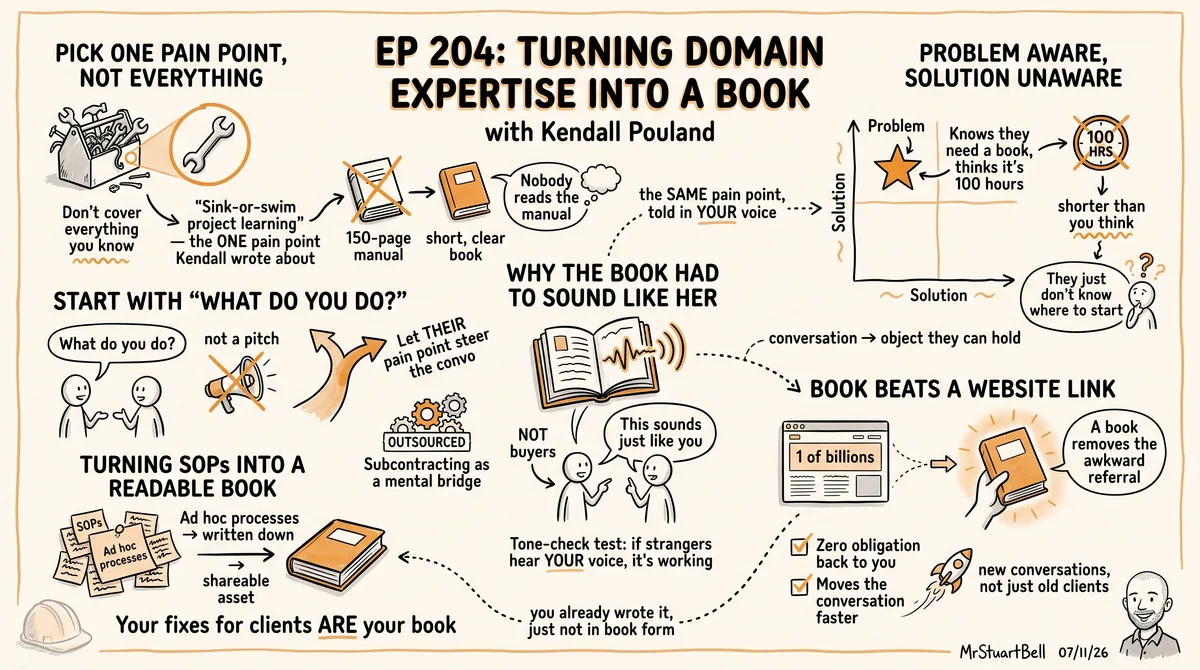
- Pick one specific pain point to write about instead of trying to cover everything you know.
- A book removes the awkwardness of a referral because the person can decide for themselves if it's useful, with zero obligation back to you.
- If two people who aren't your buyers say 'this sounds just like you,' that's proof your tone is landing right.
- Being problem aware but solution unaware is often the real gap. People know they need a book, they just think it means 100 hours and a huge time cost.
- Start conversations with 'what do you do' rather than pitching a broad service, then let the specific pain point they name guide where you go next.
- A website gets forgotten in a sea of billions of other websites. A physical book in someone's hands moves them down the conversation faster.
Kendall Pouland helps construction companies and general contractors fix the processes they built on the fly, back when there was no time to write anything down. She calls it faithfully helping builders grow, and for years the idea of writing a book about it sat on her bucket list, feeling too big to actually happen.
What I like about this conversation is how ordinary the starting point was. Kendall wasn't chasing a book deal or a big platform. She had a specific pain point she saw over and over in construction companies, the sink-or-swim way people learn to run projects, and she turned that into a short, clear book instead of a 150 page manual nobody would read.
We get into why the book had to sound like her, not like a generic industry guide. Two early readers, neither of them buyers, told her it read exactly like her voice. That's the tell that the tone landed right, and it matters more than people think when you're trying to get a stranger comfortable enough to take the next step with you.
If you've got real expertise but no idea how to package it into something that opens doors instead of just sitting on a shelf, this one's worth your time. Kendall also talks through how she's using the book right now, fresh off the press, to start conversations with people who were never her clients before.
Transcript
AI transcript provided as supporting material and may contain errors.
Stuart: Hey, everyone. Welcome back to another episode of the show. It's Stuart Bell here, and today joined by Kendall Pouland. Kendall, how you doing?
Kendall Pouland: I'm great. Thanks for having me.
Stuart: real pleasure. I'm, excited as always to share people's stories 'cause I think it just makes it much more real than kind of theoretically people understand that a book is a book is a good thing to have and how useful it is and how they can bridge their ideas into something.
Kendall Pouland: I- yeah.
Stuart: It's always that interesting position. My background is completely different industry but similar in the sense of coming from big corporate organizations and then moving into the smaller business world.
Kendall Pouland: Yeah. You know, I think,even in the smallest companies, they all want it, you know? I think they're all... Nobody's clueless. They know that they need some of these things, and they know that the bigger guys are doing it. but they don't know where to start, you know?
Stuart: Right. That hitting that right balance of where the, where the biggest return is for those first initial steps and then iterative improvements after that. How, do the conversations usually start? I was just talking to someone else before this call and talking about kind of aware, unaware- matrix of solution problem unaware, problem aware, and solution unaware, and solution aware.
Kendall Pouland: you know, I think most of them do know there's some problems, either now or they're scared to scale but, and then there would be problems.
Stuart: Right.
Kendall Pouland: Right? Not turn over the tables.
Stuart: Yeah, exactly. That kind of evolution not revolution. Yeah. The idea that, particularly I think when organizations are busy, like any idea of trying to make revolutionary change when the, all the plates need to be kept spinning, it's almost overwhelming 'cause you see the end where you wanna get to, but those- piecing the steps in place.
Kendall Pouland: So, we'll do some work as, as fully scoped out projects, but what I do for a lot of people is more like a retainer style.
Stuart: Yeah ...
Kendall Pouland: you know?
Stuart: Can share that. "This is a
Kendall Pouland: problem.
Stuart: Yeah. It is interesting, isn't it? I don't know that there's a... kind of the French general word covers some of this now, which has had a little bit more traction out there than it did before. So we have a similar issue.
Kendall Pouland: Yeah.
Stuart: Like, the fractional piece, maybe that's kind of close.
Kendall Pouland: I, I'm gonna- I'll touch on the word subcontracting second, but I believe they are used to doing everything in-house. And it is- Okay ... and I was very concerned about that when I started my business, 'cause we had no, what I call, you know, independent contractors hardly. For very specific things here and there, you know, people will outsource IT, managed services.
Stuart: Right. Which is funny, isn't it? Coming to it as an outsider to the industry, I mean- some broad awareness of what the industry does. yeah. But I would, my assumption would be knowing how much subcontracting is a thing in the area, in the industry, that even if they didn't realize that your specific discipline was an option, still the idea of subcontracting the back end thing would be less of a jump.
Kendall Pouland: Yeah.
Stuart: So that, that bridging from, they know that they've got a problem, but they don't necessarily know what the solution or the fixes are. How... We'll get to the book in a moment, but how in the past have you started those conversations with people? Has that been specifically targeting people on specific problems, or more broadly talking about the solutions and seeing who's interested?
Kendall Pouland: let's see if I can... If there's a way to summarize it 'cause it- Everybody's unique. Right. and it c- we c- they come from different places and, people are currently in a different spot in their business, than others. a lot of times what we kind of start off just talking about, "Hey, what do you do?
Stuart: yeah. It's like a big stack of Post-Its in a digital sense.
Kendall Pouland: yeah. Yeah. I mean, a- and that's a good question. How much do you have on paper? You know? But right now- Right ... it's usually like, "Oh, no, we're all digital.
Stuart: above zero, but there's lots of opportunity here. We can do some
Kendall Pouland: exciting things. that's right.
Stuart: Yeah.
Kendall Pouland: so yeah, I mean, I guess that's one example. Like I said, everybody's a little bit different. but you know, just like a lot of fractional consultant types, the question is where do you have the most pain as a leader, right?
Stuart: It's interesting, isn't it? There's such a broad footprint. I think it gives such an opportunity to put the ideas out in the world, to have those bridging ideas out in the world. That there's a pain point here that we can articulate in their language, and there's a bridging conversation towards a solution.
Kendall Pouland: construction- Well, right. I do have- ... kind of
Stuart: construction
Kendall Pouland: this, everybody's... A- and luckily, most construction companies, GCs in that category, they generally have the same processes, right? Because- Mm-hmm ... there's some expectation in the industry that these are the, this is how you work. And same with subcontractors, they all have very similar processes in a lot of ways.
Stuart: Right. And that's the interesting point is- I
Kendall Pouland: don't know if that answers your question. I think I got a little- Yeah ... off track.
Stuart: no, definitely. I mean, particularly from the, well, I guess there's one point that we'll loop back to in terms of the, that outreach to the people. But the solution providing, and as soon as someone raises their hand and you meet with them face to face or-
Kendall Pouland: Right ...
Stuart: robot face to fa- robot face. But as soon as you're kind of there seeing the eyeballs of someone, that's having enough, bandwidth isn't the right term, but having enough processes or skills or knowledge or understanding or frameworks in mind so that you can not get drawn into the one size fits all with such a 2,500 options.
Kendall Pouland: I think it's easier for,for companies, for leaders to, to see that you're the right fit if you're selling the exact thing they need right then, right? Mm-hmm. And so one of our services is training on project scheduling. And so a lot of times that will hit home with certain people that, that we, that's some- that is exactly something we...
Stuart: we're-
Kendall Pouland: Yeah ... trying to help with, you gotta get in the right door at the right time.
Stuart: And picking the campaign for now. So it might be that, we were talking t- just at an event the last couple of days that we were running, and there was a coach person there, like a business coach person there, and this was the conversation that they were having.
Kendall Pouland: Yeah.
Stuart: So that's
Kendall Pouland: that one- And trying to find out what's, what is the right thing to focus on, right?
Stuart: Yeah ...
Kendall Pouland: just to say you help with systems is not gonna get anybody's attention.
Stuart: That's... I've had that. I wrote a post a couple weeks ago on the blog and the image for it was, if you try and talk to everyone, you're actually talking to no one.
Kendall Pouland: Yes.
Stuart: And kind of the idea of the microphone just broadcasting and it not really going anywhere. Yeah. But the face-to-face conversation is much more specific. So I wanted to talk a little bit about the book. So give us a little bit of background on, the idea of writing the book in the first place and the dialing in the...
Kendall Pouland: you know, if I look back real hard,I think this has been on my bucket list for a long time, right? But almost to the point of, it felt way too big. Like it would be easier to knock off my bucket list of going to Italy than it would to be- ... to writing a book, right? And so, wanted to do it, but never felt like it was possible.
Stuart: Mm-hmm.
Kendall Pouland: And so it was like, whoa. I never, you know, never crossed my mind.
Stuart: Right, a real
Kendall Pouland: job. Yeah. and so, so that was part of it. And then, my chair heard that conversation and go- and got me in touch with, her husband actually, who had, worked with you guys before.
Stuart: Right. It's so interesting, isn't it? That separation between... And it's funny you mentioned James Clear because the guy who was at the meeting the last couple of days was, again, using that as the example- Oh
Kendall Pouland: Yeah. Well, I don't think I answered the other half of your question now. Okay. I talked a long time about just the first half of your question, which was why I decided to write.
Stuart: one.
Kendall Pouland: Yeah. Yeah. And so that's, I've been in that position. It was a s- a sink or swim, and I am not throwing stones at anyone. It's, that's how a lot of businesses are on the, they call it on the job training, which sounds nice, but it's not. and so yeah, I think I was trying to solve that problem. my personal, motto, my personal mission statement for me is to faithfully help builders grow.
Stuart: Such a perfect introduction to it because the, the- Could be taking a slightly dry topic of SOPs and processes and procedures.
Kendall Pouland: Yeah, for sure. I won't leave... I think for managers, it scares them. Like, that yes, we know we need a really great, you know, manual, but that sounds like a huge time investment- Mm-hmm ... and I need my people to be doing their jobs and building buildings and, or roads or whatever they build, and not writing procedures, you know?
Stuart: That accessible piece, I mean, the idea that as a, someone, as we started talking about, they're problem aware, but they're solution unaware, and that gap is maybe just looking at other, Like for James, go back to the book example. Like, problem aware, I know a book would be good to, to, increase the visibility and the authority and the presence. But solution unaware, thinking that the solution is a traditional 100, $150,000 book and six months of waking up at 4:00 AM to- Right ... edit something by candlelight.
Kendall Pouland: Yeah. That made me think about, you know, we all have the things that we know and that we're good at, right?
Stuart: And it's almost in, empowerment's not the right word, but it's, the conference we were at the last couple of days, the person who was chairing it was talking, and they were giving an example of, a marketing campaign that they had done for a company that was
Kendall Pouland: Yeah. I've had, and it was actually a female-owned GC, which is not very common. you know, and it was, again, she was problem aware that I know this is something I want, but I feel like I'm gonna have to sit down for 80 hours and- ... you know, get everything, and I-
Stuart: Right ...
Kendall Pouland: and I'll...
Stuart: And all of their domain expertise, they could be just focused or tweaked or the thing that you can bring is your domain expertise just...
Kendall Pouland: think. No, I mean, no doubt. I was talking to somebody yesterday who had a copy of my book, and they were like, "Well, how did you..." I, so I teach at Texas A&M, and it was a student who, who had seen the copy, and he's like, "Well, how did you... The cover, and like, how did you get it on Amazon?
Stuart: Right ...
Kendall Pouland: for sure.
Stuart: And then it's out there. And then it's out there. Which is the main thing. I mean, we joke a lot of times, like, the book i- or not joke, we say a lot of the times that the book isn't the product.
Kendall Pouland: Yeah. That's where we're at now.
Stuart: That's where we're at now. Trying to get it out there and start those conversations. Yeah. So let's talk about that a little bit. So we've, we're literally just hot off the press in terms of getting it finished. We were talking last week about the idea of getting it in front of people.
Kendall Pouland: so, so like I mentioned, we do several services, and so, you know, some of that first group is people who we have done other services for, who, you know, we're already friends and hopefully trusted advisors for. but this was not one of the services that, you know, that we did for them.
Stuart: as you were describing that, that is one of the things we spend a lot of time talking to people about. The kind of cover title is the most important thing because it, that's what stops people in their track during the day.
Kendall Pouland: Right
Stuart: reinforce that this is broadly the right area. I'm gonna give it to someone rather than- Chuck it in the trash, sure.
Kendall Pouland: Yeah.
Stuart: Though who chucks a book in the trash? but anyway, that moving people down that conversational journey faster and more efficiently. Again, the same words on a website or on social media, it just doesn't have the same effect as being brought together on the pages.
Kendall Pouland: Yeah. No, you're right. A website's easy to make, and it's easy to, you know, send that link out to a bunch of people. But it's one of eight... I don't know how many billions of websites out there, and who's- Mm-hmm ... unless they're gonna bookmark you, which is not very likely, you know, they're not gonna come see you again.
Stuart: Yeah. E-Myth. I don't know how many of copy of the E-Myth- E- yeah ... I've given to people over the years. Right. And again, I think that is a great example, although, I mean, a traditional book. But that conversational, easy to enter into the idea, I think that was the thing that resonated differently from that book at the time compared to some of the others.
Kendall Pouland: report? I
Stuart: don't think so. I'll send that to you afterwards. and for everyone listening, just so they don't feel like they've left out, I'll put it in the show notes as well. So this is a, something that Dean wrote years ago.
Kendall Pouland: Yeah. I actually, I shared that with somebody after we talked, so it definitely resonated with me. I also probably read somewhere, that... I should know where, but I don't remember. that if you ask somebody for a small favor, nothing big, but like, "Hey, can I borrow a pen?" Or, you know, "Can you give me a sheet of your paper?"
Stuart: I guess it's that you're giving them the opportunity to provide more value and feel more- Yeah ... important or useful in society.
Kendall Pouland: Yeah.
Stuart: I think that probably- Not meanness ... resonates with... Right. no, exactly. Yeah. And particularly I guess when... I don't want to steer the conversation too much, but particularly when you think about anything that is, community or purpose-based, the people who are on board with you on the train, the kind of- Mm-hmm
Kendall Pouland: Yeah. And they're not even making their friends talk to me 'cause they, their
Stuart: fr- Right. yeah, exactly.
Kendall Pouland: Sometimes I feel, you know, weird making an introduction 'cause it's like, oh God, I'm gonna sick that person on them.
Stuart: salesperson." And they're gonna feel obliged to you and they're, they... You've got that s-
Kendall Pouland: Yeah
Stuart: even with, like you say, even with the person you know is the very best- Yeah ... and you would love to have over round for dinner and you'd have no qualms about that. But still, sacrificing someone else's details and then being out of the loop completely, knowing that there's some commercial intent in that conversation- Even when we have 100, well, 99% on board, there's still that little bit of hold off, which again, another reason for Why the, a book is a fantastic tool for that mechanism 'cause you're just delivering value without the,
Kendall Pouland: Yeah, and it's
Stuart: totally up to them
Kendall Pouland: Right?
Stuart: yeah.
Kendall Pouland: Now it's completely up to you if this is helpful and you wanna take it to another step.
Stuart: Yeah, exactly. this has become a meme. I always finish this podcast by kind of looking up at the corner of the computer and realizing that we've been talking forever-
Kendall Pouland: I'm looking forward to that too. Yeah ... the only feedback I've gotten so far, and again, this is very new, right? But is, two different people have said, "Oh my God, it sounds like you." Like, I can... s- a buddy of mine- ... in my old company, he said, "Kendall, I can hear your voice saying this stuff."
Stuart: Yeah. Which is perfect. I mean, we d- we definitely try and do that. That's one of the things we're really keen to, to do. But it's sometimes it's difficult because you lo- do get from a mouth to a recording, to some words, through editing, it can get lost a little bit.
Kendall Pouland: really glad to hear that from both of them. They're not, neither one of them are buyers, and that's fine. I would, don't expect either of them to be. you know, I just... And one of them's a, she's a graduate student at A&M, and she was like, she's going through it slowly 'cause she's in school, but she was like, "I absolutely hear you in this."
Stuart: funny. Kind of cool. Yeah. But that's perfect. I mean, that's a big check in the box that it's landing, the tone is landing it right. And when people do eventually jump on the call with you, that, marrying together is just gonna-
Kendall Pouland: Yeah ...
Stuart: gel the feel of the conversation.
Kendall Pouland: Yeah.
Stuart: it's weird. Podcasts, I listen to a number of podcasts, but you hear people on there and it's a weird experience that you know them way more than- They know you.
Kendall Pouland: That's interesting. Mm-hmm
Stuart: One last anecdote before we wrap. There was, Paul Ross who wrote the tiny little book called My Damn Toe Hurts. He's a podiatrist up in the northeast, so he's written three or four books on individual conditions, and this one, My Damn Toe Hurts. We did a podcast last year sometime, and we were talking about it, and he said there was a guy came in for the first consultation, was in the chair, and Paul's kind of down at his foot and manipulating all this, and they're kind of talking back and forth a little bit.
Kendall Pouland: Yeah.
Stuart: Yeah. It's, nice that it all connects together.
Kendall Pouland: Famous podiatrist, I guess.
Stuart: Right. Yeah. Yeah, exactly. Yeah. Yeah. For anyone with dodgy toes. Every time I tell the story, 'cause it al- always sticks out in my mind, so I do tell the story quite a lot.
Kendall Pouland: Dodgy is the condition. Yeah. Yeah.
Stuart: Right. Right. Yeah. Yeah. okay. It's been fantastic. Thank you so much for your time.
Kendall Pouland: So, probably the best is, LinkedIn, it's Kendall Pouland, so I know you're gonna include a link.
Stuart: Perfect. So. Perfect. Yeah. I'll put links to all of those again in the podcast player and on the website so people
Kendall Pouland: don't need to, Okay ... be taking notes. Just click straight through. We're on Facebook and YouTube as well, so Build Better Ways, is the company site for both
Stuart: of those.
Kendall Pouland: Yeah.
Stuart: Fantastic. Well, thank you so much for your time, Kendall. Everyone, thanks for listening in again. if you've got any questions about your own book and ideas of connecting to the audience, then just either hit up the website or hit reply to the email that we'll send out with this. And looking forward to working with everyone in the future.
Kendall Pouland: Thanks, Stuart.
Stuart: Thank you.