Chapters
Show Highlights
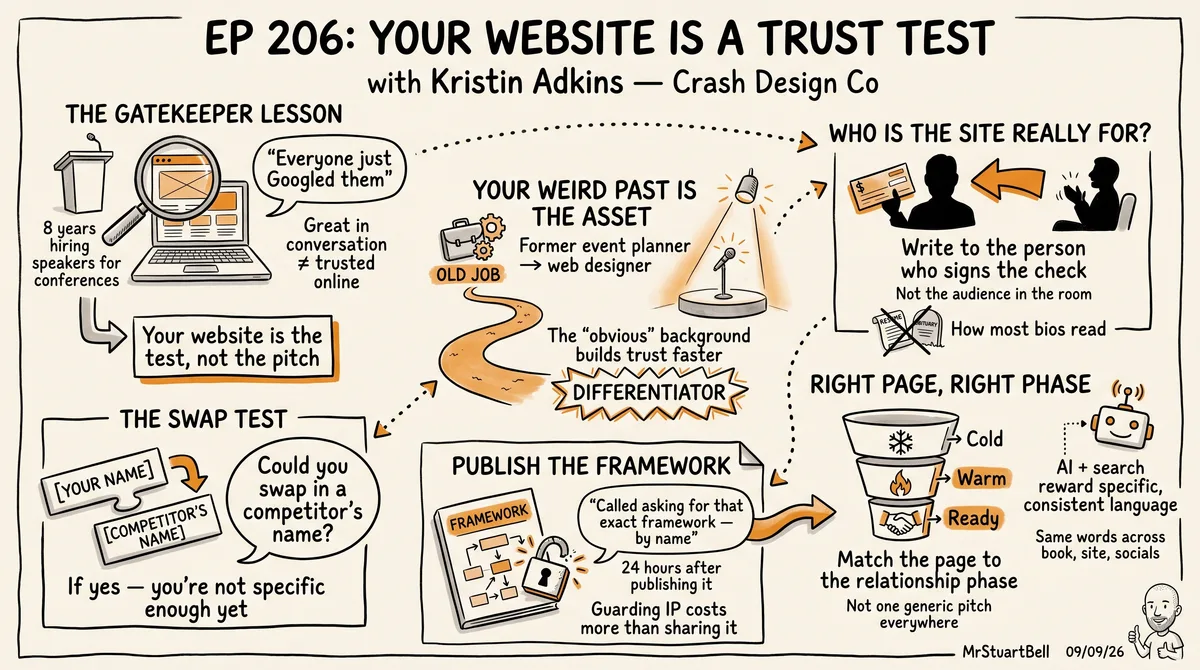
- Write every page of your website as a direct conversation with the person who writes the check, not the audience in the room.
- If someone could swap your name for a competitor's on your website and it still makes sense, your perspective isn't specific enough yet.
- Your past experience that feels obvious to you, like a former career or unusual background, is often the exact thing that makes people trust you faster.
- Publish your framework instead of protecting it. Being findable and specific builds more credibility than guarding your IP.
- Every page of your site should match the exact phase of the relationship the visitor is in, not repeat the same generic pitch everywhere.
- AI tools and search engines now reward consistent, specific language across your book, website, and social profiles, not broad claims that could apply to anyone.
Kristin Adkins spent eight years hiring speakers for conferences before she ever built a website. That gatekeeper seat taught her something most business owners never learn: the person deciding whether to hire you is not the person you picture when you write your own bio.
We get into why so many websites read like a resume crossed with an obituary, and why that kills trust instead of building it. Kristin explains the fix, write every page as a direct conversation with the specific person who writes the check, not a highlight reel of your accomplishments. That single shift is the difference between a website that gets Googled and dismissed, and one that gets you the meeting.
We also dig into why owning your specific angle beats sounding impressive, how frameworks make you memorable instead of forgettable, and why hiding your best material actually costs you credibility. Kristin shares a story about a client who didn't want his framework visible on his site. Within 24 hours of publishing it anyway, someone called asking for that exact framework by name.
If you're building any kind of trust asset, book, website, speaking one sheet, this conversation will change how you think about who it's actually written for and what happens after someone finds you through a search engine or an AI assistant instead of a referral.
Transcript
AI transcript provided as supporting material and may contain errors.
Stuart: Hey, everyone. Welcome back to another episode of the podcast. It's Stuart Bell here, and great to be joined today by Kristin Adkins. Kristin, how you doing?
Kristin: I'm doing amazing. I am looking forward to this.
Stuart: Fantastic. Me too. we got introduced through a mutual friend, Jamar, who's actually gonna be on the show next week.
Stuart: We kind of jumped you in before him. but it's always interesting speaking to people who I don't know deeply. S- same with some of our authors who path through the system, and I don't get a chance to talk to them beforehand because I think for the audience, I'm genuinely asking questions about what you do on their behalf because I don't know the answers either.
Kristin: Yeah. So- This is perfect, yeah ...
Stuart: yeah, exactly. Perfect time for it. So let's jump in with, introduction of, you and what the organization do because I think the crossover is... people will learn the crossover between what we're often talking about and what we're gonna talk about today. It's very close, so yeah, I'm excited.
Stuart: So yeah, give us the, the intro for you and y- what you do.
Kristin: Yeah. So I'm the founder of Crash Design Co. We are a web d- web design agency for professional speakers, and I started this business over five years ago because I used to be on the event planning side of things. I worked for- Oh, interesting
Kristin: eight years for a company that was doing conferences and conventions for hundreds of people throughout the year, and honestly, I struggled finding speakers. And then when we finally did get a good speaker, they were my favorite people ever. And so for a while, there were people that would reach out to me saying, "Hey, could I be on your stage for our events?"
Kristin: And I would have conversations with them. Maybe they wouldn't have a website, or they'd have a bad one, and then I would go to our board of directors, the big decision-makers, and I would say, "Hey, you know, this person is fantastic. They're everything we are looking for. I really think we should hire them."
Kristin: And of course, everybody did exactly what you would do if I said someone's name and just Googled it. And unfortunately, any conversation this person had with me didn't matter, and like even I was vouching for them. It didn't matter because their website didn't look good and didn't sell them or position them in the way that it should've to convince somebody else.
Kristin: And so- Right ... after a few of those, I got really frustrated. And when I wanted to start my bus- my business, I knew exactly who I wanted to help because of those experiences. So it's been five years now. I've worked with hundreds of speakers and, just some amazing people that were just starting out, people that have been doing it for years, and, the team has grown now.
Kristin: And so it's been a wild ride, and I get to work with the greatest people every single day.
Stuart: Fantastic. I think that crossover is so perfect because we spend so much time talking about the idea that- Quite often the business people that we're working at, working with have great referral businesses. They do great work for the people.
Stuart: They know what they do. They've been doing it for years. But the problem is that their presence isn't robustly out there. So in the past, it used to be that they could get past that bridge because it was a lot easier to get to the conversation.
Stuart: I don't know if it was the world was quieter or, there were fewer options out there, but you could, you often get to a conversation either from just a direct referral or from some minimum presence out there.
Stuart: And in the conversation, you were able to do all of those pieces. You could demonstrate- ... proof and evidence what you've done before and build that rapport. But the challenge now is definitely getting to that conversation piece, and without the presence, as you're talking about, without the perspective, which is often what I'm talking with people about, you need to own your perspective first as the baseline, and then move from perspective to presence to proof.
Stuart: The world is just a different place.
Kristin: Yeah.
Stuart: So the people who, the clients who you're working with, do they typically have something? Are they going from something to something better, or are they coming from nothing to something?
Kristin: It's usually a mix. I... Most of the people actually do have something.
Kristin: They have- ... something online that is trying to tell people what they do. the problem with it that I usually say is when someone does their own website, sometimes they have a tendency to talk about how amazing they are. Because they're used to resume writing, right? Like, that's the thing we've written that p- has put out into the world, or a LinkedIn profile.
Kristin: And so I go to websites and what I like to say is, like, sometimes it's a mixture between a resume and obituary- ... and it's nothing that anyone's trying to hire. So it's just, like, telling you, like, you know, just, like, spitting out all of your accomplishments or your experience, and it's not even telling the story to the person that needs to hear, like, the story.
Kristin: And you know, I, I- Right ... it's just so... There's just so much that we could get into of, like, just, you know, talking to the right people on your website is always the biggest thing. That's, like, where it always starts with people that I work with is whether you've had a website or not, like, what is the problem we're trying to solve and who are we trying to solve it for?
Kristin: And generally, that is the thing that trips somebody up the most right away, right? Right. So as a former event planner, if I saw a website that was talking about how amazing somebody was, it was like, "Okay, cool. You're amazing. I get it. That's wonderful. I'm not gonna hire you. I'm gonna go to the next person."
Kristin: But then if I go to a website and someone's saying, you know, like, "You are dealing with this problem, and here's why it's hurting you," and then, like, "I can be the one to help you with that," that sounds much more inviting. That's a conversation we would rather have in person-
Stuart: Right ...
Kristin: than we would rather...
Kristin: than, you know, than- Than
Stuart: just saying, "Hey, look
Kristin: at me. I'm great" ... someone telling them how good they are- ... or what they've done in the past. So-
Stuart: Yeah ...
Kristin: yeah, it's a bit of a mix, but they usually come from something.
Stuart: Yeah. It's always interesting, isn't it? People going from nothing to something that they've got a vested interest in because they created it in the first place, to them moving that onto something that's actually fit for purpose.
Stuart: So when they're thinking about who that audience is, who's going there, for most of the speakers, are most of the... I guess it depends, but are most of the visitors to their sites likely to be the audience or the event planners?
Kristin: Great question, because that is something where I think people get a lot, like really tripped up when they make their own website.
Kristin: The website should be for the people that write the checks. Right. The websites need to be like a love letter to the event planner, whether it's a meeting planner, a, a VP of HR, or whoever it is. I just say event planner. But it should be written as a conversation to them instead of the people that are actually sitting in the audience when you're on the stage.
Kristin: Because I think that, when, 'cause when you say the word you, right? We know people like to say you. That's a thing in marketing. You say you so someone feels like they're being spoken to. If you say you and then you start using language that doesn't make sense to them, they're like, "Oh, this isn't for me."
Kristin: And so as an event planner, that's what I found is we tended to hire the people that would say your people or your team is struggling with this thing, and not you are struggling with this thing. So that's one of the, the big things, so I'm glad you asked that, and that's always one of the things that I wanna make sure everybody knows.
Stuart: Yeah. It's so interesting. This kind of job of work and who the audience is, again, coming from the book side of the fence- ... we have a number of people who are speakers or c- I mean, caveat that. They're not speakers, they do speaking to support their business. The majority of the people that we're dealing with on our side of the business are business owners that are using either the books or speaking to get clients.
Stuart: Yeah. Their full-time event isn't... Their full-time thing isn't the speaking. So in that context, quite often talking to them about the idea that you've got these two audiences, because you eventually want clients, your main audience that the check writers are the people in the room- ... in the audience looking up at you when you're delivering it.
Stuart: So the call to actions, the next steps, the thing that you're delivering to them is the thing that they should take, the next step in making it easy and obvious for them. So the book structure is often the framework that they're talking about that is the easy next step that people can take to learn more about the conversation that they will have from stage.
Stuart: And on the other side of the book is then that we should work together and the steps from there. But to your point, to get on the stage in the first place, they're not talking to that audience, they're talking to the event planners or the organizers, and having a package for them that solves all of the issues.
Stuart: The, again, as an outsider, I see it as the event planners have got time to fill on stage, so that's the-
Kristin: Yeah ...
Stuart: the pure requirement. You need to be able to fill whatever the time requirement is they need. The subject needs to be relevant, but ideally as specifically relevant as possible to the audience.
Stuart: Yeah. It needs to be entertaining. But they also need to feel safe and that it's an easy yes. So if you lead with your example of the website that's all about me and how great it is, if you send them the resume, send them the letter, email, letter, hold on one. Send them the email saying, "Hey, I'm the best.
Stuart: You should hire me because of XYZ," that's less compelling, I imagine, than, "It would be great to give a talk to your people about such and such. Here's the exact framework. Here's the outline. Here's the book that supports it." "Here's the outcomes that people have had." So do you find similar thing? It's very much they need to understand pitching to the people and the, th- there is a kind of a, I don't wanna even say gatekeeper function because they are the check writers, but there is a- I,
Kristin: I've called myself the gatekeeper of my past...
Kristin: My past career many a times. Like, that's the actual word that I've said. but yeah- Right ... you do need to get past the gatekeeper, and this is... it's so interesting too to hear, like from your perspective as well f- from the book side and the speaking side, and I think it really comes down to what is the ultimate goal and how does, like someone get there, right?
Kristin: So we always talk about like, like customer journeys is a big thing in marketing, and so where is someone starting and where do they really wanna go? If the end goal is to be on a stage and speak and then go home and that's the end of it, then yeah, it's pretty obvious where we, who we need to write the, the website to.
Kristin: Right. It needs to be the event planner 'cause that's my final goal. When it comes to that, that second thing that we were talking about was like, you know, what's after the stage, or what's after the book? Like, what is the next step? Is it bringing you in? is it having you be, you know, a consultant or a coach or in some way?
Kristin: Then you do need to put that on the website as well. but it shouldn't be the first thing for a speaker because a speaker- Right ... i- a speaker that wants to be a consultant, 'cause we do need to get them to the next step first. and that's why on a website what I really like to do is make sure we're looking at every page a little bit differently, and like who is looking at this website?
Kristin: Because... or who's looking at this specific webpage, because we should have a page about consulting if we do consulting. We should have a book page if we have a book. Like, you know, we should have those things, and then talk to the people as if they are the audience for that one thing. because you can say, you know, if a speaker, 'cause this is my world so this, these are the examples I know, is like a speaker can talk about- communication and, you know, be on stage and talk about how teams that communicate better, you know, perform better.
Kristin: Cool, that's great. Then you can also bring them in and they can work on communication as a small group and really, like, just get integrated into your C-suite or whatever it is, your team. And so we need to make sure we're planting seeds throughout of like- Yeah ... "Hey, this is the final thing." But then every page should be written in a way of like, okay, what phase are we at now?
Kristin: 'Cause if we're gonna talk about the consulting, then yeah, we can talk about, hey, your team. We're gonna really talk about these things. It's gonna be interactive. It's here's the frameworks that I have for this type of thing, where it might be a little bit different if we were talking about speaking side of things.
Kristin: So- Yeah ... it's a good distinction to have.
Stuart: I think that understanding the overall picture, the job of work of what you're trying to do, I mean, it really makes a difference. It, I often say, like, book, doing air quotes for people just listening.
Kristin: Yeah.
Stuart: Book is a pretty broad category. And speaking, again, pretty broad category, and if you try and kind of just bucket it all in one thing, and either you as a small consultant who's using speaking as a gateway to conversations, trying to do the things that big stage speakers where their career is speaking, if you're trying to do those things without thinking about how it fits in, what's the minimum effective dose or the right sizing for the thing that you're trying to do.
Kristin: Yeah.
Stuart: Just bucketing them all in, "I need to do this 'cause that's what I see someone else do," without thinking, well, someone else is actually doing something else. They're just using the same mechanism. and imagine cause quite a few problems. The same goes for the websites as people- Oh, yeah ... are kind of rolling them own, rolling their own.
Stuart: They get too You can't see outside of your own site. Like seeing every page and all of the machinations of how it's set up, really then difficult to look at the user journey and how one person is getting to that- ... and which piece of it they're seeing. Yeah. And the same with the talking and s- the speaking itself, like setting that up to the right level.
Stuart: So tell me a bit about the people that you, like the ideal clients, the people you're typically working with. Where are they coming in and where do they leave?
Kristin: Yeah. so a lot of my clients, the typical client that I bring, that I have is, has been doing this for a few years. They have a proof of concept, right?
Kristin: Like they know what they're trying to do. They're just simply not getting on the stages that they think that they deserve. And maybe they're like applying for speaking gigs or they, you know, it's just not, they're not getting the yeses that they want to. And so what we do is, you know, think about that problem.
Kristin: You know, what is the problem that you solve and who are you solving it for, and being really specific about that. a lot of people that come to me are leadership speakers, and those are their words, not mine, because I say I meet three to five a week of leadership speakers. Like, what is the actual perspective that you're bringing in, and what's the actual problem, right?
Kristin: Like a leadership speaker's end problem that they solve might be burnout, and they're just not describing it well enough. And so what I do is we work, we do three things. We do strategy, copy, and design. They all have to work together, in order to have a successful website. And so the strategy, is people, the...
Kristin: Yeah, you have a proof of concept and you can talk to somebody about it. Because how I start with a project is you're gonna have a 90-minute conversation with me, and that is how I pull the copy out of it. Because speakers are really good at speaking. They might not be so good at giving, you know, writing a prompt or, you know, looking at a blank page and me saying, "Well, I need your website content."
Kristin: Right. It just doesn't work that way. So what I do is just have a conversation with them, and usually they have a few... They, yeah, they have proof, right? So they have proof that their concepts work, their frameworks work. They might have a book. A lot of them do, and so that's always good to bring in and everything.
Kristin: And then, Usually like years-wise it's about three, over three years of trying the speaking thing. And I do work with new speakers as well. but our main signature process is the let's have a strategy call, let's really do this and then I do websites in a week because this is not something that like we, we really should be holding off and like waiting- Yeah
Kristin: forever to do. So we do like VIP weeks with people. but it's people that are looking, yeah, to get on a bigger stage. Maybe they have a conference coming up. Maybe they're just sick of hearing no too much. and then would like to stop the grind of everything, like every single speaking engagement or every single sale that they have on their website or whatever it is.
Kristin: If they're just sick of the grind, Yeah ... you know, with websites the beautiful thing is AI and SEO now. Like i- if you work with somebody who understands that, I mean, I'm getting people that are getting speaking gigs right away because of it. And it's like they had it, you know, the whole time. They just needed someone to amplify it.
Kristin: Right. And so that's, those are my people that I love working with are-
Stuart: It's
Kristin: that- ... people that wanna make a good in the world too. Right. Just a side note.
Stuart: yeah. It's that, knowing where their expertise is. Like their expertise- Yeah ... that gets someone on the expertise that makes someone on stage a good speaker that's engaging with the audience and has a real story or framework to share-
Kristin: Yeah
Stuart: is oftentimes quite different from the prior step of, okay, well how do you get in the door on that? 'Cause it's just different skills.
Kristin: Yeah.
Stuart: And to- Like
Kristin: you're not just telling a story, right? You're not just going on stage and being this... I mean, what people think a motivational speaker is, but a motivational speaker, a good one, is like really teaching you as they go and everything.
Kristin: But I think a lot of people just wanna get on stage and tell their story. But once they've really shaped it and they've worked with somebody, you know, that has been able to put words into what they actually teach, like those are the people that are just the best to work with. Yeah. 'Cause they're the people that are going to see success afterwards.
Stuart: Yeah. Yeah. Unique ability and knowing where your expertise lies. Yeah. Yeah. you were talking about, you mentioned perspective there, which is the foundational level of the high trust, Yeah ... the high trust set up because it is so fundamental because it sets the scene for everything else.
Stuart: So building the presence on top of it and the truth that reinforces it. The- The challenge now, we were talking earlier a little bit, it is just a noisy world. Yeah. It's difficult to cut through. So you mentioned meeting three or four leadership speakers a week. Yeah. I mean- Yeah ... that name is somewhat, well used and doesn't set a particular perspective.
Stuart: So do you find it i- or how important is it that people have a unique perspective, or if their perspective itself isn't very unique, that they really own that perspective so it's very clear what they do, as opposed to everyone else who might be in the same bucket?
Kristin: Yeah. And i- in terms of how important it is, not to be dramatic, but I think it's make or break.
Kristin: I think if you have... If you just drill into your perspective and really, like, just make sure people know about it, you're going to see success. You're gonna be start- and being known for something. ... and so I think that's the biggest part, right? and whether you're writing a book or trying to be on stage, it's what is so unique about you that people should listen to your, you know, p- your perspective, your words?
Kristin: and so that is the biggest one that I am always encouraging my people to just drill down in, and then, and I'm asking them, you know, "What is unique?" And sometimes, you know, if you get asked that, you're like, "I don't know."
Stuart: Right.
Kristin: But like, you know, sometimes it'll just come out in a casual conversation of, like, "Oh, you know, my background."
Kristin: and like, when I started my business, I really didn't lean into the I used to be an event planner thing. I was just like, "I like speakers, and I wanna work with them." And it was un- It wasn't until I was like, wait a minute, like I actually used to hire them. Like, I- ... I really do have something, a, a part of this.
Kristin: Like, that's when it started to turn because that gives me a little bit more authority. And so- Yeah ... that's why for speakers or authors or whoever, any kind of thought leader that is trying to build trust with somebody, you know, leaning into your past, leaning into what other people have said about you, you know, showcasing that you have different assets like a book, a podcast, a media, whatever it is, it just continually shows that you have perspective in this noisy world.
Kristin: Because we're all- Yeah ... using the same buzzwords, and buzzwords can get you a little bit, but it's not gonna be the thing that gets you to be a bestseller or, you know, a big sellout stage type of person.
Stuart: Yeah. Because it's on, it's diluted. The message gets diluted- Yeah ... if it's the same as all of the other signal that's out there.
Stuart: It's so funny you mentioned the event planner. You didn't anchor on that to begin with, but literally we've been doing this for, 12, 12, 13 years, helping people write books, 12 or 13 years. Which in itself- Yeah ... is a fair chunk.
Kristin: That is amazing,
Stuart: by the way. And we've done... Yeah, so we've done, d- close to 13,000, 13,000, 1,300 books.
Stuart: Wow. 1,300 books.
Stuart: It wasn't until last year that I was doing some perspective-based work to kind of reinforce, Reinforce the things that I was putting out there. It's why this podcast turns to the High Trust Business podcast rather than the Book More show.
Kristin: Yeah.
Stuart: In that work, I was going back and forth with a robot, and the robot said, "Well, the fact that you've done 1,200 books, I mean, that probably means something."
Stuart: And it was almost like, I mean, it was comical how much of a, "Oh yeah, that's true." Yeah. And I imagine it's the same for you. Someone pointing out that, "Oh, well, you used to do this, so that seems-" Yeah ... quite important.
Kristin: Yeah. And- So you have that experience. I've had this experience. Yeah. And then everyone I work with has the same experience.
Kristin: Sometimes you just need someone else to mirror it back to you- Yeah ... and tell you, like, "Hey, by the way, that is amazing." 'Cause I think what we- Yeah ... or, you know, we're always in our head, and we always know how we did something, so it's less amazing 'cause we know every step- Right ... that we did. '
Stuart: Cause it's there all the time.
Stuart: Yeah. It's not something unique. It's just the baseline, but why doesn't everyone do it like that?
Kristin: Yeah. You're like, yeah, you're like, I just did that thing." Like, it's whatever. Yeah. No, obviously. Let's move on. And then people are like, "Wait, no." Like- Right ... we wanna hear more about that. And so, yeah, it's-
Stuart: Yeah
Kristin: it's a huge part
Stuart: of it. It's such a f- such a funny realization. And I don't know, I mean, again, not wanting to harp on too much about it, but I mean, it seems stupid, like 50 years old, doing this for over a decade, telling other people to do the same thing. But really, like literally,And you'd hear the, the penny dropping as the connection was made.
Stuart: Yep. And it's, "Ah, yeah. Of course."
Kristin: It happens to everybody.
Stuart: Right, yeah. So funny. So that, you can't see it from the inside. You can't read your own label. A- ... friend's just written a book based on that subject. You can't see it yourself. It really does need someone else. So that benefit that you bring to people to help bring that out in them.
Stuart: Yeah. And knowing that they need a unique perspective, but people get hung up on... It's like looking at a blank page. They hung up on the word unique thinking that, "Ah, everything's been done in the past," but failing to re- recognize the way that they do it is unique, or the stories that they're bringing, or the position that they tell it from, the, the overall perspective.
Kristin: Do
Stuart: you find that unique element is not necessarily that it needs to be world-shattering and never been done before, but it's more about their experience that they bring to it?
Kristin: Oh, gosh. Absolutely. I don't know if I've talked to anybody that's ever done something that no one else has ever done before.
Kristin: You know? Like, it's just how you did it, right? Like, I have speakers that were in debt, and then they worked themselves out of it, right? And now they share how they did it. And s- you know how many people have gotten out of debt? Like, it's just, it's simply, like, how you did it and how- Yeah
Kristin: maybe, like, a mom's perspective is gonna be very different than, you know, like a young couple or some- like, or a corporate man. Like, there's just so many different perspectives that, like, you can lean into it. And that's why I love, on the website side, is to really, like, make sure that's obvious because I then go back to thinking about when I was trying to hire speakers.
Kristin: So, the, the company that I worked for, we did sales and marketing training for college students. And so that, it was very specific. So if somebody didn't say they were a college speaker or that they've spoken to colleges, I automatically didn't trust them with my audience 'cause it's a very different audience than a corporate world.
Kristin: And so, like, yes, the, like, the perspective's amazing, and then to go one layer deeper, it's like, who are we talking to? To call them out just makes it, makes you more successful, makes it more like- ... this person's like, "Ooh, I, I really do wanna talk to them for so- like, about something." And so that was one of the biggest things that I learned from my past that I try to teach someone.
Kristin: It's like... And I tell that story all the time in my strategy calls. It's like, hey, like, if you didn't say you were a college speaker, if you didn't say that you've, you know, helped people with- recruitment because that is a word that college kids use. They don't use hiring. And so, like, if you say recruitment, okay, I feel a little bit better.
Kristin: I feel a little bit more safer about bringing you in to my audience. And so, yeah.
Stuart: That's the, right, that's the thing, is making the other person feel safe and a, a quick decision.
Kristin: Yeah.
Stuart: Like, you might know that you've done all these things, and if people only spent 20 minutes looking, then they'd find it.
Stuart: I mean, true, but who's gonna s- I mean, are you going into a cold relationship expecting them to dig around for 20 minutes before- Exactly ... they might happen to connect all of the dots that- ... that you're
Kristin: seeing? Yeah. I mean- 'Cause you're like, "Oh, they'll know my story. they'll read- Right
Kristin: every word of my website," right? Like we all totally do that, right?
Stuart: yeah. We've all got all of that time in the world to go digging- Yeah ... around and digging around.
Stuart: It's funny 'cause the same people might not, write a resume in that way. They would anticipate that a resume needs to be ta- well, maybe not.
Stuart: They might anticipate that a resume needs to be tailored for the individual organization, and- Yeah ... your general background should be tailored and the language switched. Yeah. But they don't necessarily think about it. They see, again, going back to the book analogy, website, book, speaking- Yeah ... one big bucket of one thing.
Stuart: And everything is just hanging off the edge and people need to find their own way in as opposed to no, no, all of this needs to be tailored to remove the friction as much as possible all the way down the chain.
Kristin: Yes.
Stuart: Right from actually the cold outreach to the turning up to the having the, material ready to go to making the Don't turn up like a di- I would imagine.
Stuart: Don't turn up like a diva. Be helpful and get it done and then give the audience some value and something that goes beyond-
Kristin: ...
Stuart: what might people think of as just the main delivery of a talk. Yeah. Adding that value after the sale almost.
Stuart: Because I would imagine what the planners want is the feedback from their people, the feedback from their guests, the people who are writing checks to them- to say, "That was the best event ever. Thank you for setting up. It was life-changing."
Kristin: An event planner is putting, pretty much putting their job on the line every time they hire a speaker when it comes to big events like conferences and stuff. Like, maybe it's not so, like, cutthroat, but w- the person that comes in and comes on stage is a reflection of the person that hired them.
Kristin: And so, like, yeah, and we talked, we've talked about trust and all of that. Like, d- some- if someone's job is, like, their reputation's on the line, they want to trust you, and so we just need to give them so many reasons to trust us. And
Stuart: I think even more so these days, overwhelming reasons. So part of that, part of the overall high trust business and the ascent that people go through, customers go through in order to get to yes, that conversation piece that we talked about before where people in our world would get to conversation quickly- and then be able to do all of the other pieces like the presence and the freef- and the rapport building in conversation. But then there's a confirmation stage afterwards- ... where they would say, "Hey, that's great. Let me think about it," or that, that let me think about it stage might be quite quick, but it's still happening in their head.
Kristin: Yeah.
Stuart: But increasingly, that step, that confirmation step, is being done with a robot assistant. So they're gonna ask, increasingly ask, their trusted advisor, which is their robot pal that's either in their phone or on their computer- ... "Hey, I'm thinking about doing this. Tell me about such and such." And if all of that presence, that perspective, if you haven't removed all of the friction all the way down, then the human bit might pass, but the robot bit will fail- Yes
Stuart: because it will say, "Oh, great, we had a good conversation. Sounds like it might be a good fit, but actually I can't find anything that reinforces what you've said." "And actually, here's three other people. Have you thought about them?" And immediately, 'cause it's trying to be helpful- The, the house of cards falls down because- Yeah
Stuart: there isn't that base of perspective, and each layer kind of reinforces it so that there are no gaps in that system.
Kristin: Yeah. We gotta make the robots trust us now these days too. Yeah. I just did a workshop last week about being found on, like AI, like ChatGPT and stuff, and how speakers can raise their chances.
Kristin: You know, it's not guaranteed, but how you can raise your chances is to make sure you have, you know, y- the same type of language throughout all the things that are learning, like it's learning about you and it's all, it all stacks on top of each other from your social media and your LinkedIn to your book to your website to, you know, videos about you, to podcasts that you're on.
Kristin: The more you stay, like just if you have that distinct point of view and you just keep- Yeah ... saying it, the more your chances are of being found by the robots, which then the humans are like, "Ooh," like I, I trust that. Now I'm gonna look into it. And so that's where I come in of making sure what they do look into is good.
Stuart: Yeah. I think that perspective piece is the, gonna be the game changer over the next few years. Yeah. That element, because it is so noisy. There was the Google paper earlier in the year, which I'm gonna forget the name of, although I've quoted it so many times. ah, I can't remember the name of the paper exactly, but they put it out talking, the basic premise was the robots know all of the baseline facts are known.
Stuart: There's no difference. The baseline of your information, what you do, y- what everyone else is doing, what someone should know about it. The baseline questions are all known.
Kristin: Yeah.
Stuart: So what Google in this paper, what they're looking to index on is the difference. So the gap between, I'm kicking myself for not remembering the name.
Stuart: I'll link it in the show notes. Yeah. but this gap between whatever the baseline is, the 80%, which basically represents everyone in your industry, everyone's doing the same thing.
Stuart: But the difference, your particular perspective, is what they're now increasingly indexing on because as the robots know more about you and your search history, and as Google and the other robots are trying to provide you with answers that you would like, they've now just got much more context.
Stuart: If there's five financial advisors but one financial advisor was a single mom and dealt with raising a family in that way and the story talks- Right ... about that, and the person looking for it is that person, it's n- far less the case. it's even detrimental now if you're just trying to be the general advisor that does everything- because you just get lost in the noise. You get sucked down into that 80% that is just completely undifferentiated. The only successful way forward is knowing that those 100 people are your people and being absolutely the person who talks to those people more coherently than anyone else, as you say, across every platform so that perspective is completely reinforced with no gaps.
Stuart: And the, the footprint is much smaller, but the specificity is there and you become that one rather than trying to shout at everyone hoping that- and again, speaking of books, it's the same thing. It's knowing- Yeah ... that job of work that you're trying to do and that perspective. Often describe the, when trying to get people to see the analogy, thinking you're standing on the top of your office building and you're either shouting out, "Hey, I'm a financial planner," and hoping that someone's gonna hear you as they're walking past.
Stuart: Or you're kind of looking down with binoculars and saying, "Hey, Dave, I can help you with that specific thing that you need."
Kristin: Yeah.
Stuart: So that specificity, what's the balance between- the right amount of niche because for- ... I'm sure you have the same conversations. For me it's always, ah, I don't wanna be too specific 'cause I'm gonna miss out on all of these other people.
Stuart: So how do you overcome that with the speakers that you're dealing with?
Kristin: Yeah. I- that's a good question, 'cause that is something that comes up a lot is, you know, somebody has, like, the background in a finance business or something like that, and now they're speaking. They're, you know, it would be too niche to say you only speak to finance businesses, but you could draw from your experience as a finance person.
Kristin: I think you do need to say the words, but you don't have to absolutely say, like, "I only do that specific business." If you only, but if you only want to, then awesome. Then I'm like, I'm here 'cause I wanna watch it. Like, I wanna cheer you on as you drill in super niche. well, like, I mean like me.
Kristin: I don't do websites for anybody else but speakers. But I do see when it comes to, like, my clients, it is a we need to be specific But we don't have to say, "I don't do something." Right. You can just really continually say what you do, and then I think people will self-select that way. So like, you know, talk about your experience in a specific industry.
Kristin: Talk about, you know, "This is the speech that I give that's super helpful for this thing." from the website side, I like to put some of those words in because if someone says, you know, the specific thing or the robots are looking at your Google search knowing who you are that, that you could bring in that perspective, I think that's just the balance is don't say, "I don't do something," but- Yeah
Kristin: just highlight the things that you can do or that you do.
Stuart: Yeah.
Kristin: but if somebody- That's- I will say if somebody can take your name off of their website and put their name on it and it still could apply, then we're not specific enough. Yeah. Then we haven't told enough of our story or we haven't, you know, said enough of our perspective.
Stuart: Yeah. That's a great point on the swapping out the names. The same with emails and outreach. Yeah. We talk to people about that a little bit. I mean, specifically around the book side of things, but a lot of people are using the books as cold outreach, and you just see generic after boilerplate type content.
Stuart: And that test of just put your finger over the name and if nothing differentiates you, then that's a problem.
Kristin: I hired somebody to help me in my business. This is not any bit, like, relevant to speakers at all, but it could be. I hired someone because I had sent out a job posting for a company, and they specifically looked up where I lived, right?
Kristin: They were like, "Oh, you live in Wisconsin." They were like, "I live in Texas. Our... You know, you guys have all the beef cattle, but we have the best barbecue." And he said, I... He said something like, "I could make the best barbecue you'd ever have," or something like that. It was just something so silly. And then he went into...
Kristin: There was nothing else that different about him, but that got me in. I read the whole email. I reached out. I was like, "Yes." Like, and it was just something really specific. So-
Stuart: Yeah ...
Kristin: take that, that message and apply it to any other industry and it would work.
Stuart: I think it's that level of the future... Going off on a bit of a tangent here, but-
Kristin: Love
Stuart: it
Stuart: the future seems to be hyper-personalization.
Kristin: Yes.
Stuart: Because- The world is so noisy. There's so much stuff. I mean, if you try to consume everything, it's just far too much. So the hyper-personalization, and there's just evidence after evidence that's what people resonate and connect to, for good or bad.
Stuart: Like, the filter bubble problem is, I mean, there's no- th- that's not gonna get any better. So but the hyper-personalization of whatever we do within the kind of trying to keep it as human as possible, knowing that we're actually talking to real people. I mean, particularly speakers more so than, maybe not more so, but, but definitely to a deep degree, the fact that someone is speaking in front of a stage in a room full of people and there's a very human connection in that moment, I think that's going to live on as something more higher valued than just content generally speaking, which is digitally delivered.
Stuart: Yeah. Because that's gonna be the volume play. There's gonna be hyper-personalization in there as people are trying to cut through the noise, but the personal connection to the people in the room. But on the personalization, the hyper-personalization level, as much as you can do at every single interaction to make it as personalized as possible.
Stuart: I mean, I guess it's the same with speakers. If they deliver the exact same s- talk in every single venue, I would imagine that's not gonna go down as well as if they tailored it and personalized it for the group that's there.
Kristin: Yeah.
Stuart: So to take that one step further to the event organizers and the outreach that you're doing, and even one step afterwards to how do you engage with the audience after the event- I've often talked to people on the book side of things.
Stuart: Again, all of our client, all of them, I'm pretty sure all of them are really using speaking to the extent that they're using it as a gateway to conversations afterwards.
Stuart: And I've often suggested to them, have the thing ... If you can get the list of people at the event, that's one thing. If you can't, you need to capture those details and start that conversation.
Stuart: So rather than sending people to just some random landing page where they c- just the generic landing page on your website where they can download a, a copy of the book, send them to ... Give them a QR code or a dedicated link that goes to a page specific to the event.
Kristin: Yeah.
Stuart: And record the event like a personal thing.
Stuart: "Hey, it's Stuart here. I'm just recording this before the event. Super excited. We're gonna have a great conversation about it. Here's the asset, the, the thing that I'm gonna link to. I'm actually gonna put another video up here next week after the event based on what we talked about, so stick the details in here and then we'll follow up."
Stuart: So that opportunity to hyper-personalize it and keep the conversation going, that seems to be a big difference. I don't know if you feel the same on that human-to- I do.
Kristin: I mean, I have different business cards for different events that I go to. If they're, if it's a general person that's not gonna be a professional speaker, they're gonna get my general business card.
Kristin: If I have, if I go to an event specifically with a, a very specific organization which is, like, really into my niche clients, like I have a different one and I have a different landing page that QR code goes to, and it's a video of me saying, "Hey. So happy that we met at this event. Like, this was my favorite part," blah, blah, blah.
Kristin: Like all those things and maybe I'll just type it out, you know, so it's there. Like I'm looking- Yeah ... forward to. And then when I get home, you know, fix it up a little bit. But yeah, I think just a little bit of thought goes a long way. Yeah. And with speakers it is. It's, you know, 80% of your speech is probably gonna be the same every time you get on the stage, but that 20% that you pick up from talking to the event planner of like what their specific problems are, and even if you just call out a little bit about them on the stage, right?
Kristin: Like everyone loves that. I mean, think about a concert. If you go to a concert and- ... the artist has been to every city, and then all of a sudden he's like, "Milwaukee, I love you" The crowd is the loudest at that point. Yeah. Because they're like, "That's to me." And I think like- Yeah ... it's the same in a speaker or in any kind of conversation that you're having.
Stuart: Yeah. That element of just, you said that, just do that little bit extra and it goes a long way.
Kristin: Yeah.
Stuart: It constantly surprises me. And I guess if you don't know, you don't know, so I mean, some grace to if you don't know. But if you do know , then just that little bit extra effort- And thinking about the other people who are involved in it- not just being, "I'm doing my thing"- Yeah ... "and everyone else can get out of the way." Just doing that, I mean, that moves the needle so incredibly, because the majority of people don't do it. And I don't know if it's because they don't know, or they're too lazy, or they're too, I
Kristin: don't think a numbers game is fun.
Kristin: I don't... I just, for me personally, like, I would rather reach out to 10 people that I know, like I could really like have a conversation with or really connect with, instead of trying to reach out to 1,000 people that are just gonna be like, "I've gotten four of this email before." Like, I don't want this," and so yeah.
Stuart: Yeah.
Kristin: 100% agree.
Stuart: you were mentioning, a lot of the speakers have books already. Do you see... This is c- obviously we'll check with your guys as well, but for our guys that we'll share it with, a lot of them coming from the book-related thing. How much of a needle mover is having a book in terms of either closing a speaking event or even just kind of narrowing down that perspective so you've actually got something structured to talk about rather than talk about something completely disconnected?
Kristin: Yeah. I think it's a big thing. thinking back to the speakers that I hired, there's one that was just an all-star. Everything he did, like is what I feel like I based my entire career off of right now. Because it was just like, wow, I was impressed every single step of the way, and he had a book, and it was...
Kristin: And then he spoke, and then he gifted our people the book, and it was all like just this little ecosystem that just worked. We hired him back like three times. Like, and we didn't care. Like, everybody loved him because i- they were just like, "Yes," like, "He's knowledgeable," and all that. And so like the book was a big part.
Kristin: It... something that they can... they're tangible and they can take home after they speak. But from the event planner side, it's good to know that you've given some thought to this thing, right? Like, you have enough content and enough, like- Just advice or expertise or background about this thing to write a whole book about it, now I know I'm in good hands, right?
Kristin: So I think it's a big trust builder. And then on the other side, it's also like a ... talking about hiring and something if book people don't know, you know, if you're talking to a nonprofit, if you gift your book or sell your book to the group, that comes out of a different budget for most nonprofits. And like I'm not a financial person so don't take this as like legal advice or whatever it is.
Kristin: But if, in, in my past what I've seen is we maybe couldn't afford a speaker, but we could buy a specific number of their books in order to offset the cost, and it came out of a different budget. Interesting. And so like for me, I was like, yes, like that's great because protecting the budget for a small organization is the thing you hear the most.
Kristin: Right. So you have to just protect that budget. And so, there's a lot of different facets- Those insights ... that book brings in. Right.
Stuart: Right. And those insights, those small things that people on the outside wouldn't know- ... that's what makes the big difference in working with
Kristin: you. And book signings too is another thing that could elevate the experience of the event.
Kristin: So the event planner loves that. Like, "Hey, I'm gonna bring my backdrop. We're gonna do a book signing and a photo op and peop- ..." And like I- we did that for a, a speaker one time and it ab- it was a hit. And so like there's just so many things you can do with a book. I love when speakers have books.
Stuart: It's such a great
Stuart: So that budget conversation is something that hasn't come up in that particular context before. So we did some work, ... Did I introduce you to AJ Perkins?
Kristin: Not yet.
Stuart: No? so he is a good friend out in Hawaii in the west coast, so they do a lot of renewable energy related work. So he's actually on the technical side, but he's done a lot of work with the, NREL,I'm getting the name wrong, but the speaker conferences, the renewable energy speaker conferences out there.
Stuart: And he's done a lot of moderating from stage and is prese- so he's very good at- he's very good at this, as well as the technical thing, he's got the stage presence and is very good at sharing that conversation. So in their world, he crosses over the renewable space, crosses over a lot into the government projects and that- Yeah
Stuart: side of things. So we were talking in that space around that crossover between, there's the whole grant side of things- ... and then there's the whole business side of things, and connecting those two pieces together and the little- Yeah ... moving parts that need it. The nonprofit thing that you were just talking about, understanding that those budgets are different, so going into that conversation, almost helping them, knowing that might be a constraint, so giving that as another opportunity- Yeah ... to get the message out there. Yeah. Those little things
Kristin: Most groups have an education budget, and that is not- Yeah ... that can't be allocated towards a speaker, 'cause that's the event budget. But the education part of it, something that they're taking home, is- Right ... I- a huge advantage for authors.
Stuart: Yeah.
Stuart: Yeah, such a great ... Those little things are just the seeds that help people just accelerate things away.
Kristin: Yeah.
Stuart: They've got the underlying knowledge. They've got a message to share. The audience wants the answers to the questions. So sometimes just the mechanics of being able to stitch it together in a way that works.
Stuart: It's such a missed opportunity where just y- people just don't know, like rephrase this to this or suggest it in a slightly different way, and it would mean- Yeah ... that there was such a bigger outcome.
Kristin: Yeah.
Stuart: we talk about frameworks a lot because frameworks are easy to write books from because they effectively write themselves almost.
Stuart: I think from a speaking perspective, frameworks are also good for audiences because they're coming in, and within the l- window of time that you've got, you're trying to share with people something that might be completely alien. So frameworks give people hooks in order to kind of anchor themselves to, kind of like climbing hooks, going up a wall.
Stuart: It's anchor there, and then the next one, and then the next one before you get to the top.
Kristin: Yeah. So
Stuart: do you see, across all of the speakers that you work with, are frameworks a big thing that people are trying to kind of anchor these particular bits around a framework? Or is it more they come from a story perspective and they're sharing a story?
Stuart: I mean, I'm guessing the best then the blokes- Yeah ... but-
Kristin: Yeah. Yeah. I, so I'll tell you, I had a client come to me one time and he had this framework. he was telling me all about, like in our strategy call, he was talking about this is what I do on stage, this is what I teach people, all these things. He's writing a book.
Kristin: it was all of it. And I was like, "Awesome." And so whenever I designed his website, I put the framework right on the website, and he was like, "I don't want that on there." He's like, "This is my IP. I can't have this." And let me tell you, like out of context, most frameworks don't really make any sense.
Kristin: Like, you know? Like, you need the stories behind it. You need the, the digging deep into each step of a framework. And I was like, "Just trust me." I was like, "If you feel like you are seeing your IP being stolen somewhere, like we'll take it off, I promise." Within 24 hours of launching his site, somebody had called and said, "I want the framework."
Kristin: They didn't tell him a speech, 'cause he had multiple speeches that he could do. They called and said, "I want the framework." And he messaged me- Right ... immediately and was like, "Oh, you were right." I was like, "I know I was right," because we wanna see it. We wanna be trustworthy, right- Right ... for an event planner.
Kristin: So yes, most of my speakers will come with a framework. Right. And to me, I'm always like, "Can we please put it on the website? Is there some kind of way we can graphically show it on a website?" Because it's just, it's comforting as an event planner- Yeah ... but then it's memorable as an audience member.
Stuart: As you say, comfortable as an event planner and from the audience perspective, because it's very visually- Yeah
Stuart: I get what you're trying to say. Don't make me read or listen to an hour's worth of conversation or a thousand words. I can see it, and yeah, now I want to know more.
Kristin: Yeah. And the
Stuart: point that people- Like, what's that
Kristin: acronym? What are those steps? Right. What... Like, what's that thing that I can just look at and be reminded about what I read about or what I saw somebody say on stage?
Stuart: Yeah. Yeah, exactly. That point you said about people not wanting to give it away, we get the sa- I mean, it's less so now fortunately, but we used to get it all the time with books- ... and people saying, "I don't wanna give it all away." And I used to say to... I mean, going back 10 years, you used to see people...
Stuart: Honestly, this isn't anything special. I mean, you can't... All of this stuff is out there already, for the most part, and if the person who you're dealing with feels like you're gatekeeping, that you're holding back, that relationship isn't gonna continue. Obviously in the book you're not gonna give it all away, and giving it all away, what does that actually mean anyway?
Stuart: Because realistically, to do whatever you're doing requires all of the knowledge that you're bringing to it. It's very unlikely that you're gonna- That's what I was
Kristin: gonna say. Isn't it the point to give it away? Right. Yeah. Like, we create frameworks in order to give them away. Like that- Yeah ... I thought that was the point, but yeah,
Stuart: so.
Stuart: Yeah, exactly. I mean, that in the last three years has completely gone out of the window, because two minutes with a robot and everything is there anyway. Yeah. So the thing that you have to do, and the only way it's gonna be successful going forward, is you have to own the thing, not- Try and keep it back.
Kristin: Yeah
Stuart: When someone types in that framework, that you need to make sure that your name pops up and not- Yeah ... whatever derivative ones down the track. It's- Yep ...
Kristin: yeah. So having the context around it, having stories and stories around your framework working or how it was built or all of those things, putting that out there is so key.
Stuart: And on the websites particularly, that level of depth and detail, I imagine that adds the, it, the gateway of where someone comes in, but then the rabbit one that they can go down to the- Yeah ... extent that they wanna keep going. It's just- ... reinforcing layers all the way down.
Kristin: Yeah. Yeah. Absolutely.
Stuart: Yeah.
Stuart: this is fantastic. We could talk for a lot m- more. I just kind of glanced up at the clock and- ... and realized that time's flying. We have been talking for a while. I know, it's surprising. We should definitely do a follow-up. It would be great- Yes ... to g- do another show and go into some more details on maybe people coming in with books and that transition that they've made.
Stuart: Yeah.
Stuart: but in the meantime, people definitely need to see what you do. So where's a good place for people to find out more?
Kristin: Yeah, so our website is crashdesign.co, and I am pretty active on LinkedIn if anybody wants to connect with me. love meeting more people like that and yeah, that's pretty simple and pretty easy.
Stuart: Fantastic. Well, I'll make sure that I put a link to the website and LinkedIn on the, on the show notes so as people are listening they can just scroll down and click straight through. But this has been fantastic. Thank you so much for your time, Kristin.
Kristin: Absolutely. This was such a good conversation, Stuart.
Kristin: We're, we are gonna definitely do it again.
Stuart: Yeah, definitely. Fantastic. Well, everyone, I really hyper recommend? That's a weird way of saying it. I really recommend heading over to the website. I've, there's a lot of good information on there. I know a number of people have gone down the speaking route from the book journey.
Stuart: So- Yeah ... that's a direct path to Kristin's. Yeah.
Kristin: Like I said, those are my favorite people, so
Stuart: Yeah. Fantastic ...
Kristin: they, 'cause they know what they're doing and they have something to really work off of, and I see them- Right ... have a lot of success.
Stuart: Perfect. Fantastic. Well, everyone, thanks for listening. Kristin, thanks for your time, and we'll catch everyone in the next one.
Kristin: Yeah. Thank you.