Chapters
Show Highlights
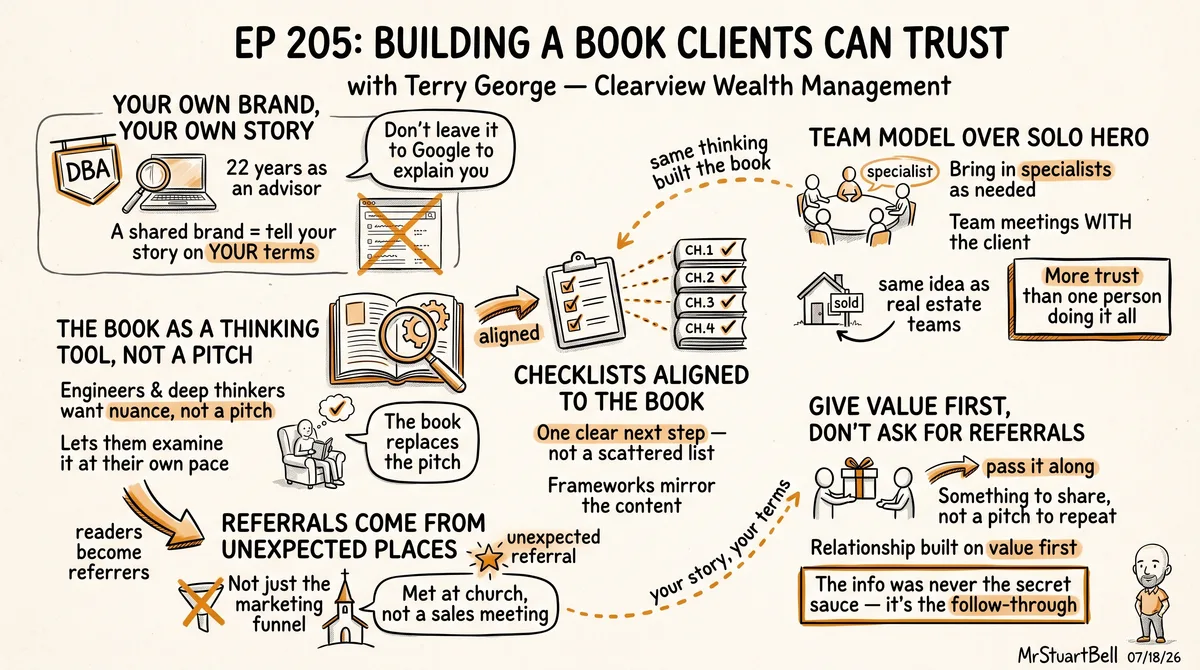
- A shared brand name lets you tell your story on your terms instead of leaving it to whatever clients find searching online.
- Bringing in specialist advisors as needed builds more trust than one person trying to be the expert on everything.
- Deep thinkers and detail-oriented clients respond better to a book than a pitch because it lets them examine things at their own pace.
- Referrals often come from unexpected places, like a casual conversation at church, not just your marketing funnel.
- Align your book's checklists and frameworks directly with its content so the reader always has one clear next step.
- Giving people something to pass along, instead of asking for referrals outright, keeps the relationship built on value first.
Terry George has been a financial advisor for 22 years, and this conversation is a companion piece to the one I recorded with his colleague John Becker a few weeks back. Same firm, same book, different angle on why it works.
What I liked most here is how Terry talks about niching without boxing himself in. He's built deep relationships with engineers over the years, people who think in systems and want the nuance, not the pitch. But he's also quick to point out that some of his best clients came from a conversation at church, not a marketing funnel. The lesson: your book should reflect who you naturally connect with, not just who you think you're supposed to target.
We also get into why Terry's firm built out a team model, bringing in specialists as needed instead of one advisor trying to do everything. That same thinking shaped how they built their book, aligning checklists and frameworks directly with what's in the pages so there's one clear next step instead of a scattered list of options.
If you've ever worried that sharing your process gives away the secret sauce, Terry's take is worth hearing. The value was never the information. It's the personalization, the follow-through, and the relationship that starts once someone actually reads what you wrote.
Transcript
AI transcript provided as supporting material and may contain errors.
Stuart: Hey, everyone. Welcome back to another episode of the show. Stuart Bell here, and today joined by Terry George.
Terry George: Hey. Very good. Thanks for having me on, Stuart.
Stuart: Pleasure. this is gonna be an interesting show because for people who follow along episode by episode, yesterday as we record, but a couple of weeks ago as we release, we had a conversation with your colleague, John Becker. So for people who are following along, this is gonna be your perspective of a similar model.
Terry George: Well, I've been an, an advisor for 22 years now, and, have different experiences from different companies along the way, and that experience has helped me get a better understanding of how things should work.
Stuart: Yeah.
Terry George: And, when I got down here, to Florida- We, began to think about putting together a DBA name, you know, a, a company that we could brand under and create that brand so we could market ourselves in a different way. just tell our story the way we wanted to tell d- in a deeper way. The... and so that clients these days, we understand that if they're trying to investigate a firm to work with, well, I would, just like you probably, will turn to the internet and-
Stuart: That's the first point that I
Terry George: think
Stuart: The, sometimes an idea comes to you and you just like it, but it doesn't necessarily stick together at every level. What I really love about the name and the location is that it does work on so many levels, for you guys particularly.
Terry George: Yeah. and after that, we got, rolling on, on putting some things together, and it is a process, but we're able to connect with other advisors and bring them in and, have them all join our group, to strengthen that.
Stuart: It's such an interesting point, isn't it? So we've got a lot of ideas. And that's the, that's the benefit. Again, we were talking with just recording with John yesterday.
Terry George: I think that was the thought process. If there was a gap, you know, just like, let's, talk to these advisors because I think they're doing that.
Stuart: Right.
Terry George: You know, that way we can do more, than what we could do on our own. And so I think the standalone scenario of what small advisor practices that they had with this, the, Prudential advisors was a little bit more customary.
Stuart: It's interesting. There is a corollary with the kind of, real estate idea.
Terry George: Yeah. You know, we really are dividing up the services, you know, of the, of tho- those types of things. If somebody needs something, we're bringing in that advisor as opposed to, one advisor trying to pull it off on their own.
Stuart: Right.
Terry George: and having team, team meetings and, with a client.
Stuart: Right. And then bringing in the people as and when you need them, kind of playing up the team- Yeah ... for the- Right ... the disciplines needed.
Terry George: Yeah. And that's- And I think the big thing is... Yeah, I'm sorry. Go ahead.
Stuart: Oh, sorry. Yeah. I was just gonna say, I think that then ties nicely in with the idea that we talk about here, this kind of amplified expert idea.
Terry George: and what I'm s- I think the reason why that works so well is we all have a shared passion, a passion that we want that end result for that client to be successful.
Stuart: And being able to talk to people like that and have the y- the 22 years, the expertise that you've got across a broad suite of examples, I think that's the main difference that people... that's a key thing that people forget sometimes when they're thinking about sharing their knowledge.
Terry George: We had all these ideas floating around in our heads and I think I'm more of a
Stuart: And then their options are narrowing. Right.
Terry George: Yeah, their options are narrowing. and I think that's often the case is people get to the point where they say, "Ah, I'm gonna retire next year. I hope I'm okay." I, and, but I haven't... but so we hope that this book, with these ideas, not that they're, too difficult.
Stuart: That's such a great point, that idea of it could keep going and going, particularly f- when we've been in business for any number of years. I mean, we can probably keep going until someone turns the lights off on us. But making the right fit for the right purpose, Given enough information that it's adding value, knowing that the next step is out of the pages of the book.
Terry George: I mean, we had some of it, but I think we, we dialed it in and for just this project,to say if we're gonna put this book together, let's streamline this and say, how does it align with the book?" Right? Yeah. So we wanna make sure that the checklists were also things that we talked about in the book,to get out there.
Stuart: That's the truth, isn't it? I mean, we joked slightly a second ago saying the answer to most things is, "It depends." For any of us who are in a kind of, kind of consultative service-based business, if it's not just buying something at, a checkout, then the answer is usually, "It depends." And for those people who are worried about giving the secrets away, I mean, that ship sailed years ago really, but definitely in the last year.
Terry George: answers, right.
Stuart: It's, yeah. So, so- But not the personalization ... it's building trust. Exactly. That trust, understanding the detail, the nuance, that's the piece that is important and remote going forward.
Terry George: Right.
Stuart: That, that idea of, there's a right match and some people aren't a right match, and that's fine. Do you have a strong feeling for who it is that you work well with? Is it a certain type of person or, are they coming from a certain perspective that really resonates with what you guys do?
Terry George: Well, that's an interesting question about finding that niche, you know, of who is the best type of fit. And for me, I would say I, I've had a lot of engineer clients over the years and I know maybe sometimes that they're deep thinkers, examine a lot of things and so I've been able to s- to step up and provide some, a level of support for them for what they're looking for.
Stuart: eggs in one
Terry George: basket ... their one, one asset. Yeah. Right ... so, so that, that's just, I think, an area just because of generally caring, you know?
Stuart: any exposure
Terry George: to it Yeah, exactly. So our job, you know, I mean, amongst the different niches and different groups of people,is to help them. but I do find that the engineers some- sometimes they have a base knowledge of things already, and so I can kind of get beyond that and we can just start implementing a little bit more of the, the more thoughtful strategy process-
Stuart: Yeah
Terry George: that. And- And I think that,
Stuart: that way that you were describing it, I mean, again, having done 13, close to 1,300 books now, it is the... Everyone goes through the same kind of mental cycle of, well, we could help anyone 'cause it's a service that's applicable to anyone, so we could help it. We like working with these people, but then these people we can help as well.
Terry George: Sure. and we, understand we wanna focus on certain areas, but, you know, we may get referrals from,
Stuart: Right
Terry George: some other people you meet along the way. Yeah ... for example, I had, I just met a lady at a church who said, I'm getting close to retire. I just don't know whether I can do it or c- ... when I can retire. Can you help me?" Well, yes, I can help go through that. And so it's not necessarily somebody that I'm marketing to, but it's that caring- Absolutely
Stuart: Right. Yeah. And it's- Particularly if we've got a geographic footprint, if everything's online and you're actually face-to-face with people, then okay, there's a bit of a distance and a separation.
Terry George: Right. And but with that being said, I mean, just bringing that up, there is something, an idea that we may wanna help people. Again, with this whole, the concepts of preparing for retirement is that whole faith community.
Stuart: Yeah. They
Terry George: might find value out
Stuart: of that. I think there's that element of, What's the best way to describe it? We sometimes get people come in and saying, "Hey, I've done a presentation from stage for years. Can I just turn, magically turn that into a book?" And we u- used to try and do it occasionally in the early days, but since learned a lesson.
Terry George: other thing too. Right. So, so I think that we, you know, we wrote the book to be able to help people as such, as groups, and I think that is a nice way to do it, to be able to find some connection like that to- Yeah ... for different groups and,to see how we can help them.
Stuart: Yeah.
Terry George: Yep. Yep, and then after that, the ongoing relationship is critically important in how we provide service, how we are proactive in reaching out to people.
Stuart: Yeah ...
Terry George: or,I don't hear from them unless I call them.
Stuart: yeah.
Terry George: Yeah. Yeah. So, so I think that personal connection and really, providing, Great customer service, you know- Yeah
Stuart: Right
Terry George: s- that they care about as well.
Stuart: They're the biggest fans because they're the people who- Yeah ... all of that,the psychological elements you were talking about before, about the peace and the certainty that someone's taking care of them and their unknown questions are becoming resolved. Yeah.
Terry George: Right.
Stuart: To give them rather than then have to kind of, I don't want to say taint the relationship, but then ask for, "Okay, you're feeling good about it, now open up the phone book and give me some names and addresses." Yeah. Well- Instead to be able to give them something that they can give to someone else.
Terry George: Value first, right? And- Yeah ... and we hope that, you know, the concepts in the book are ones that we can then work with them through that service follow-up process to say, "Let's track the progress on these. How are we doing? How do we find some of those wins that we're trying to track as we move forward and fi- and celebrate the accomplishments?"
Stuart: Oh,
Terry George: really? And, Oh, that's interesting
Stuart: mean, you really
Terry George: see the results ... 40 to 60 and in- Right ... you know, through their working years and into retirement, or some that are near retirement. Now they're older, and just you see a lot and know that you know them very well, and so those are some deep standing relationships.
Stuart: Like you say, if that information dies in your head and doesn't get into the hands or the ears of someone who could really benefit from it, then it's a little bit- What we doing here. the opportunity to- Yeah ... resonate, knowing that you resonate with this person, someone else resonates with that person.
Terry George: Yep. And I'm sure that the information's out there from other sources, but it's our take on it and our experience- Yeah ... with it, and our stories. And so, w- we thought that if we're trying to find the right, types of clients that we can relate with and they can relate with us and that we have a basis for having a business relationship, then at least, w- we can use that as a process to at least start a conversation.
Stuart: Yeah. Exactly. And that's such a key point. I think some people get hung up or kind of held back thinking, "Well, I've got nothing new or unique to say." But the reality is- Yeah ... that doesn't matter. Yeah. The way that you say it is probably unique anyway to some degree. The fact that you are saying it is absolutely unique, and the fact that you're saying it to that person at that time is completely unique.
Terry George: yep,and eventually gets in their hands, whereas otherwise- Yeah
Stuart: Yeah. Yeah, exactly. Exactly. time always goes fast on the podcast, it kind of flies by a little bit. I wanna make sure that people can find out more about what you guys are doing and follow along. Where's a good place for people to check out? I know John was saying when we were talking the other day, you guys are in 22, 25 states, so it's definitely not just a Florida specific thing.
Terry George: Well, that's just because, yeah, we are licensed. We have,to do business in a variety of different places, connect with other advisors, and,just trying to, grow that way. but people can follow us on social media, which we have created, that Clearview Wealth Management of Florida for our, Facebook and our LinkedIn profiles.
Stuart: Perfect ...
Terry George: and th- that is, at least a, a place where someone can learn our mission statements, our, about us, our process and the services that we provide, that we...
Stuart: Fantastic. Well, I'll put links to the website and the social media channels down in the, description of the show.
Terry George: Yep. that sounds good. Right. we have a, a process where we're trying to get the word out and we'll see how that, that, transpires with all our different efforts and, to reach out and to see how it's m- we'll get feedback on reviews and responses from it.
Stuart: Yeah. Yeah. Absolutely. well, having read it, I'm sure it will. Absolutely. Terry, thanks again for your time. Everyone, thanks for listening and we'll catch you in the next one.