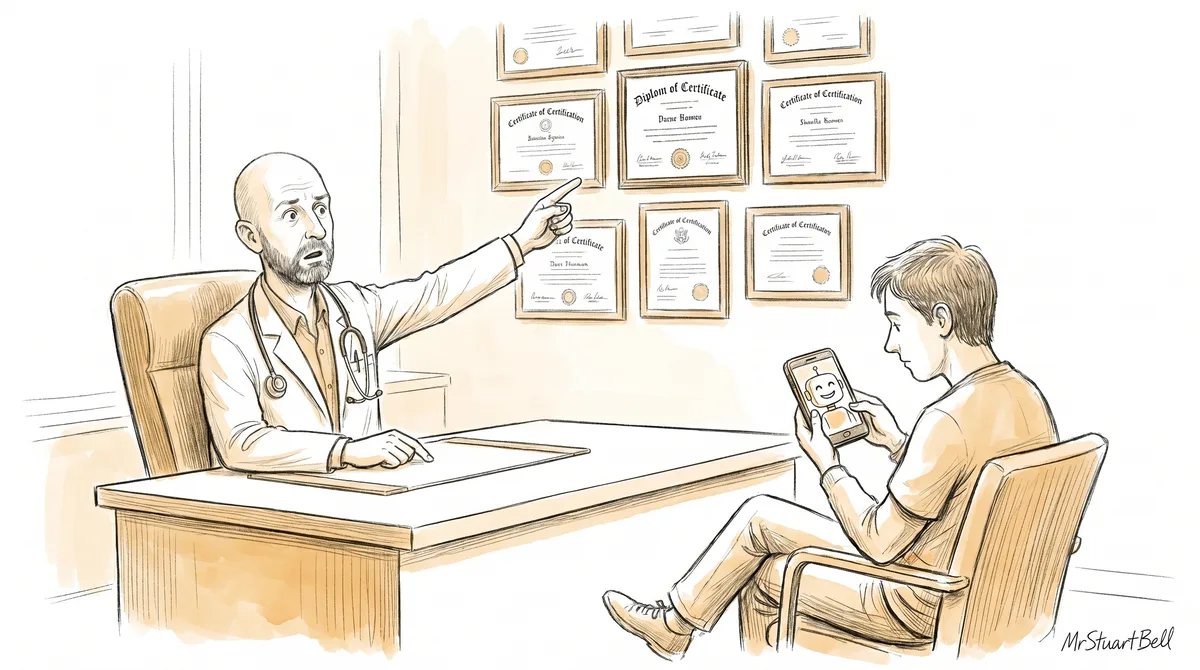
Credentials used to be the moat. Now AI gives your prospect the illusion they don't need you at all.
The 2026 Edelman Trust & Health report dropped last week. It covers trust across the entire healthcare ecosystem, from hospitals to pharmaceutical companies to media reporting on health. The headline finding isn't surprising. Trust is declining everywhere.
One number really stood out.
64% of consumers who are comfortable with AI say they can do at least one medical task as well as, or better than, a doctor.
Not schedule an appointment.
Not look up a medication.
Perform a task that a doctor does.
If even doctors are losing trust ground to AI confidence, your credentials aren't protecting you either.
Doctors are the ultimate high-trust profession. Years of training, licensing, board certifications, institutional backing. If there's a profession that should be immune to the "I can do this myself" impulse, it's medicine. But they're not immune.
"My doctor" still wins. But barely.
The report has a second finding that matters more than the headline. Despite trust declining across the entire healthcare ecosystem, my doctor remains the most trusted figure. Not doctors in general. Not the medical system. My doctor. The specific person who knows me.
It's the same pattern I see across every high-trust industry. Your prospect doesn't trust financial advisors. They trust their financial advisor. They don't trust contractors. They trust the contractor their neighbor recommended. The general category loses trust while the personal relationship holds.
So the challenge is bridging that divide. How do you become their person without being their person?
It's a trust architecture problem that needs a new approach.
The same thing is happening to you
Your prospect doesn't think they need an estate plan because ChatGPT walked them through the basics. A homeowner watches three YouTube videos and decides they can manage a renovation without a general contractor. A business owner asks an AI to draft their financial projections and thinks they don't need an advisor.
They're not rejecting you because you got worse at your job. They're rejecting the need for you because AI makes them feel competent. It's a different problem your credentials don't solve.
The answer from the Edelman data is clear. "My doctor" still wins because "my doctor" is a relationship, not a credential.
Visibility is the new qualification
Think about what makes someone say "my doctor" instead of "a doctor." It's not the diploma on the wall. It's the relationship built before the medical question came up. The checkups. The conversations. The trust built over time so that when something serious comes up, the first instinct is to call, not Google.
That's exactly what your book does. Your scorecard does. Your LinkedIn presence does. They build the "my" instinct before the need arises. The prospect who's already read your thinking, already taken your assessment, already seen how you approach problems doesn't Google their way around you when the moment comes.
You're already their person.
If your competitors are winning the business you deserve, it's not that they're better than you. They're just the ones who showed up before the AI did.
The illusion gap
The Edelman report calls it a confidence gap, but at best this is agentic trust, and at worst it's agentic sycophancy. Either way, it's real.
People feel more capable, not because they got smarter, but because the tools got easier to use. AI doesn't always make your prospect more competent. But it certainly makes them feel more competent. Those are very different things.
And here's what Edelman found downstream: lower trust in the health ecosystem is directly linked to less preventive care.
People who think they can handle it themselves don't show up until it's urgent.
In your world, that means prospects who think they don't need an advisor show up when they're already in trouble, stressed, price-sensitive, and harder to serve.
The professionals who build relationships before the crisis, who help prospects feel more competent before the transaction, get better clients, better outcomes, and better referrals.
The ones who wait for the phone to ring get the panicked call at 9pm.
What to do about it
Don't fight the illusion. Build the relationship that makes it irrelevant.
Your prospects are going to ask AI before they call you. That's not going to change. But if they already like your perspective, already trust your thinking, already feel like you understand their situation, the AI conversation becomes a confirmation, not a replacement.
Nobody remembers your elevator pitch. But they remember the person who already showed up in their world before they needed help.
Be that person.
Put it to work
My clients already trust me. Why should I worry about this?
Your current clients aren't the risk. It's the ones who never call in the first place. The Edelman data shows people are bypassing professionals entirely because AI makes them feel capable. Those prospects never enter your world. You don't lose them. You never get them.
How do I build the "my" relationship before someone needs me?
Create something that puts your thinking in front of people before the crisis hits. Your book, your scorecard, your content. The goal isn't to sell. It's to be familiar. When the moment comes, they should already feel like they know you.