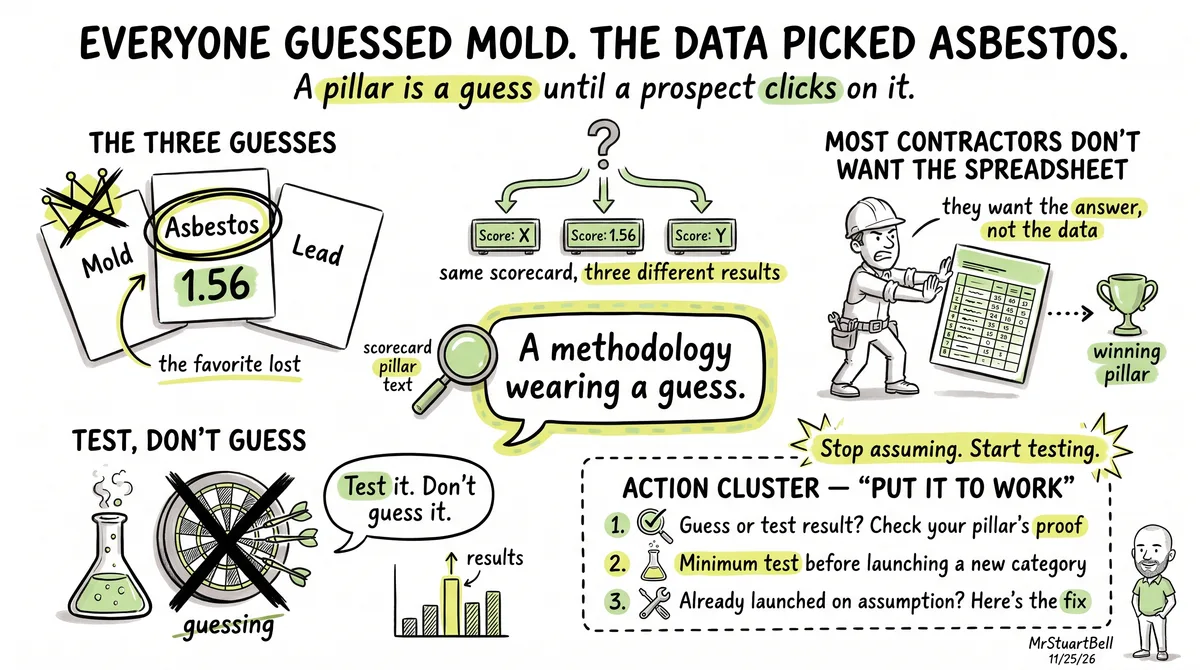
The pillar your scorecard leads with is a guess until a prospect clicks on it.
A team building a scorecard for an environmental mitigation company walked into subtitle testing sure of one thing. Mold was going to win. Every facility manager has a mold horror story. The stained ceiling tile. The insurance fight. The tenant who called a lawyer.
So they ran three hazard categories against each other, mold, asbestos, lead, each one layered with a different angle: budget pressure, staff burden, building concern. Nine variations. Real clicks from real facility managers deciding what to open.
Asbestos won. Not close either. It scored 1.56 on the client's tracked performance metric against the other two.
A scorecard that assumes which pillar matters most to the prospect is a methodology wearing a guess.
That's the part worth sitting with. The team wasn't wrong because they didn't know the industry. They'd built scorecards before. They knew facility managers. They still got it backwards, because knowing an industry and knowing what one specific prospect clicks on are two different kinds of knowledge, and only one of them is testable.
The same question, three different answers
Here's what makes this interesting instead of just a fun anecdote. This isn't the only time that exact three-way test has run.
Andrew, who runs ScoreFunnel testing, ran the same mold-asbestos-lead comparison for a home services client in Louisiana. Lead remediation pulled ahead there, by a wide enough margin that it surprised the team again. Different market, different audience, same three hazards, different winner.
Run the comparison a third way, against school facility managers specifically, and the click-through numbers invert again: lead paint at 0.92, asbestos at 0.64, mold at 0.56. Three tests, three hazard categories, three different rankings depending on who's looking and what they're responsible for.
None of these results transfer to the next client. That's the whole point. A facility manager worried about a school board meeting reacts to a different word than a landlord worried about a tenant lawsuit. The hazard that should terrify someone on paper isn't always the one that gets the click, and you don't find out which one does by asking your team what sounds scariest in the pitch deck.
Most contractors don't want the spreadsheet
Here's where it gets practical. Most facility managers are too stretched to sit through a data readout. They want a yes or a no on what's working, not a breakdown of nine subtitle variants and their relative performance scores.
Which is exactly why the testing has to happen before the scorecard ships, not after. Once the pillars are set, the questions are written, and the scorecard is live, you're not in a position to tell a client "actually, we should swap the lead pillar for asbestos." You're already asking them to trust the framework. The framework needed to earn that trust first, against real clicks, before it ever reached them.
The fix isn't better intuition about which hazard sounds worst. It's running the same question three ways and letting the prospect's own behavior pick the winner.
That discipline matters more in a scorecard than almost anywhere else in your marketing, because a scorecard's questions aren't just copy. They're the diagnosis your prospect is trusting before you've said a word to them. Get the framing wrong and you've built a quiz. Get it right and you've built something that reads their actual problem back to them, which is the entire reason a prospect takes one seriously instead of closing the tab.
It's the same reason a scorecard result can't just hand back one of five generic buckets. If the diagnosis is specific, the result has to match it, pillar for pillar, hazard for hazard.
Put it to work
How do I know if my scorecard's pillars are a guess or a test result?
If you can't point to a click-through number, a conversion rate, or some other behavioral data that justifies the order your pillars appear in, it's a guess. A good guess, maybe. Still a guess.
What's the minimum test before launching a new hazard or problem category?
Three variations, real audience, real clicks. You don't need a six-figure ad budget. You need enough traffic to tell the difference between 1.56 and 0.92, and a willingness to be wrong about which one wins.
What do I do if I've already launched a scorecard built on assumption?
Test the live version against an alternative framing for two weeks before you touch anything else. You'll either confirm your instinct was right, which is useful, or find your own asbestos, which is more useful.