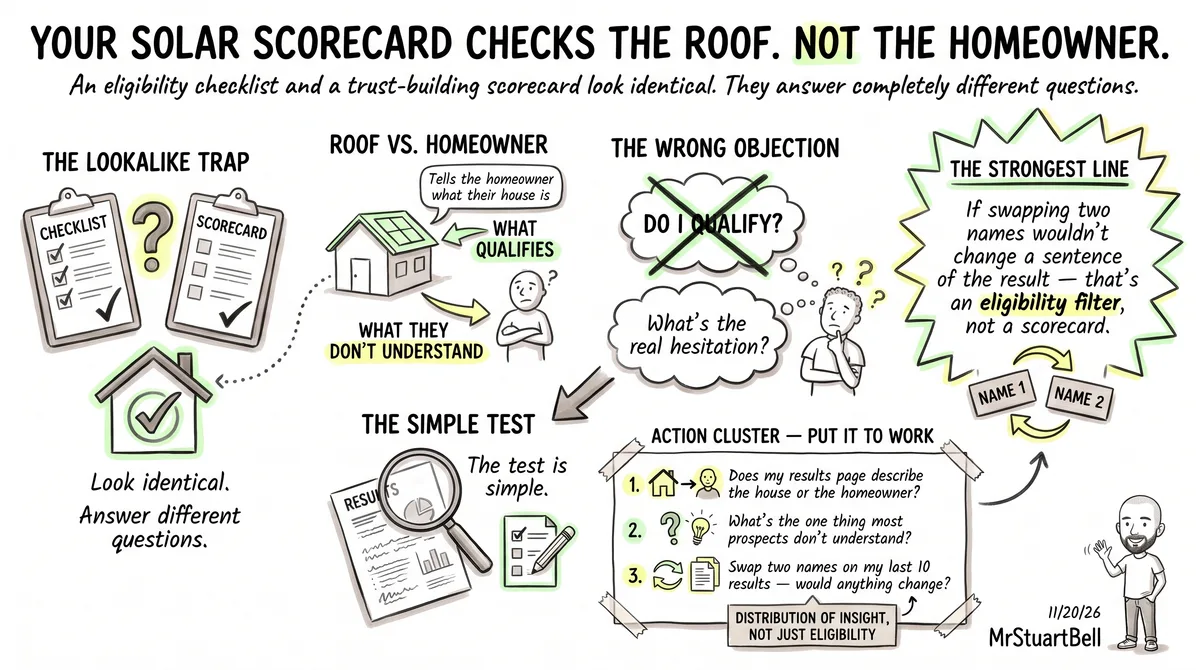
An eligibility checklist and a trust-building scorecard look identical. They answer completely different questions.
I've seen the book from an engineering conglomerate that builds solar, wind, and hydrogen projects. Inside it, the assessment was thorough. Roof angle. Shading analysis. Credit tier. Utility rate structure. Everything a grant application actually needs to clear.
It was also the wrong tool for the job.
It tells the homeowner what their house is. Not what they don't understand.
An eligibility checklist answers one question. Does this house qualify. Roof pitch, shading, credit score, utility structure, all of it feeds a yes or a no. A diagnostic scorecard answers a different question. Does this homeowner understand their own situation well enough to make the decision sitting in front of them. Only one of those builds trust before the sales call happens.
Run two homeowners through the eligibility version. One owns a 1990s rancher with decent south exposure and a 720 credit score. The other has a steep, partially shaded roof, a 590 score, and two years left on a home equity loan he forgot to mention. If both results pages say some version of "your roof qualifies, here's your estimated system size," you built a filter. Swap their names and nothing in the result changes. That's eligibility, not diagnosis.
If swapping two respondents' names wouldn't change a single sentence of their result, you built an eligibility filter and called it a scorecard.
The objection isn't "do I qualify."
Almost nobody shopping for solar is worried their roof can't physically hold panels. They're worried this is a bad deal wearing a good deal's clothes. "Is this actually worth it for me, or am I about to sign something I'll regret in six months?" A technical checklist never touches that question, because it was never built to. It was built to clear a grant, not to earn trust from a person about to commit fifteen years of payments to a company they met on Facebook three days ago.
I wrote about this exact gap on a roofing scorecard that opened with "do you love your home." Same failure, different vertical. A question or a checklist that produces the same answer regardless of who's in front of you isn't diagnosing anything. It's just collecting contact information with extra steps.
The engineer who built the grant checklist wasn't being lazy. He knows his industry cold, and a measurable spec sheet feels like certainty to someone who thinks in specs. That's exactly why it's easy to miss. The checklist feels rigorous. It just isn't answering the question the homeowner actually walked in with.
The test is simple.
Pull your last ten assessment results. Read through them. If swapping two respondents' names wouldn't change a single sentence, you've built an eligibility filter, not a scorecard, no matter how many data points it collects.
A diagnostic version of the same solar assessment doesn't throw out roof angle and credit tier. It just stops treating them as the whole story. It asks whether the homeowner has compared financing against buying outright. It asks whether they know what happens to their rate if the utility changes its buyback terms in year four. Those questions produce a different answer depending on who's answering them, which is the entire point. An eligibility checklist can't tell you that. A scorecard can.
The conglomerate's checklist wasn't wrong. It did exactly what a grant qualification tool should do. It just wasn't the tool that gets a stranger to trust you enough to pick up the phone. That's a different job, and it needs a different set of questions.
Put it to work
Does my results page describe the house or the homeowner?
Read your last result page out loud. If every sentence is about square footage, shading, or credit tier, you're describing a house. The homeowner is still invisible.
What's the one thing most of my prospects don't actually understand about this decision?
That's your first diagnostic question. Not roof angle. Whatever gap sits between "I'm curious about solar" and "I feel ready to sign."
If I swapped two names on my last ten results, would anything change?
If the honest answer is no, you've got an eligibility filter with a scorecard's branding on it. Fix the questions before you fix the design.