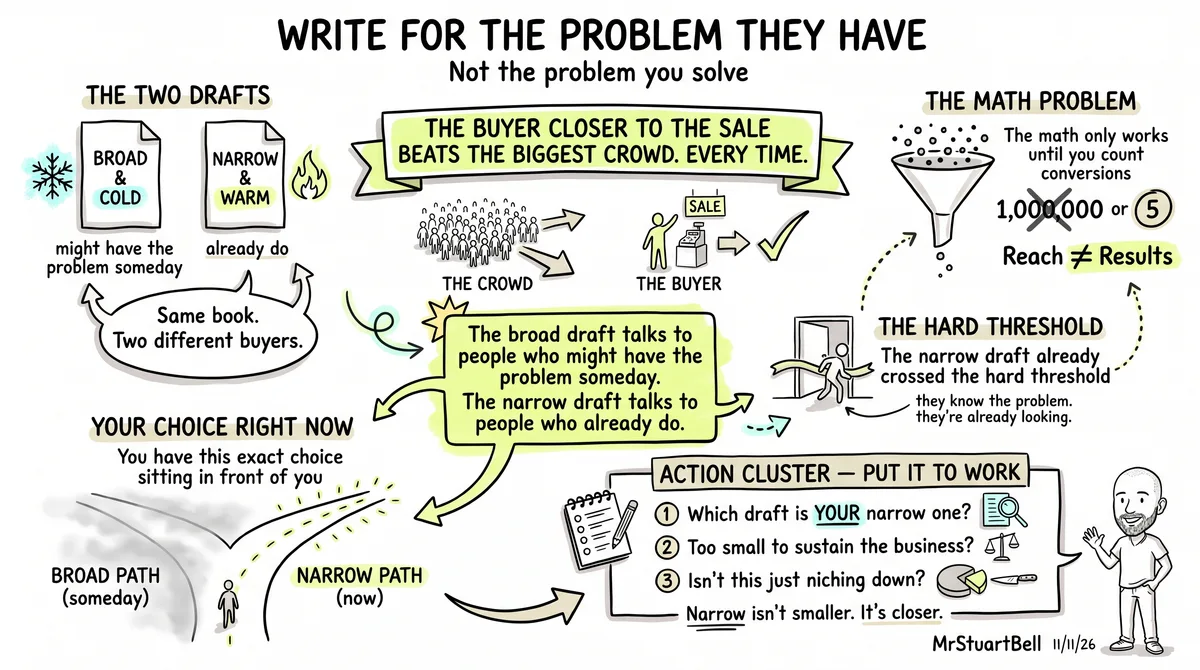
The buyer closer to the sale beats the biggest crowd you could reach. Every time.
You've got two drafts of the same book open in two different tabs, and you can't decide which one to finish.
A client of mine helps employers hire internationally, the visa paperwork, the compliance landmines that show up six months after the hire goes through. On a call last month she laid out the exact fork in front of her. Draft one talks to any employer with a staffing problem. Bigger market, colder room, everyone's welcome. Draft two talks only to employers who've already decided to hire internationally and are now quietly panicking about compliance. Smaller room. Much warmer.
She wanted to go broad. Of course she did. Broad feels safer. More people see the book, more people might buy, why would you ever turn away eyeballs on purpose.
That instinct is exactly backwards.
The math only works until you count conversions
Draft one reaches every employer who's ever thought "we might need to hire" in the loosest possible sense. Most of them aren't hiring internationally. Most of them aren't hiring at all this quarter. They'll nod along at a chapter about global talent strategy and go back to whatever they were doing before they opened it.
Draft two reaches a much smaller number of people. But every single one of them has already crossed the hardest threshold there is: deciding they have this exact problem. They've committed to the hire. They're now awake at night about the compliance exposure nobody warned them about. They don't need convincing that international hiring matters. They need someone who clearly understands the mess they're already standing in.
The broad draft talks to people who might have the problem someday. The narrow draft talks to people who already do.
Count the conversions and the broad book loses almost every time. Same expert, same book, and the only variable that changes the outcome is who the pages were written for. Reaching more people was never the goal. Reaching the right few, at the exact moment they're ready to act, was.
The narrow draft already crossed the hard threshold
Here's what the broad version actually costs you, beyond fewer conversions. It also costs you specificity. A book written for "any employer with a staffing problem" can't name the exact compliance trap that keeps the international-hire client awake, because naming it would narrow the audience she's trying to avoid narrowing. So the book stays general. General chapters, general advice, general relief for a problem nobody reading it actually has yet.
A niche only works if your reader can put a word on it, and "global talent strategy" is a phrase, not a problem. "I already hired someone overseas and I don't know if I'm exposed" is a problem. Only the narrow draft gets to say that sentence out loud, because only the narrow draft knows exactly who's reading it.
She picked the narrow draft. Not because the bigger market stopped existing. Because the bigger market was never actually buying.