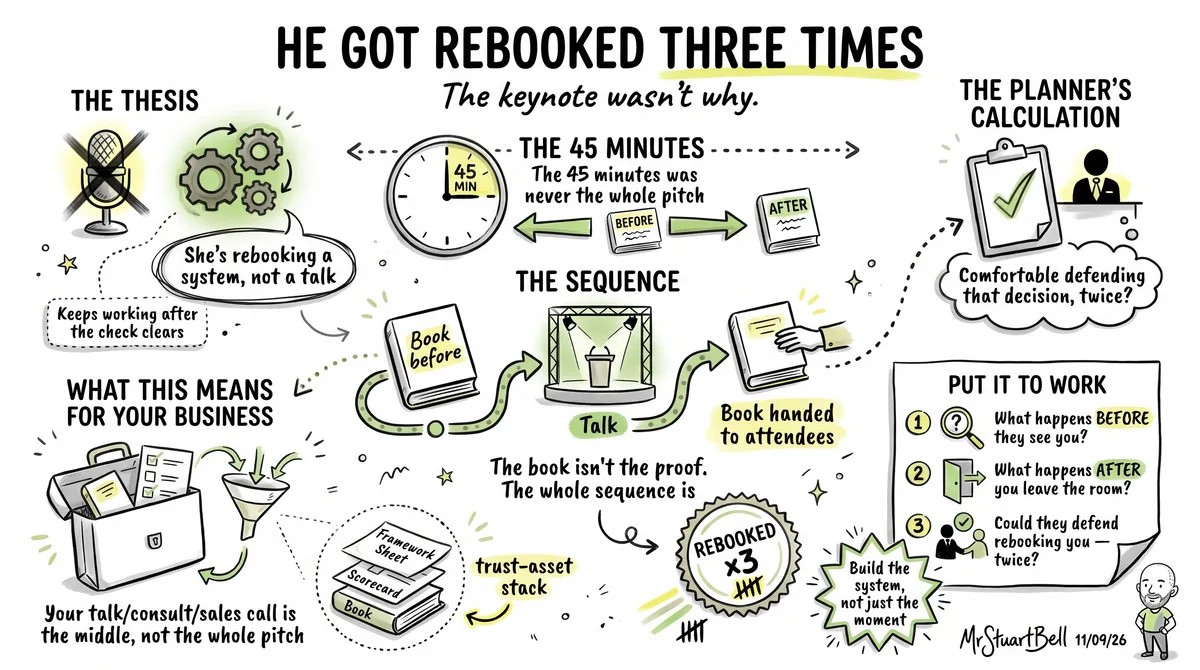
The planner isn't rebooking the talk. She's rebooking the system wrapped around it.
Kristin books speakers for a living. Conferences and association events, mostly. She hired the same keynote speaker three times in a row, and when she explained why, she didn't mention the talk at all.
"He had a book and then he spoke and then he gifted our people the book and it was all just this little ecosystem that just worked. We hired him back like three times."
Most speakers think the sale ends when they walk off stage. This one understood that the planner evaluating a rebooking isn't replaying his best lines in her head. She's remembering a sequence. A book arrived before the event, which made the invitation easy to justify to her own stakeholders. The talk delivered on what the book promised. Then a copy went home with every attendee, which made Kristin look good long after the invoice cleared.
A planner isn't rebooking a speaker. She's rebooking a system that keeps working after the check clears.
The 45 minutes was never the whole pitch
Most speakers optimize exactly one thing: the time on stage. They polish the opening, time the laugh lines, rehearse the close. All of that matters for the room in the moment. None of it answers the question Kristin is actually asking six months later, which is whether hiring this person again is safe, impressive, and easy to defend to her boss.
Kristin's three touches:
Before: A book arrives ahead of the event. It frames what the speaker will say and gives Kristin something concrete to point to when she pitches the booking internally. Nobody has to take her word for it.
During: The talk delivers on what the book set up. The room gets the live version of an idea it already has a head start on.
After: A copy goes home with every attendee. The value keeps showing up on someone's desk weeks later, and Kristin gets credit for an event that's still paying off after she's moved on to the next one.
Cut any one of those and the booking becomes a one-off. Keep all three and it becomes a habit.
The book isn't the proof. The whole sequence is
A single good book doesn't rebook a speaker. Plenty of speakers hand one out at the back of the room and never get called again. What made Kristin's experience different was the order. The book before lowered her risk. The talk confirmed the bet. The book after extended the win past the day she was accountable for it. She wasn't managing a speaker. She was managing her own reputation across three separate moments, and he gave her something to work with at each one.
Most speakers treat the book as a souvenir, something nice to leave behind once the real work is done. Kristin's speaker treated it as infrastructure. The timing did the work a better delivery never could. A book that shows up after the booking decision is already made can only ever be a thank-you gift. A book that shows up before it is a risk-reducer, and a book that shows up after the talk is a reason to remember him in month three, when the next planner at the next conference asks who she'd recommend.
A referral and a rebooking run on the same logic. Your advocate needs proof they can hand someone else, not a memory they have to recreate from scratch, which is exactly why a mailed book opens doors a pitch never could. The speakers who only have a great 45 minutes are betting that Kristin remembers the feeling. The ones who build the system around the book aren't betting on memory at all.
The keynote still matters. Nobody gets rebooked for a bad talk. But the keynote was never why Kristin hired him three times. The ecosystem was.
Put it to work
What happens before your audience ever sees you?
If the answer is nothing, you're relying on the room to remember a single performance. Give the planner something to point to before you ever walk in.
What happens after you leave the room?
A gift that disappears into a tote bag doesn't extend anything. A book that goes home and gets opened keeps your name in front of someone long after the event is over.
Would the person who booked you be comfortable defending that decision to their boss, twice?
That's what Kristin was actually buying. Not a talk. A decision she could keep making.