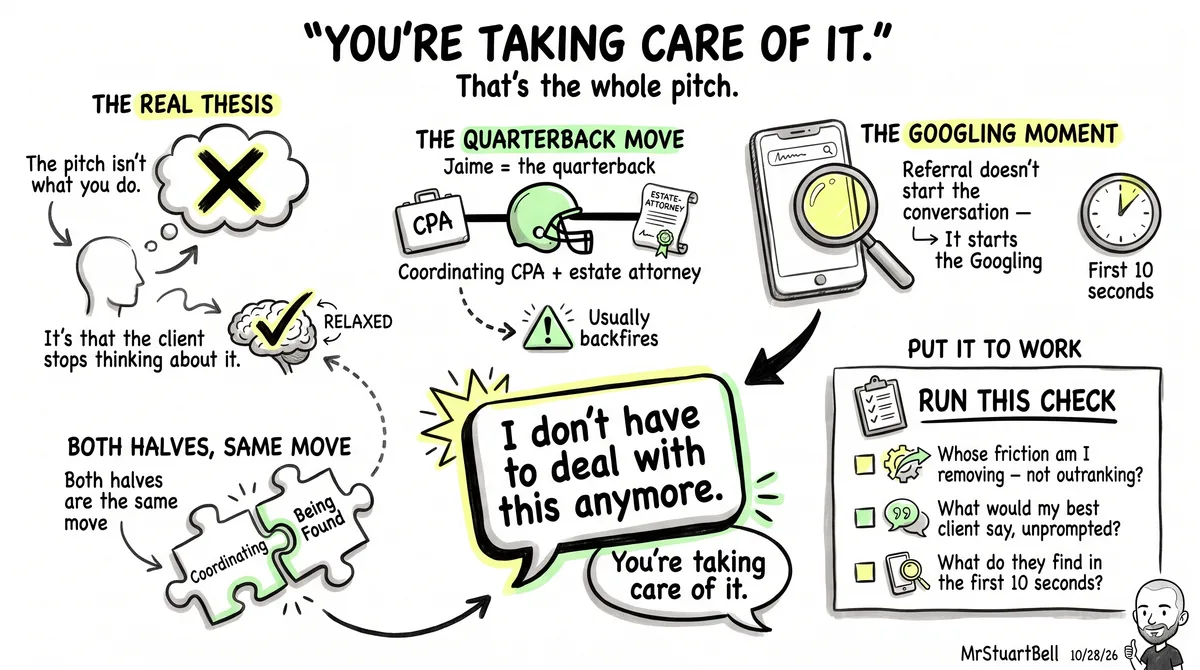
The pitch isn't what you do. It's that the client stops thinking about it.
Jaime is a financial advisor. Most advisors in his position sell returns, fees, a quarterly review call. Jaime sells something else. He tells clients up front that he's the quarterback for their whole team, the CPA, the estate attorney, the investment manager, and he means it literally. He calls the CPA before tax season gets messy. He loops the estate attorney in before a document goes stale. The client doesn't coordinate any of it.
Here's what that produces. Not a testimonial Jaime wrote for his own website. A sentence the client says back to him, unprompted, in the middle of an unrelated conversation.
"I don't have to deal with this anymore. You're taking care of it."
That line is a client describing the absence of a problem. Harder to fake than a compliment about service, because nobody rehearses relief.
The quarterback move usually backfires
Here's the part that should worry you before it reassures you. Positioning yourself as the leader of someone else's advisory team is a known way to lose the relationship, not win it. The CPA has usually been in that client's life for fifteen years. Walk in talking like you're the one calling the plays and you're the rookie trying to audible on his first snap, in a locker room somebody else already owns. CPAs have a thousand quiet ways to make that go away.
Jaime doesn't survive that because of the title. He survives it because of what he does with it. He's not telling the CPA what to do. He's removing friction the client would otherwise have to manage themselves, closing loops before anyone has to ask who's handling it. The CPA gets looped in, not displaced. The client experiences coordination. Nobody on the team experiences a turf grab.
That's the difference between claiming a role and earning one. Say "I'm your quarterback" in a pitch deck and you sound like every advisor who read the same book. Call the estate attorney before the document lapses, three years running, and the client starts saying it for you.
The referral doesn't start the conversation. It starts the Googling
Someone searches your name after a referral whether you've thought about it or not. Jaime noticed what happens on his side of it. A client refers him, and the first thing the prospect does isn't call. It's Google his name.
He's watched it happen enough times to describe the exact sequence. The name search pulls up a video first, then an article, and "in a way it was like a sense of credibility, a sense of awareness," as Jaime put it, before he'd said a word to the person himself. They land on a video where he's talking through exactly the kind of situation they're in. An article that sounds like the conversation their friend just had with them, except it's already written down. By the time they call, they're not evaluating whether Jaime knows what he's doing. They already decided that. The call is just logistics.
That content isn't there to generate a cold lead. Jaime never built it to be found by a stranger scrolling at random. It's there to confirm what a referral just told someone, which is the exact moment it actually gets used. Most advisors treat their videos and posts like a brochure nobody reads twice. Jaime's content functions like a second witness, backing up the first one.
Both halves are the same move
The quarterback positioning and the Google trail aren't two separate wins. They're the same thing told twice. One happens inside the relationship, where coordinating the CPA and the estate attorney quietly becomes Jaime's job instead of the client's. The other happens outside it, where a referral prospect confirms that story before they've said a word to him.
Credentials didn't do either of those jobs. A CFP after his name doesn't coordinate anybody's estate attorney, and it doesn't show up when someone searches his name at a stoplight. What shows up is the work, recorded, and the behavior, repeated, until a client describes it back to him in six words instead of six sentences.
Put it to work
Who on my client's team am I actually removing friction for, versus trying to outrank?
If a CPA or attorney would describe you as a turf grab, you're doing the title without the behavior. Fix the behavior first.
What would my best client say about me, unprompted, in a conversation I'm not in?
If you don't know, ask one directly. The answer tells you whether you're solving the coordination problem or just claiming to.
When someone Googles me after a referral, what do they find in the first ten seconds?
If the answer is a headshot and a slogan, you're relying on the referral to do work your content should already be doing.
The client who tells you "I know you're taking care of it" isn't praising your service. They're describing a problem that used to be theirs and now isn't. Build toward that sentence. Everything else is a brochure.