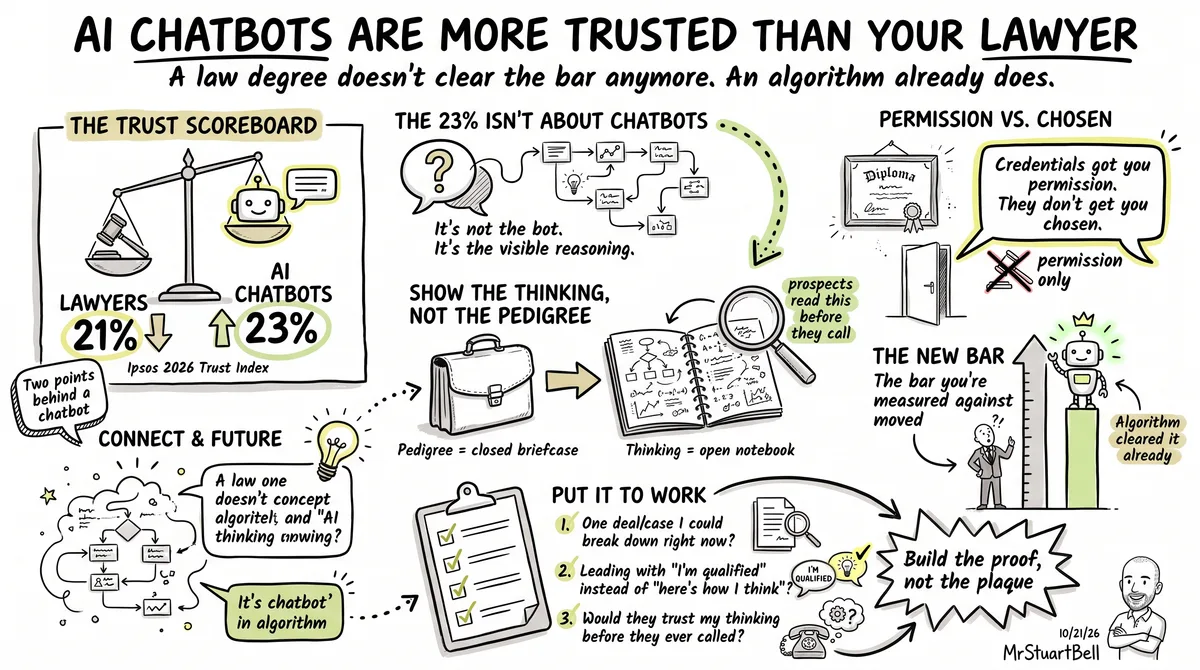
A law degree doesn't clear the bar anymore. An algorithm already does.
Ipsos published its Global Trustworthiness Index on September 17, 2026. Thirty-one countries, surveyed on which professions people actually trust. Doctors came first at 58%. Scientists at 57%. Teachers at 53%. Then it drops, all the way down to bankers at 26%, business leaders at 24%, AI chatbots at 23%, and lawyers at 21%.
A chatbot that gets things wrong close to half the time now outranks a law degree.
That's not a lawyer-bashing stat. It's a credentials-bashing stat. For decades the law degree was the whole pitch. I went to law school. I passed the bar. I know things you don't. That used to be enough to get picked over the next firm in the search results. Now it's not even enough to beat a chatbot.
A corporate attorney who still opens with "I went to law school, I passed the bar" is standing on ground that already eroded under her.
Credentials got you permission to practice. They stopped being what gets you hired.
The 23% isn't really about chatbots
Look at who's above lawyers on that list. Doctors, scientists, teachers. None of them are trusted because of a piece of paper on the wall. They're trusted because their work gets checked, constantly, by someone other than them. A diagnosis gets a second opinion. A lesson gets watched by thirty kids and their parents. The credential was the entry fee. The visible, repeated proof is what earned the trust. And even doctors are starting to slip on that same measure, which tells you the floor is moving for everyone, not just lawyers.
A law license doesn't work that way. Most of what a corporate or M&A attorney actually does happens behind closed doors, described after the fact in language the client can't verify. "Trust me, I handled it" used to be good enough, because there was nothing to compare it to. Now there's a chatbot sitting right next to you on the trust table, and it's not winning because it's smarter. It's winning because explaining itself is the only thing it knows how to do. Law firms already learned this the hard way when clients said they'd rather wait for a human than get a smooth answer from a bot. The chatbot showing up above lawyers on a trust index isn't a contradiction. It's the same test, applied earlier in the relationship.
That's the gap. Not competence. Visibility.
Show the thinking, not the pedigree
A client who walks into a consultation already assumes you're competent. Nobody hires an M&A attorney wondering if she passed the bar. The open question in their head is different: does this person understand my deal, my risk, my situation, specifically. Answering "yes, I'm qualified" doesn't touch that question. It never did. It's just that a license used to be close enough to a proxy for it that nobody noticed the gap.
The fix for a corporate attorney isn't a better bio page or a longer list of deals closed. It's a breakdown of how a specific deal structure actually protected a specific client, written so a prospect can follow the reasoning before the first call. Not the result. The thinking that got there. That's the part a chatbot can't fake and a law degree never proved in the first place.
This is the Prove-It Economy showing up as a single data point. The credential got you permission to practice. Proof is what gets you hired, and right now a surprising number of people trust an algorithm's proof over a lawyer's pedigree.
The bar you're actually being measured against
None of this means clients are about to hire a chatbot to close their acquisition. It means the comparison they're running in their head has shifted, and most attorneys haven't noticed the test changed. They're still answering "am I qualified" when the real question on the table is "can I see your thinking before I trust it."
Ipsos didn't publish a stat about chatbots getting smarter. It published a stat about credentials getting weaker as the only form of proof on offer. The Prove-It Economy has been eroding that for a while. Lawyers just became the clearest example, because the gap is no longer theoretical. It's two points wide and it's got a number on it.
Twenty-one percent isn't a verdict on the profession. It's a measurement of how much the bar and the bio page are still being asked to do alone.
Put it to work
What's the one deal or case I could break down for a prospect right now?
Pick something recent and specific. Write out the reasoning, not just the outcome, in language a client could follow without a law degree of their own.
Where am I still leading with "I'm qualified" instead of "here's how I think"?
Check your bio, your proposal template, your intro call script. If the first thing a prospect hears is your credentials, that's the gap this stat is describing.
Would a prospect trust my thinking if they read it before they ever called?
If the honest answer is no, that's not a writing problem. It's the proof you haven't built yet.