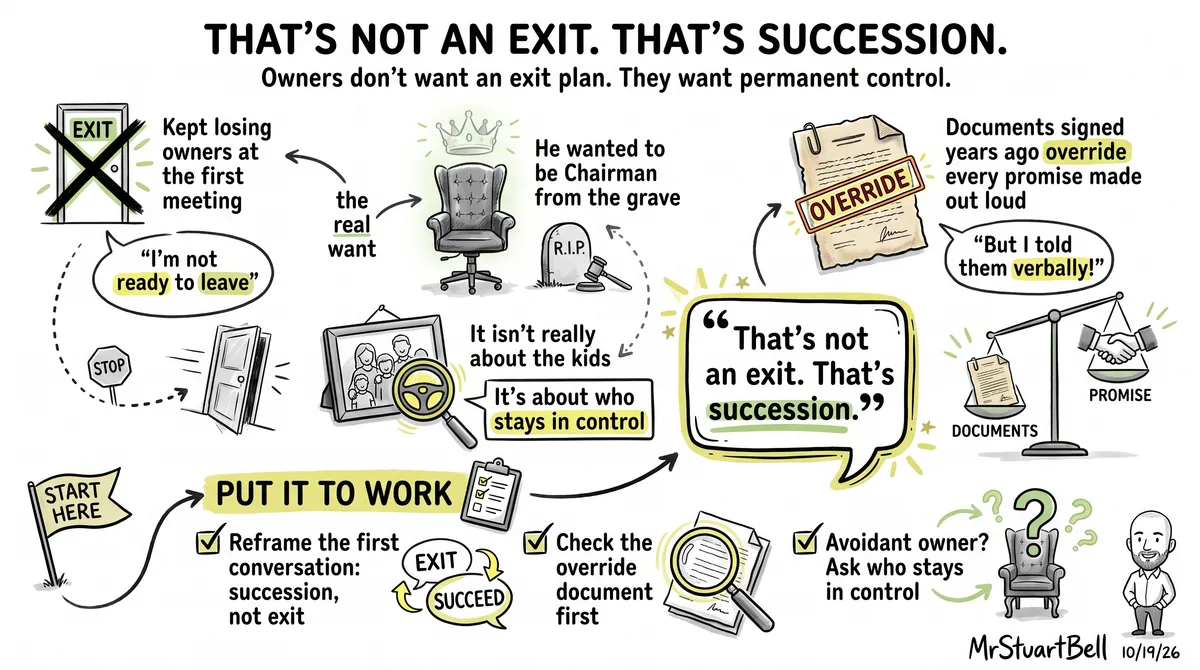
Owners don't want an exit plan. They want to make their control permanent.
A wealth advisor who built his practice around family business transitions kept losing owners at the first meeting. Same pitch every time, same subject line, same word doing all the damage: exit. He'd open with a timeline for stepping down and watch the owner's face close before he got through slide three.
Nobody wants to sit across from someone whose entire job is helping them leave. "Exit planning" sounds like the end of something they spent thirty years building, and the owners worth planning with aren't trying to depart. They're trying to stay, just without having to show up every morning to do it.
The advisors who get this right stop selling departure and start selling permanence. Governance structures. Voting trusts. Veto rights that let an owner's judgment keep running the business long after his hands are off the wheel. None of that is retirement. It's the opposite of retirement.
That's not an exit. That's succession.
He wanted to be Chairman from the grave
Ask an owner to "transition leadership" and you're asking him to picture a future where he doesn't matter. That's not a preference problem. Control is how these people live. They built a business by deciding things, and a plan that doesn't let them keep deciding something, anything, after they step back reads like a eulogy with extra paperwork attached.
The advisors who win these conversations give the owner a seat that outlives his desk. A board veto. A voting trust that keeps his judgment enforceable after his name comes off the door. He isn't clinging to the business. He's making sure the business still sounds like him in year twenty.
The documents he signed years ago override every promise he made out loud
Most owners think their will decides what happens to the business. It doesn't. The operating agreement does. The buy-sell provision does. The shareholder agreement he signed in year three, barely read, and forgot about does. Die with nothing but a simple will and your spouse inherits frozen accounts, a forced buyout clause, and a room full of panicked employees, while holding a document that says everything goes to her.
That gap between the paperwork and the intentions is where most succession conversations actually need to start. Not with "do you have a plan" but with "do you know which document wins."