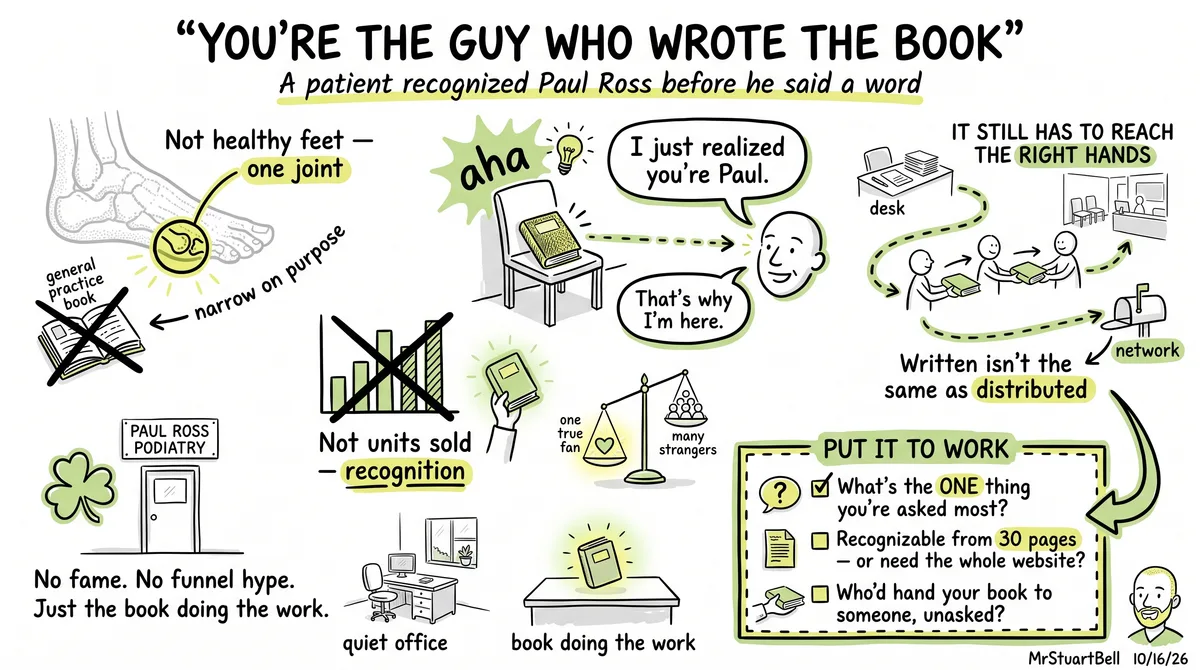
A patient recognized Paul Ross from a book about one joint before he said a word.
Paul Ross runs a podiatry practice in Ireland. A new patient sat down for a consultation, looked at him, and said it out loud before he'd asked a single question: "I just realized you're Paul. You're the guy who wrote the book. I read the book. That's why I'm here."
That's not a compliment. That's proof, arriving before the appointment even started.
He wrote about one joint, not healthy feet
Most podiatrists who write anything write the safe version. A general guide to foot health. Bunions, nail care, diabetic foot checks, the whole catalog. It covers everything a patient might ask about, which is exactly why nobody remembers it once they've put it down.
Paul picked toe arthritis. One condition. One joint. The kind of topic most specialists would never dedicate an entire book to, because it feels too narrow to justify the effort.
That narrowness is the entire point. A general guide gets skimmed. A book about one joint gets remembered, because the person reading it either has that exact problem or they don't. If they do, every page is talking straight to them.
"I just realized you're Paul. You're the guy who wrote the book. I read the book. That's why I'm here."
The patient had already decided
By the time that patient sat down, the appointment wasn't really a sales conversation anymore. It was a formality. They'd read the book, recognized their own symptoms in it, and walked in already convinced Paul understood exactly what they had.
That's the part generalists miss. They think a book's job is to describe the practice. Your book's job is to let a stranger diagnose themselves before you've said a word, so that by the time you're both in the room, you're confirming what they already believe instead of trying to earn it from zero.
The proof isn't the sales number
Nobody's claiming toe arthritis is a huge market. That's not the measure here. The measure is a stranger sitting down, recognizing a specialist from a handful of pages on one specific problem, and saying so unprompted. That doesn't happen with a general foot-health handout. It happens because the book was narrow enough to be about the patient's actual problem instead of about the practice that treats it.
The same thing happens outside podiatry. An MSP owner wrote one book for one niche and didn't turn away the rest of his business either. The narrow book was the door. The wider practice was still open behind it.