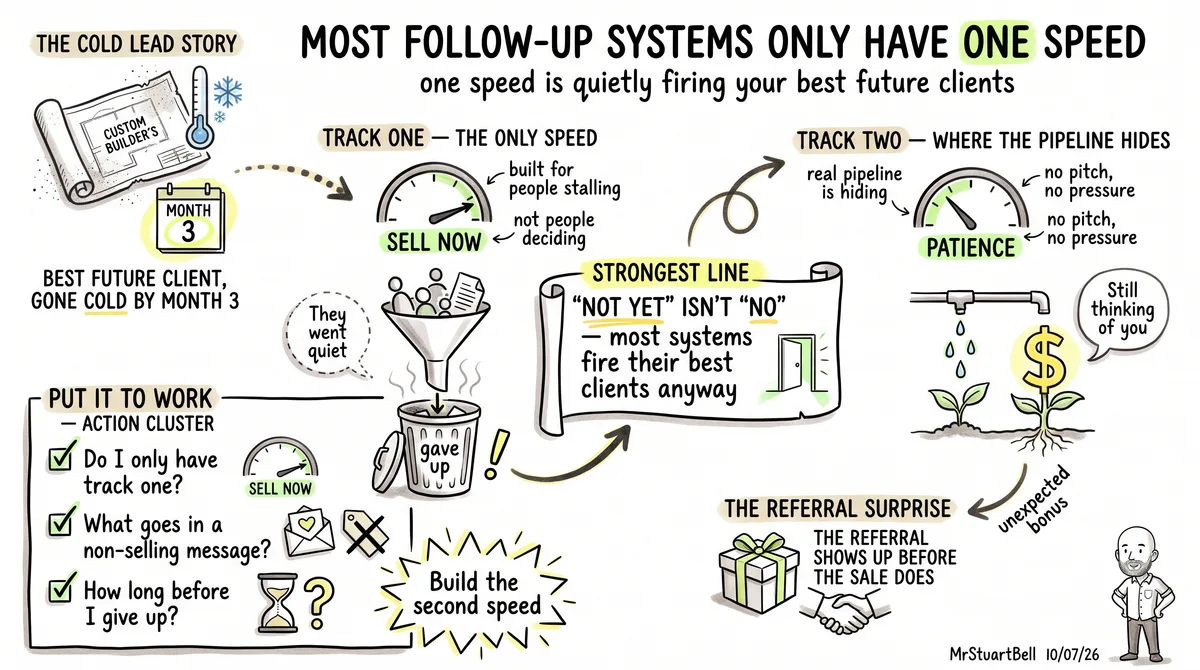
A follow-up system that only runs at one speed is quietly firing your best future clients.
A custom home builder told me about a lead who toured a finished home, loved everything about it, and wasn't ready to break ground for fourteen months. By month three, that lead had dropped off his pipeline entirely. Nobody called. Nobody emailed. The builder's follow-up system had one setting: fast. Reminders, check-ins, a nudge to schedule another tour. All of it built for someone who's ready now.
That lead wasn't ready now. He was ready in month fourteen, and by then the builder had moved on to someone who returned his calls faster.
Here's the mistake. Most owners think their follow-up is slow or fast. It's actually single-speed or missing a second speed entirely. A faster version of the same pitch, sent more often, doesn't reach someone who said "not yet." It just annoys them until they stop answering.
Track one is built for people stalling, not people deciding
Track one is short. A week, maybe two. It's for the lead who's ready, who has the budget, who toured the house and loved it, but hasn't signed. That person needs a nudge, a deadline, a reason to act this week instead of next month. Most CRMs ship with exactly this. A sequence, a few touches, done.
"They went quiet" doesn't mean "they said no." It usually means "not yet," and a business with no track for "not yet" is quietly firing its best future clients.
The problem isn't that track one exists. It's that most businesses stop there, because track one is the easy part to automate and the obvious part to build.
Track two is where the real pipeline is hiding
Track two runs for months, sometimes years. It's for the lead who loves what you do and genuinely isn't ready, whether that's budget, timing, or a life circumstance you'll never fully know. Treating that person like a dead lead by month three is how a builder loses the fourteen-month client to whoever stayed visible.
Track two isn't more selling. It's staying visible with something worth reading. A finished project. An answer to the exact question they asked on the tour. The content is the relationship, not the pitch.
Declaring a lead dead because it didn't convert in thirty days is the single most common way high-ticket businesses lose their best future clients, because the leads with the longest timelines are often the ones with the biggest budgets. They're not slow because they're not serious. They're slow because the decision is big.