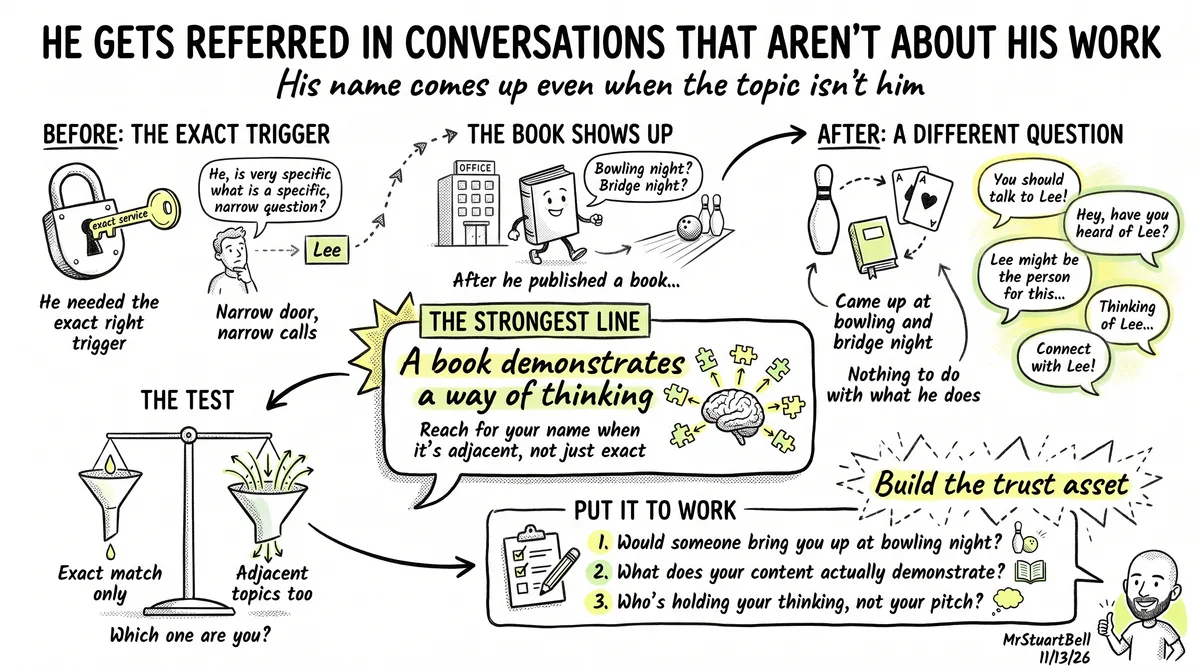
His name started coming up in conversations that had nothing to do with what he does.
Lee is an independent consultant. For years, he got referred the way most consultants get referred. Someone had a problem that matched his service description, word for word, and his name came up. No match, no referral. Narrow trigger, narrow pipeline.
Then he put out a book and a set of detailed guides laying out how he actually thinks about problems in his field. Not a pitch deck dressed up as a PDF. Real thinking, written down.
Here's what changed. People started mentioning him in conversations that had nothing to do with his actual service.
Before: he needed the exact right trigger
Before the book, Lee's referral pipeline only fired when the stars lined up. Someone had to be sitting across from a person with the specific problem Lee solves, described in close to the exact language Lee uses for it. That's a narrow window. Most conversations never hit it.
This is the referral trap almost every high-trust business owner lives in without naming it. You're easy to refer for one thing. The second someone's problem drifts even slightly off your exact service line, you disappear from their head. They don't think you're wrong for it. They just don't think of you at all.
Lee could count on one hand the number of referrals that came in a given month, and he could trace every single one back to a conversation that started with his service, word for word. That's not a weak referral network. That's a referral network with one door.
After: the book made him the answer to a different question
Once people had absorbed Lee's guides, the trigger changed. It wasn't "does this match his service" anymore. It was something closer to "who's the person who thinks clearly about this kind of problem."
One client described exactly when this kicks in: "When they're doing their job, playing bridge, whatever, bowling, whatever. If the subject comes up, where were the ones they want to recommend?"
A book doesn't just describe a service. It demonstrates a way of thinking. Once someone's absorbed that, they reach for your name whenever the topic is adjacent, not just when it's an exact match.
That's the whole mechanism in one sentence. Lee's guides didn't advertise what he sells. They showed how he sees things. People who'd read them started treating him as the person they bring up, not the vendor they file under one keyword.
Nobody decided to become Lee's referral source. They just absorbed enough of how he thinks that his name surfaced on its own, in rooms Lee never got to pitch and never needed to.