Micro-Niche Marketing

Frank's Niche Isn't an Industry. It's a Skill With a Name.

Stuart Bell 4 min read

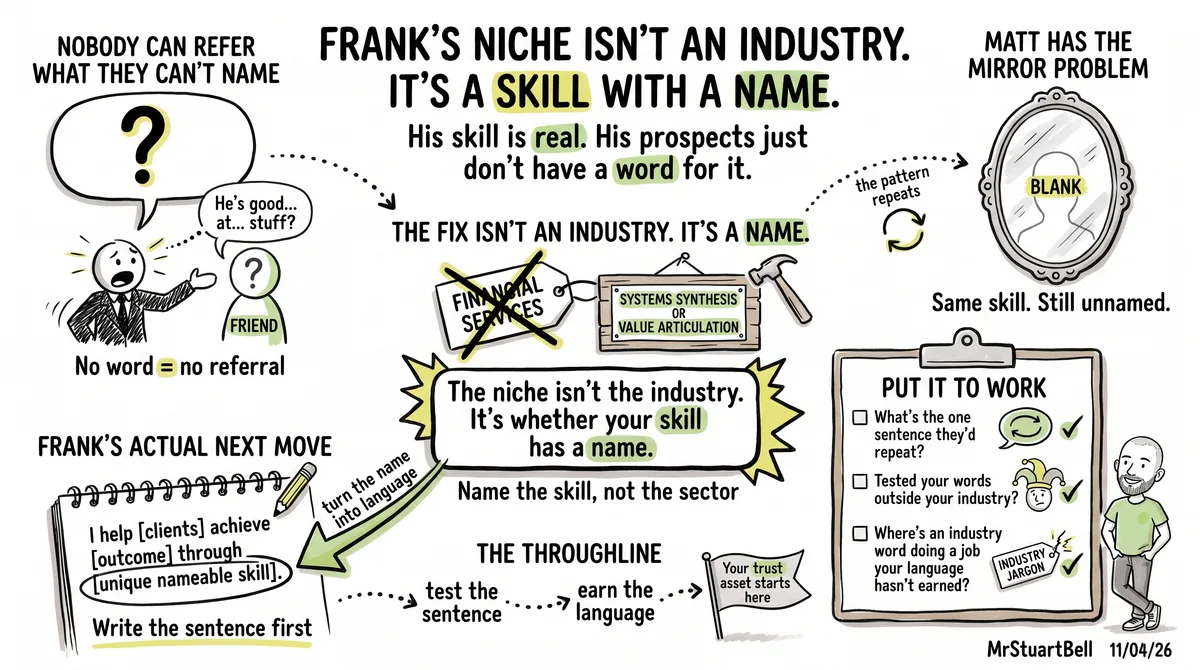
Frank's skill is real. His prospects just don't have a word for it.

Frank got on a call with me and said he wasn't going to pick one industry. His skill was the niche, he told me. Lock into a single vertical and he'd be leaving money on the table everywhere else that skill applies.

He's not wrong about the skill. I've sat through enough of these calls to know the difference between someone bluffing about their expertise and someone who's actually got it. Frank's got it.

Then, about five minutes later on the same call, he said the thing that undoes his own argument. "It only works if the customer already understands what that skill is and why it matters." Without the words for it, the specialization doesn't land, however real it is.

That's the whole problem with skill-based positioning. It's not wrong. It's incomplete.

The niche isn't the industry. It's whether your skill has a name.

Nobody can refer what they can't name

Here's where it breaks in practice. A prospect meets Frank, likes him, maybe hires him. Then a friend asks what Frank does, and the friend has nothing to reach for.

"He's good at a lot of different things" isn't a referral. It's a shrug.

Industries work as niches because everyone already carries the word for them. Say "estate planning attorney" and the listener files you instantly, no explanation needed. Say "I'm good at cross-functional problem solving" and you've said something true that means nothing to the person hearing it.

Matt has the mirror problem

Matt places candidates for a living. He's worked well outside tech and demonstrably mastered the technical knowledge those roles demand. Other recruiters still pass him over for anything outside his declared lane.

Not because he lacks the skill. Because nobody, including Matt, ever gave his skill a name a prospect could repeat to someone else. He's industry-agnostic in exactly the way Frank wants to be, except nobody built the vocabulary first.

The same gap shows up every time someone reaches for insider shorthand instead of the word a stranger would use. A niche you can't say out loud functions the same as no niche at all.

The fix isn't an industry. It's a name.

Niching down doesn't always mean an industry does the naming for you automatically. Sometimes it means doing the harder work yourself, finding the words your prospect already uses for the narrow thing you do, precisely enough that it functions exactly like an industry niche would.

That's not the same as narrowing your market down to nothing. One MSP wrote a single book for a single niche and never turned away the rest of the work. The niche is the door people walk through. It was never meant to be the only room in the house.

A valuation expert who worked three different niches is the version that actually landed. The skill stayed exactly the same skill. Only the language shifted per audience, until each one heard its own industry name reflected back at them.

Frank's actual next move

Frank doesn't need to pick real estate tax or dental practices or anything else. He needs three or four sentences that name what he does in words his prospects already use, tested on an actual prospect, not polished alone in his own head.

Matt needs the same thing before he needs a better pitch. Name the skill the way an industry names itself, and recruiters stop filing him under "generalist" and start filing him under something they can repeat to the next hiring manager.

The niche isn't always the industry. But something has to be nameable, or nobody downstream can do the one thing that actually grows a business. They can't tell somebody else about you.

Put it to work

What's the one sentence a prospect could repeat about your skill?

If you can't get there in under ten words, that's the gap. Not the skill itself.

Have you tested your language on someone outside your industry?

Your own team already speaks your shorthand. A stranger is the only honest test of whether the words travel.

Where are you asking an industry word to do a job your own language hasn't earned yet?

That's usually the exact moment "I do a lot of things" starts costing you a referral.