High-Trust Business

They Stopped Vetting You. That's Not a Compliment.

Stuart Bell 4 min read

Patients aren't trusting you more. They're vetting less, because something already did the vetting for them.

A patient sat down with two orthopedic surgeons before she let either one touch her knee. She asked the younger one how many robotic procedures he'd done. Twenty-eight hundred, he told her. Then she asked the harder question, which technique he'd pick for his own knee. He said he'd trust the senior surgeon's judgment over his own newer method. When she asked if the senior surgeon, thirty-five years in, had already peaked, he said he couldn't say.

That's what real vetting sounds like. Pointed questions, to two different providers, until she got honest answers instead of pitches. Most patients don't do that anymore.

A cosmetic surgeon told me something recently that sounded like good news. Consults are arriving more decided than they used to be, patients seriously looking at one practice instead of four or five. That's not a stronger reputation. That's Trust Bandwidth narrowing.

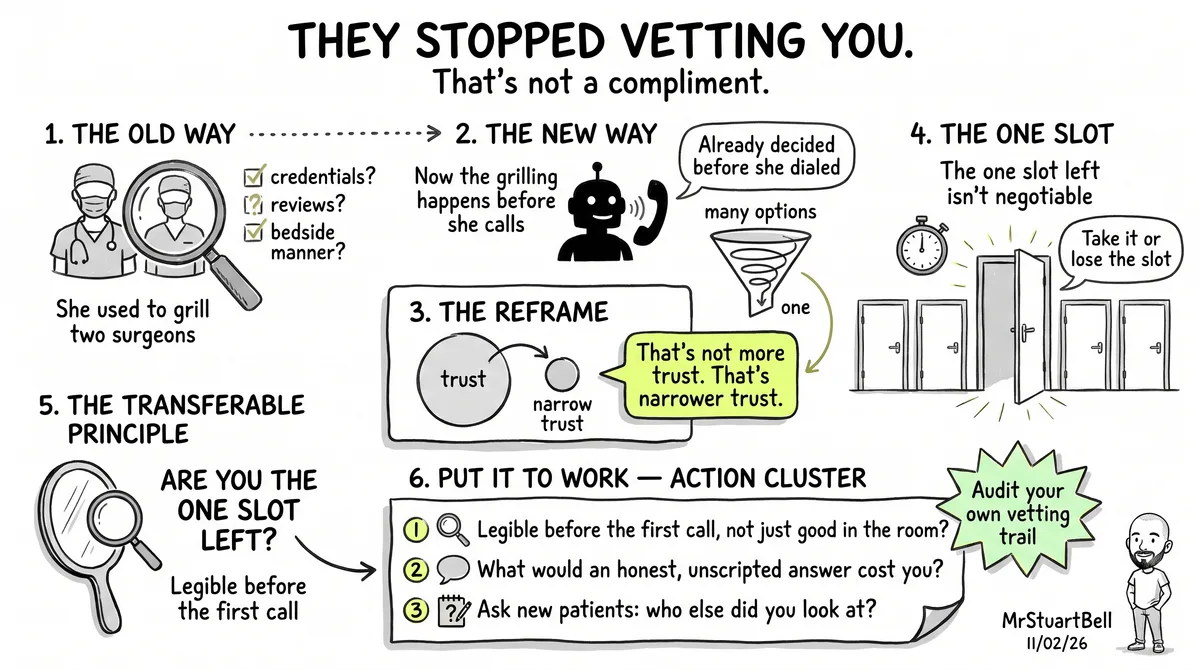
That's not more trust. That's narrower trust.

Trust Bandwidth is the amount of personal vetting a prospect is willing to do before they hand something high-stakes to someone they haven't met. AI narrows it. Not by overwhelming anyone with options. By doing the grilling quietly, before the human conversation starts, so the narrowing feels like the patient's own conclusion.

She used to grill two surgeons. Now the grilling happens before she calls.

The patient in that consult room was doing manual due diligence the hard way. Comparing procedure counts. Testing for an honest answer instead of a confident one. Checking whether the junior surgeon would admit the senior one might still be better.

Most patients never had the energy to run that comparison more than once or twice. The provider with the strongest local reputation usually won by default, because nobody was going to sit through a third consult just to be thorough. That default is gone.

An AI delegate runs that same comparison now, quietly, before anyone picks up a phone. Reviews, outcomes, how a practice talks about its own limits versus how it talks about its wins. It's the Agentic Trust Loop doing the first pass. The patient experiences the output as her own conclusion, not research she outsourced.

That's not the patient skipping due diligence. That's due diligence that doesn't look like due diligence anymore.

The one slot left isn't negotiable

Elective, high-stakes, high-trust work used to guarantee heavy manual vetting. Multiple consultations. Hours of review-reading. That volume of personal checking used to be a moat, because it took real effort for a patient to seriously compare more than two or three providers.

A narrowing Trust Bandwidth hits exactly the businesses that counted on that effort as protection. If a delegate's first pass drops you before the human conversation happens, there's no consult where you get to make your case. I've written before about why an AI shortlist isn't the finish line, and this is the sharper version of it. The conversation that used to be your chance to win the comparison now only happens with the one or two names still standing.

The senior surgeon didn't get chosen because he was more polished in the room. He got chosen because the junior surgeon's own honest answer, deferring to someone with more years in, was legible proof before anyone called either one.

This isn't only a surgeon's problem. The estate attorney who used to win every second opinion off a decades-long reputation is facing the same drop-off, and so is the financial advisor who used to be the obvious local name. Nobody told them the vetting stopped happening where they could see it.

So when consults start arriving more decided, don't read it as your reputation finally landing. Read it as a signal to check whether you're still one of the names making the cut, not just whether people like you once they meet you.

Put it to work

Are you legible before the first call, not just good in the room?

Check what's actually public about the specific procedures you do, the outcomes you report, and the limits you admit. That's what an AI delegate has to find before a patient ever dials your number.

What would an honest, unscripted answer cost you?

The junior surgeon's honesty, trusting someone else's judgment over his own newer method, is exactly the kind of specific, unscripted proof that survives an AI's first pass. Generic confidence doesn't survive it. Specific honesty does.

When did you last ask a new patient who else they looked at?

Not where they found you. Who else they seriously considered. That answer tells you whether you're the one name left standing or the only name they ever saw, and those are different problems to solve.