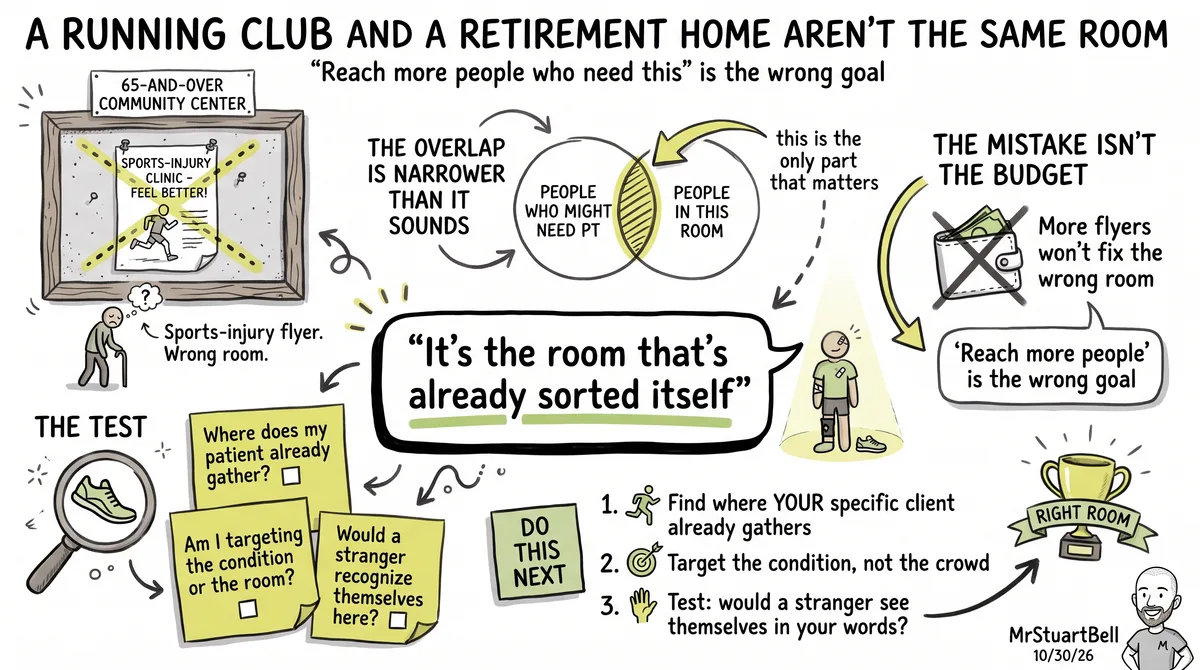
"Reach more people who need physical therapy" is the wrong goal, not just the wrong room.
A physical therapist I know specializes in sports injuries. Torn ACLs, mostly. Runners who went down hard on a trail and need six months of rehab before they're back to full pace. She put her flyer in a 65-and-over community center, because technically, a lot of people over 65 need physical therapy.
That's the myth. "People who need physical therapy" sounds like an audience. It isn't one. It's a condition, and a condition is too broad to be a room. Most of that community center has joint pain from age, not a torn ACL from a trail run. They're not her patient. They just share a diagnosis code with her patient.
Her actual patient is sitting somewhere else right now, and that place already exists. It's the running club.
The room isn't "anyone who could plausibly need this." It's the room that's already sorted itself by the one specific problem you solve.
Her flyer, two rooms:
The community center: A broad room full of people who share a diagnosis code with her patient. Most of them have a bad back from being 70, not a torn ACL from Saturday's long run. She's a stranger talking about the wrong injury. The running club: A narrow room that already pre-sorted itself. Everyone in it runs. Some percentage of them are injured right now. She's not a stranger here. She's the answer to a question half the room is already asking.
Same flyer. Same message. Two completely different rooms, and only one of them was ever going to work.
The overlap is narrower than it sounds
"People who need physical therapy" feels like the bigger audience, and bigger feels safer. It isn't bigger. It's vaguer. A runner with a torn ACL and a 70-year-old with age-related stiffness technically share a treatment category. They don't share a room, a Facebook group, a Saturday morning habit, or a reason to notice her flyer. The community center reaches more people. It reaches almost none of her people.
The test isn't "where are the most people like my patient's condition." It's "where is the room that already exists, pre-sorted by this one specific problem." A runner with a torn ACL doesn't need to be found by a demographic search. She's standing in the running club's parking lot right now, in a walking boot, talking to three other runners about the same injury.
The same logic runs in reverse for a chiropractor doing infant cranial adjustments. She doesn't belong at a general health fair, trading a table next to a dentist and a gym. She belongs in a mother-and-baby group where every single person in the room has an infant and is already paying close attention to anything that touches their baby's head. The technique doesn't change. The room does all the work.