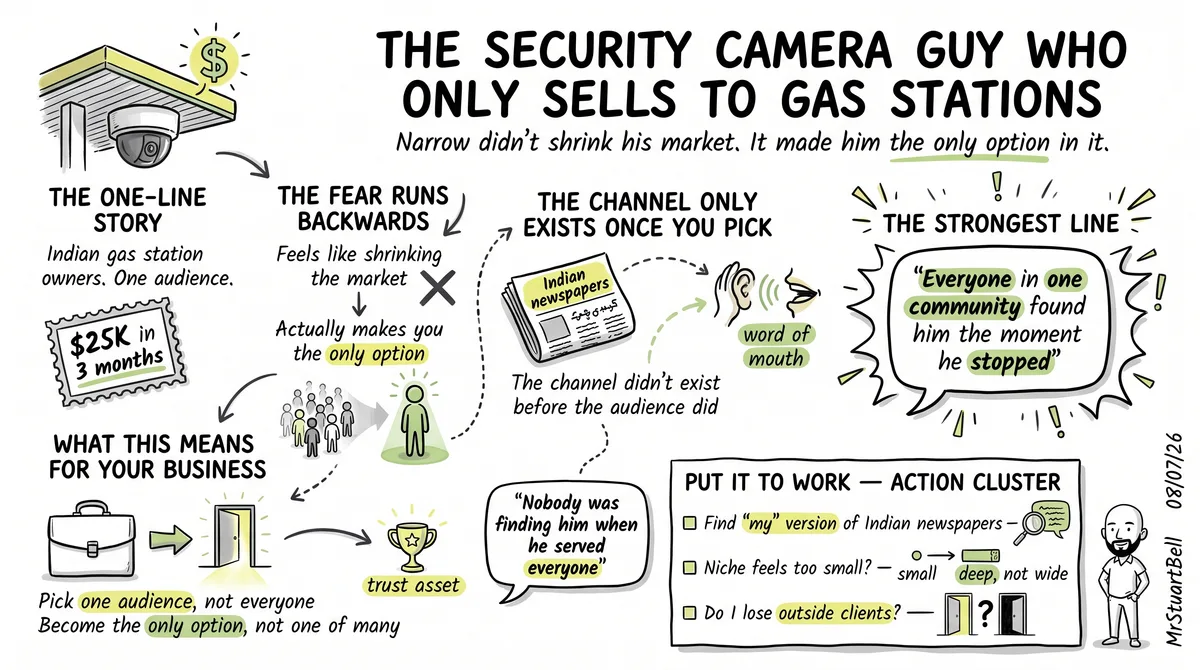
The niche didn't shrink his market. It made him the only option in it.
Beant Singh ran a security camera installation business. His target market was anyone with a building and cash to spend. That's the whole strategy, and it's the same strategy most service businesses run on by default. Advertise everywhere. Talk to anyone who'll listen. Hope enough of it sticks.
It didn't stick. So Singh picked one audience: Indian-owned gas stations. Not "gas stations." Not "small business owners." Indian gas station owners, specifically. He stopped advertising everywhere and started advertising in Indian newspapers, the ones his old generalist business would never have thought to touch. Three months later he'd made $25,000.
Here's the part that trips people up. He didn't get $25,000 by reaching more people. He got it by reaching fewer people, on purpose, through a channel that only existed because he'd named that audience in the first place.
Nobody was finding him when he served everyone. Everyone in one specific community found him the moment he stopped.
The fear runs backwards
Every business owner who's thought about narrowing down has had the same reaction: won't I shrink my market? It feels true. Fewer prospects, less revenue, obviously. Your identity wants to reach everyone. All 8 billion people, if it could. Saying no to a category of customer feels like leaving money on the table.
But Singh wasn't leaving money on the table before he niched. He was invisible to all of it. "Anyone with a building and cash" isn't an audience. It's the absence of one. Nobody searches for "anyone with a building and cash." Nobody refers a friend to the guy who does cameras for whoever needs cameras. There's no community, no publication, no conversation where that message lands, because it isn't a message. It's a shrug.
The math people run in their head is wrong, too. They picture the niche as a smaller circle inside the market they already had. It isn't. It's a different market entirely, one that didn't answer their calls before because it never heard the offer in a language it recognized as being for it.
The channel only exists once you pick the audience
This is the real mechanism, not the moral. Indian newspapers weren't a channel Singh discovered by being clever. They became a channel the moment he named a specific community as his audience. A generalist installer has no reason to advertise there. A specialist who serves that community exactly has every reason to, and gets to do it in a publication with almost no competing security camera ads in it.
That's what specificity actually buys you. Not a smaller slice of a market you were already reaching. A channel that was closed to you until you named who it was for.
The same trade is available to a fee-only advisor, an HVAC contractor, an accountant. Two accountants I know picked a lane instead of staying open to anyone with a tax return, and the same thing happened. The wider your positioning, the more crowded and expensive every channel you touch. The narrower the audience you name, the cheaper and more specific the channel gets, right up until you're the only ad in the publication your buyer actually reads.
What this means for your business
You don't have a marketing problem. You have an audience problem, and it's been disguising itself as a marketing problem. If you can't name the one group your business is for, you're advertising to "anyone with a building and cash," and you're exactly as invisible as Singh was before he picked gas stations.
You already know who you do your best work for. You've probably known for years. The only thing standing between you and your own version of Indian newspapers is saying it out loud instead of leaving it broad enough to keep the door open to everyone.
Naming your audience isn't giving anything up. It's the only way anyone finds you at all.
Put it to work
How do I find "my" version of Indian newspapers?
Name the specific audience first. The channel only reveals itself after that. A community has its own publications, associations, forums, or referral networks that a generalist never sees, because a generalist isn't looking for them.
What if my niche feels too small to support a business?
Singh didn't sell fewer systems. He sold to a community small enough to become known in fast, and connected enough to keep referring him inside it. Small and specific beats broad and invisible.
Do I lose the clients outside my niche?
No. You still get the building owner, the accountant, the advisor outside your named audience. Narrowing the message you lead with doesn't narrow who's allowed to hire you.