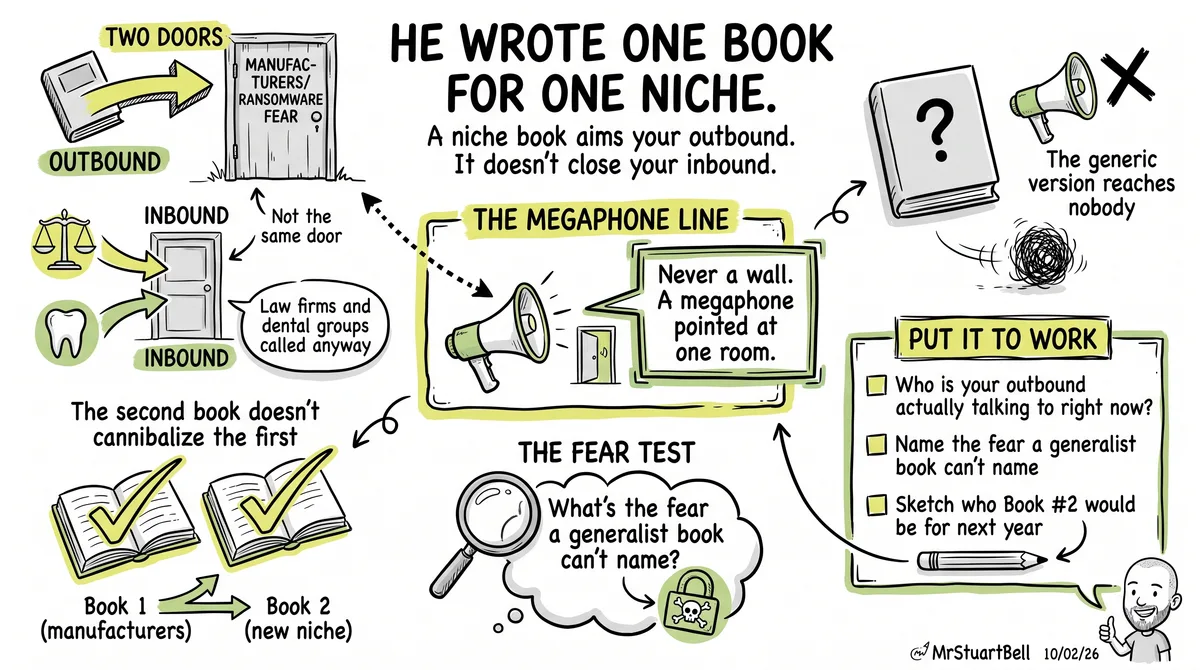
A niche book aims your outbound. It doesn't close your inbound.
"If I write for one industry, I'll lose the clients I already have in other industries." I hear that objection more than almost any other, right before someone talks themselves out of writing the book that would have worked.
An IT managed services provider wrote his book for one audience. Small manufacturers scared that ransomware would take down their production line. Every chapter is a manufacturer's fear. The examples are manufacturing examples. A dentist reading it would recognize maybe a third of the specifics.
He didn't turn away the dentist. Or the law firm. Or the accounting practice. They called anyway, because someone in manufacturing referred them.
The book was never a wall around the business. It was a megaphone pointed at one room.
Outbound and inbound aren't the same door
Here's the mechanic people miss. The book, the ads, the LinkedIn posts, those are outbound. They're the megaphone, and a megaphone only works if it's pointed somewhere specific. Inbound is a different door entirely, and it stays wide open the whole time.
A law firm that calls an MSP because a manufacturer mentioned the book doesn't care that the book wasn't written for law firms. They're not reading it for relevance to their industry. They're reading the signal. This guy wrote something specific enough that someone recommended it to a friend. That's the whole message, and it travels across industries fine.
I saw this from the other side on a call with someone building a scorecard for compliance-focused hiring. She worried her narrow book would shrink her addressable market of employers. Same fear, same false model. The book targets who you're talking to first. It doesn't gate who's allowed to call.
The confusion happens because most owners have never separated the two functions in their own head. Outbound and inbound feel like one thing, "how I get clients," so narrowing one feels like narrowing both. It isn't. You can point your outbound at manufacturers with a laser and still say yes to the dentist on Tuesday.
The generic version reaches nobody
Compare that MSP's book to the alternative: "The Complete Guide to IT Security for Any Business." That title tries to serve everyone and lands with no one. A manufacturer reading it doesn't feel like the book knows their production-line risk any better than it knows a dentist's HIPAA risk, because it doesn't. It knows nothing specific about anybody.
That's the trade nobody wants to make explicit. Narrow enough to be useful to one reader, or broad enough to be useless to all of them. There's no third option where "for everyone" also means "specific to you."
There's a referral cost to the generic version too, and it's the one owners feel but rarely name. Nobody can hand a friend "The Complete Guide to IT Security for Any Business" and say why it matters to them specifically. The manufacturer who got the ransomware book can hand it to another plant owner and say exactly what it's for. Specificity is what makes a book easy to pass along. Genericness is what makes it easy to forget.
The second book doesn't cannibalize the first
Here's the part that surprises people most. That same MSP can write a second book later, this one for dental practices or law firms, and it doesn't dilute the manufacturing book at all. Each niche book is its own megaphone, pointed at its own room. I've watched this pattern repeat across niche-specific books built on a clear framework. They create their own kind of repeat business, because the owner already knows how to build the next one.
Nobody has to choose their permanent identity when they write a niche book. They're choosing where to point the megaphone this quarter.
Put it to work
Who is your outbound actually talking to right now?
Not who you'd serve if they called. Who you're choosing to write for, advertise to, and post about. Those can be one narrow group even while your client list stays broad.
What's the specific fear your narrowest audience has that a generalist book can't name?
A manufacturer fears the production line stopping. A dentist fears a HIPAA violation. Pick the fear you can describe in someone else's exact words, and build around it.
If you wrote a second niche book next year, who would it be for?
You don't have to answer today. But if the answer comes easily, that's evidence your first book isn't a wall. It's just the first room you lit up.
Specialists get chosen because they aim their message at one audience, not because they refuse business from anyone else. The security camera installer who only advertised to gas station owners still took every job that came his way. The valuation expert who stopped saying "valuation services" and named three niches instead didn't shrink his practice. He made it possible for the right referral to find him at all.
Write the narrow book. The wide door was never closed.