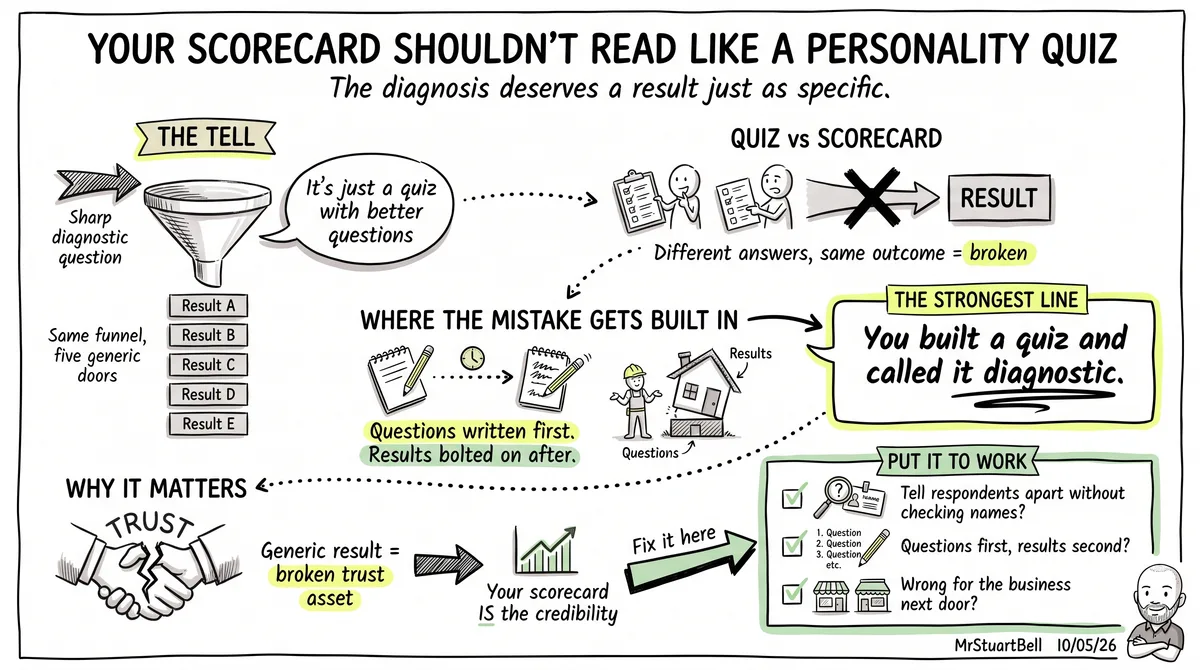
A sharp diagnostic question followed by a generic result isn't a scorecard. It's a quiz with better questions.
A marketing agency owner ran through Dean Jackson's Profit Activator Scorecard last month. He answered a set of questions about how he gets clients, what he charges, how his pipeline actually fills up. What came back wasn't a bucket. It was a sentence built for him: "great delivery engine with excellent offers, but the pipeline is starving from weak targeting in the first place."
Read that again. That's not a quiz result. Nobody else who took that scorecard got that sentence, because nobody else answered his questions the way he did. That's a diagnosis, and a diagnosis has to be wrong for the agency next door or it isn't one.
The tell that separates a scorecard from a quiz
Most of what gets called a scorecard right now is a quiz wearing a scorecard's clothes. The quiz-vs-scorecard distinction usually gets framed as a questions problem. Ask about strategy instead of personality and you've built a diagnostic. That's half of it.
The other half shows up on the result screen. A quiz can only ever tell someone which of five buckets they landed in. "Strategic Visionary." "Growth Stage." Whatever the label is, four other respondents got the same one this week. A real scorecard has to be able to say something that would be flat wrong for the business sitting next to it. Excellent offers and a starved pipeline is a specific failure. So is the opposite. So is a dozen other combinations that don't fit any of them.
If two respondents with different answers would get the same result, you didn't build a scorecard. You built a quiz and called it diagnostic.
Where the mistake actually gets built in
Here's how it happens, almost every time. Someone sits down to build their scorecard and starts with the questions, because the questions are the fun part. They're specific, they're clever, they sound like something a real consultant would ask. Then they get to the results, and they're tired, and they write five paragraphs of feedback and route every respondent into one of them.
The questions were sharp. The output wasn't. And the person who built it usually can't see the gap, because they know the diagnosis cold. They've been doing this work for years. They can read someone's answers and know exactly what's wrong in about four seconds. What they don't notice is that their result copy still reads like a template, because writing five templates felt like enough work at the time.
It isn't a technology problem anymore either. A scorecard used to have no choice but to blend a handful of pre-written outcomes together and call it personalized. Giving a genuinely nuanced answer, one shaped by the actual combination of things someone said rather than which single box got checked, was closer to a research project than a weekend build. That excuse is gone now. The tools that write a one-off sentence for one specific respondent exist and work. The excuse for shipping five buckets is the same one it's always been: the result copy needed the same care as the questions, and it didn't get it.
Why this matters more than it looks
The scorecard proves you understood the question, not just that you asked a good one. A prospect filling out an assessment isn't just being sorted. They're finding out, before they've ever spoken to you, whether you actually looked at their answers or just routed them to the nearest generic bucket. That's the whole prove-it argument applied to an assessment instead of a book. Your prospect has read a hundred pieces of content that could have been written for anyone. The scorecard is the one moment you get to prove yours couldn't have been.
The agency owner who got that pipeline-and-targeting sentence didn't need convincing that his delivery was strong. He already knew that. What he needed was proof that something looked at his specific situation and named the actual gap. That's what got him to reply.
Put it to work
Can you tell which respondent got which result without checking the name?
Pull up your last ten scorecard completions and read the results with the names covered. If two or three read interchangeably, you're running a quiz.
Did you write the questions first and the results second?
If the result templates got written in an afternoon after weeks on the questions, that's where to go back and do the real work.
Would this result be wrong for the business next door?
A diagnosis that's true for everyone in your niche isn't a diagnosis. Test every result against the business that would answer completely differently.