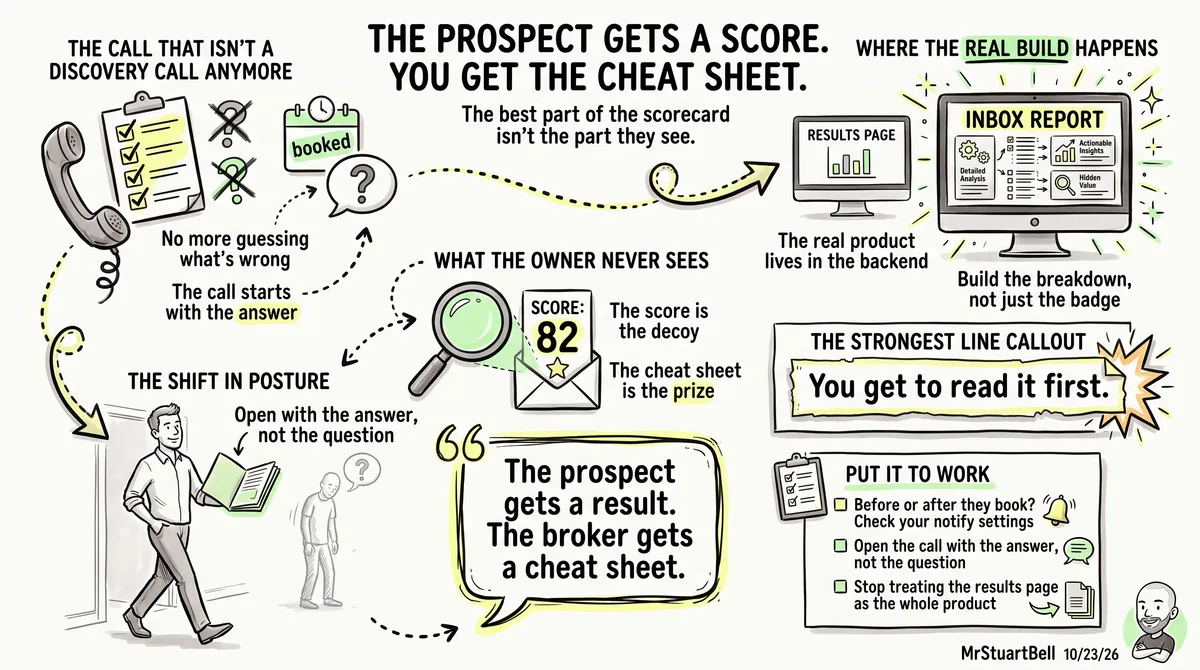
A scorecard's best feature isn't the score it hands the prospect. It's the one you get to read first.
A commercial real estate broker's phone buzzes on a Tuesday afternoon. A building owner just finished a lease-renewal-readiness assessment on his site. Before the broker has said a single word to him, he's looking at the breakdown: strong on tenant relationships, exposed on lease-expiration timing, roughly two quarters out from a renewal conversation nobody on the owner's side has started yet. The broker hasn't dialed the number. He already knows more about this owner's exposure than the owner has said out loud to anyone.
That's not how anyone pitches a scorecard. The pitch is always about the prospect. Answer eight questions, get a personalized result, see where you stand. True, and also the less useful half if you're the one running the funnel.
The call that isn't a discovery call anymore
Most first calls in a high-trust business start the same way. Fifteen minutes of questions before the real conversation can begin. What's going on with your portfolio. What's working. Where's the gap. Every broker who's ever run that opening thinks of it as the job, not as an obstacle he built himself.
Flip the order and the fifteen minutes disappears. The broker calls back and doesn't ask what's going on with the building. He opens with it. "Your tenant relationships look solid, I can see that in how you answered question four. Where I'd want to spend our time is the renewal window, because that's where you're exposed." The owner doesn't experience a sales call. He experiences someone who understood his building before they'd ever met.
The prospect experiences a personalized result. The broker experiences a cheat sheet.
That's the trade most brokers would miss if they built this themselves. A quiz gets clicks. A scorecard gets clients, and the difference shows up twice: once in the questions the prospect answers, and again in the dashboard the business owner never thinks to ask for.
Where the real build happens
Here's the mistake. Someone sets out to build a scorecard, gets excited about the front end, the questions, the branding, the result page the prospect sees. All of that matters. None of it is the part that changes how the first call goes.
The part that changes the call is the notification. The per-prospect breakdown that lands in the broker's inbox the moment someone finishes, showing exactly which pillar is weak and exactly what to say about it. Build the quiz and stop there, and you've made a nice lead magnet that still forces you to spend the first fifteen minutes of every call finding out what the scorecard already knew. Writing sharp result copy for the prospect isn't optional either, but a sharp result that only the prospect sees is still half a tool.
Think about what that backend view actually does to a sales process. It doesn't just save fifteen minutes. It changes what the broker is doing in those fifteen minutes. He's not diagnosing anymore. He's confirming a diagnosis he already ran, out loud, in front of the one person who can tell him if he's wrong. That reads to the owner as something most brokers never manage to communicate: this person already understands my building.
What the owner never sees
The owner who filled out that assessment thinks he got a personalized report. He has no idea the broker got the same report first, with his name attached, hours before the call. That's the same gap that trips up a lot of scorecards built around the wrong question. The front end gets all the attention because it's the part prospects see and the part that's easy to demo. The backend is the part that actually earns the next call.
The owner doesn't need to know any of that to feel the difference. He just needs to notice that this broker, unlike the last three, didn't spend the first call finding out what he already told a form.
Put it to work
Does your scorecard notify you before or after the prospect books a call?
If you're only finding out what they said when they're already on the phone, you built a lead magnet. The diagnosis needs to land in your inbox first.
Could you open your next call with the answer instead of the question?
Pull the last completed assessment and write the first sentence you'd say to that prospect. If it's still a question, the backend isn't doing its job yet.
Are you treating the results page as the whole product?
The prospect's result matters, but it's the half everyone builds. Ask what the person running the scorecard sees, not just what the prospect sees.