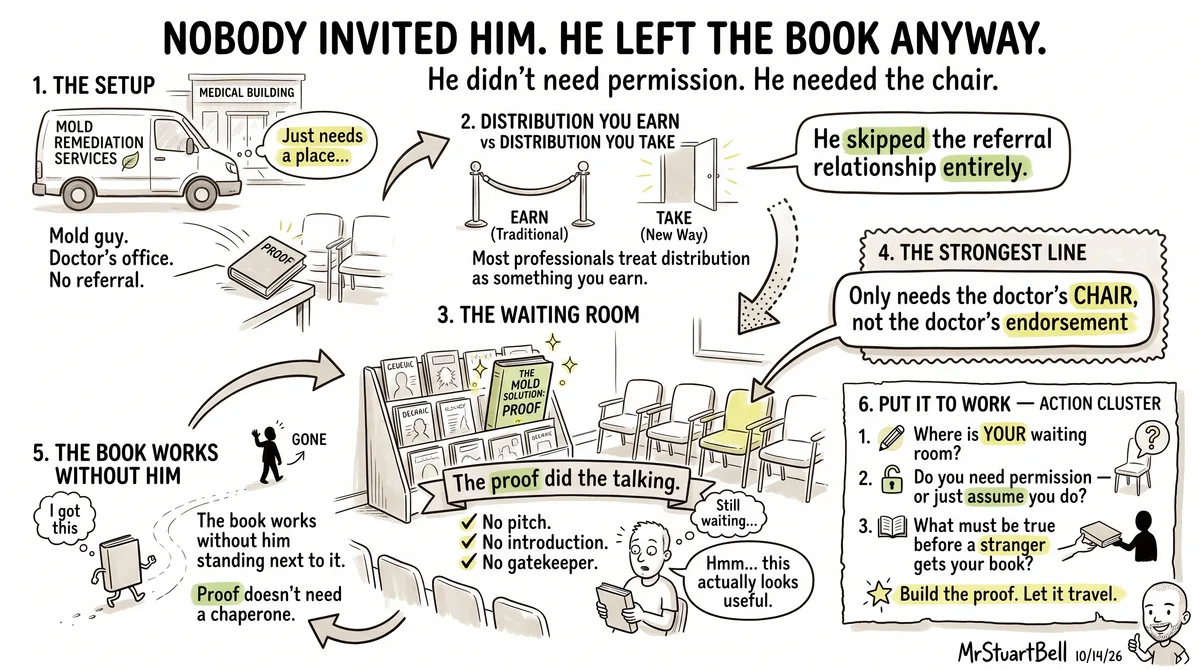
He didn't wait for the doctor's permission. He only needed the doctor's chair.
He runs a mold remediation company. Ten copies of his book under his arm, no appointment, no referral, nobody in the building has ever heard his name. He walks into a doctor's office, sets the stack on the magazine table in the waiting room, says good morning to the receptionist, and leaves.
The book covers what actually shows up on a home inspection, what a real remediation job involves, and how to tell a legitimate quote from a scare tactic. On the back cover, a sticker with his number.
He does this in doctors' offices because that's exactly where someone already worried about water damage sits with nothing to do but read. A patient waiting on test results, thinking about the stain on their bathroom ceiling, picks up his book instead of a magazine that's three years out of date. He's not interrupting anyone's day. He's handing someone exactly what they were already thinking about.
He doesn't need the doctor's endorsement. He only needs the doctor's chair.
Most professionals treat distribution as something you earn
That's the default move. Build the relationship first. Get the referral program in place. Wait for the partnership, or the warm introduction, before you put anything in front of a stranger. Months of calls, a pitch to the practice manager, maybe a formal agreement before a single book touches that table.
He skipped all of it. No formal relationship with a single doctor's office he's dropped books in. No compliance sign-off, no revenue-share conversation, no meeting on the calendar. Just a stack of books and the chair somebody's already sitting in.
That's not a growth hack. That's a bet that the book does the trust-building a cold pitch never could, to ten strangers at once, without him in the room to make the case. And the bet costs him an afternoon and the price of printing, not a quarter of relationship-building.
The book works without him standing next to it
I've seen 90-Minute Books clients use physical copies this way for years. One doctor hands a copy to a patient mid-consultation, the page doing double duty as something they take home and reread later. Another uses copies as a referral tool with existing clients, handing off the book instead of a business card that gets thrown out with the junk mail.
None of them are in the room when the book does its job. The pages carry the proof that credentials alone don't carry anymore. A homeowner reading a chapter on how to spot a fake remediation quote doesn't need him there explaining it. The book already did the explaining, and it did it better than a pitch would, because nobody's trying to sell them anything mid-chapter.
The objection I hear most when I tell this story is simple. Doesn't giving away the whole book undercut the actual meeting? If it already explains everything, why would anyone call? It's backwards. A prospect who reads your book before calling isn't skipping the conversation. They're arriving at it already sold on you specifically, already able to spot a bad quote when the next contractor tries one on them, which is a better call than the one who found him cold with no idea what a legitimate job even looks like.
There's no exclusivity to protect either. He's not asking the doctor's office to only recommend him. He's not asking for anything. If a patient reads the book and calls someone else, he's out ten dollars of printing and nothing else. If one patient in fifty calls him instead, the ten doctors' offices paid for themselves many times over.
He's not waiting for the doctor's office to become a partner. He's not waiting for a referral channel to exist before he's "allowed" to show up. He prints ten books, drops them where the right person is already sitting, and lets the book do what a cold call can't.
Put it to work
Where is your version of the waiting room?
Somewhere your prospect is already sitting, already thinking about the exact problem you solve, with nothing else to do. That room already exists. You just haven't put anything in it.
Do you actually need permission, or have you just assumed you do?
If what you're distributing is genuinely useful to the person receiving it, most of the "permission" you think you need is a story you're telling yourself to avoid something that feels forward.
What would have to be true about your book before you'd hand it to a stranger with no introduction?
If the answer is "it would need to prove something real on its own," you've just described the bar. Build to it, then go find your waiting room.