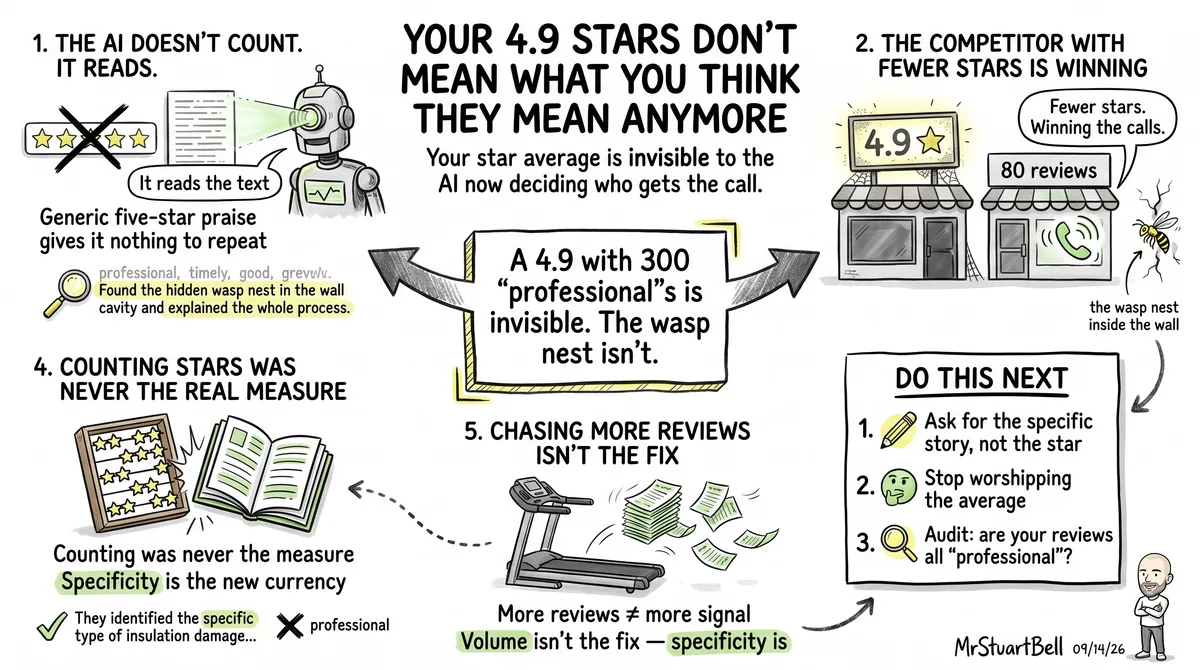
Your star average is invisible to the AI now deciding who gets the call for you.
Mark runs a pest control company outside Charlotte. Every Monday morning he pulls up his Google Business listing and checks the same two numbers: 4.9 stars, 340 reviews. Two years of steady work built that number, and it's the thing that tells him he's winning.
More stars, more reviews, more business. That's the assumption almost every service business owner still makes. It held up fine for a decade, because the person reading those reviews was a homeowner scrolling past ten listings in ten seconds, and a big number next to a lot of stars is exactly what that person needed to decide fast.
That's not who's reading the reviews anymore.
The AI doesn't count. It reads.
A homeowner with a wasp problem this year doesn't scroll ten listings. She opens ChatGPT and asks who to call. The AI doesn't see 4.9 stars and 340 reviews the way she used to. It reads the actual text of every review, looking for something specific and repeatable it can hand back as an answer.
"Great service, very professional, on time" is a five-star review, and it's also completely useless to a model trying to generate a recommendation. There's nothing in it to repeat. Three hundred versions of that sentence add up to a number, not an answer.
A 4.9 with three hundred reviews that all say "professional" is invisible to the thing doing the recommending now. An 80-review competitor who mentions the wasp nest inside the wall is not.
The competitor with fewer stars is winning the calls
Picture Mark's competitor across town. Eighty reviews, maybe 4.6 stars, nothing close to Mark's number on paper. But a chunk of those reviews say something like "got rid of a wasp nest that was inside our bedroom wall in one visit" or "found carpenter ants three other companies missed." That's specific. That's describable. That's exactly the kind of detail an AI can lift out and hand back to someone asking who handles wasps inside a wall.
This is the same mechanic behind AI recommending your competitors by name when a prospect asks who does what you do. The homeowner never sees Mark's 4.9. She sees an answer built from language that happens to exist in someone else's reviews and not his.
Counting stars was never the real measure
Stuart has said this for years about a different metric: count the calls, not the clicks. There's no dashboard for whether a relationship is real, and a click was never proof that trust existed. The star average has the same problem, just later in the funnel. It was always a proxy standing in for something you couldn't measure directly, and it worked only because the reader doing the counting was a person willing to accept a proxy.
An AI generating a recommendation isn't accepting a proxy. It's looking for the real thing, which here is specific, checkable language about a specific, checkable outcome. That's the same shift behind what Google now rewards that AI can't fake elsewhere in search: proof over polish. A star average never contained proof. It just used to be good enough.
Chasing more reviews isn't the fix
Mark's instinct will be to go get more reviews. That's the wrong lever. More generic five-star praise makes the average look better and does nothing for the thing that actually decides who gets recommended now.
The fix is what you ask happy customers to write about. Not "leave us a review," which produces "great service, would recommend." Ask the real question: what was the problem, and what did we actually do about it. That produces "they found the wasp nest inside the wall that two other companies missed," which a model can use and a person skimming reviews can use too.
You don't need three hundred of those. You need enough that the specific, repeatable stuff outnumbers the generic stuff in whatever a model reads when it goes looking, which matters even to your existing customers, who are already running the same quiet confirmation check on you that a new prospect runs before the first call.
Mark still checks his rating every Monday. He should. It's just not the number that decides whether he gets the next call anymore.
Put it to work
How do I get reviews that actually say something specific?
Ask a different question when you request the review. Instead of "how was your experience," ask "what was the problem before we showed up, and what did we actually do." You're prompting for the sentence you need, not hoping someone writes it unprompted.
Should I stop caring about my star average?
No, just stop treating it as the whole picture. Keep the rating healthy, but put your energy into the text of the reviews themselves. That's the part doing the work now.
What if my reviews are already mostly generic?
Go back through your last twenty jobs and ask three or four of the best ones for a specific follow-up review naming the actual problem you solved. You don't need to replace three hundred reviews. You need enough specific ones to give the model something to repeat.