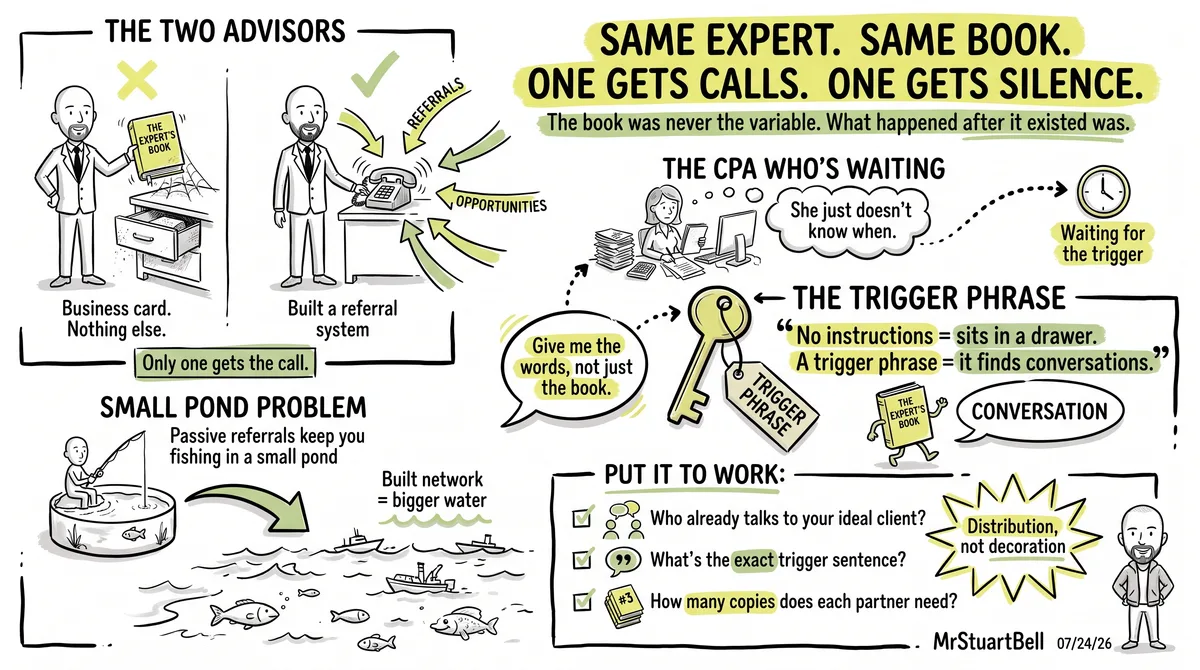
The book was never the variable. What happened after it existed was.
Two financial advisors hire the same team to build the same kind of book. Same length. Same chapter structure. Same production process, start to finish. A year later, one of them is fielding calls from prospects who already trust him before he picks up the phone. The other has a box of copies sitting in his garage that hasn't been touched since the launch.
The book didn't change between them. What happened next did.
The first advisor treats the book like a business card. He hands out copies at conferences, keeps a stack on his desk for walk-ins, mentions it in his email signature. He measures success by how many copies he's given away. Ask him how many calls it's generated and he shrugs. "That's not really the point," he says. "It's more of a credibility thing."
The second advisor treats the book as a referral system. He gave ten copies each to the CPAs and estate attorneys he already sends work to, and he told them exactly when to hand one over. "Next time a client tells you they're worried about outliving their money, give them this." Not "here's my book, pass it around if you feel like it." A specific trigger, tied to a sentence he knows his referral partners hear from their own clients all the time.
Give someone something valuable with no instructions and it sits in a drawer. Give them the same thing with a trigger phrase attached, and it starts finding its way into conversations you'll never see happen.
The CPA already wants to send you business. She just doesn't know when.
Most referral relationships don't fail because the CPA doesn't trust the advisor. Trust isn't the bottleneck. The moment is. A CPA sits across from a client who mentions a health scare, an inheritance, a business sale, and she has about four seconds to decide whether that's a "call my advisor friend" moment or a "make a note and move on" moment. Most of the time she moves on. Not because she doesn't want to help. Because nobody ever told her which sentence to listen for.
That's the piece almost nobody builds. Referral partners get handed a book, a stack of business cards, a "let me know if you ever hear of anyone." What they don't get is the exact line that turns a routine client conversation into a referral. Wait for a client to say something close to "I don't know what happens to this money after I'm gone" and that's the cue. Hand over the book right then. That's a completely different instruction than "here's some marketing material."