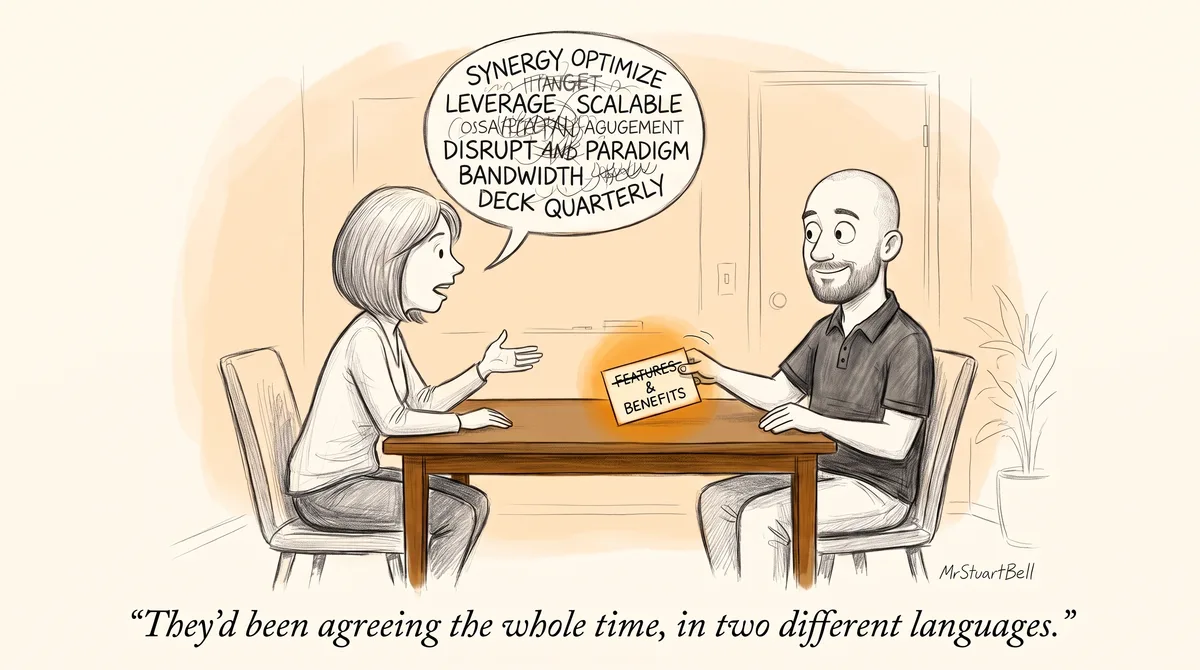
Insider language feels like fluency. To the person across the table, it reads as "you're not on my side."
Last week I got on a call with Shannon Milliken, who runs a nonprofit called PLAY Education. No agenda, just two people comparing notes across a fence. It was great and we really got onto a problem that turns out to be the same in her world and mine.
How do you get two groups who genuinely need each other to actually understand each other?
Her side of it is helping nonprofits engage businesses. Typically a nonprofit approaches a small business about partnering. The business says "we don't want our logo on some banner, the return isn't there." So the nonprofit asks the obvious next question. "Okay, what would a good partnership look like to you?" And the business says "I don't know."
It's a gap nobody in the room can name. It's the gap Shannon is helping solve.
Outputs and outcomes
The distinction she brought to it was outputs versus outcomes.
An output is the tangible thing. "Your donation put 50 backpacks in the hands of 50 families." Easy to see, easy to count, fits neatly inside a grant report.
An outcome is what actually changes. A kid with a backpack is better organized, so less homework goes missing and less chance a missed assignment turns into trouble with a teacher. A shift that changes how their whole year goes, but an outcome that's five or six steps down the road, and not an output you measure inside a quarter.
The problem is nonprofits have an internal outcomes language small-business owners don't resonate with, so they fall back to talking about outputs. Outputs that business owners don't really see a return from, but they don't have the language to talk about the outcomes they're passionate about either.
The same idea has a different name in every industry. The skill isn't knowing the idea. It's translating it into the language of whoever's sitting across from you.
Outputs are features. Outcomes are benefits. Sell the sizzle, not the steak. Every marketer has heard it a hundred times. But if your organization doesn't have that framework, it's easy to fall back on bad habits.
Almost everyone defaults to features and outputs when there's a language gap because it seems simpler. When the outcomes language gets lost, we fall back on the numbers that seem obvious.
But the person listening is reaching for the outcome. They want the benefit (even if that benefit is for others).
Measure one while they're feeling for the other, and you get a quiet disconnect neither side can quite explain. It's the same reason nobody remembers your elevator pitch. You gave them the features. They wanted to know the benefits that are going to change the things they care about.
And as the person on the sell side, it's your job to close that outcomes gap with words they connect with, not default to the easy feature list.
Signal becomes noise
Language exists to close the gap between people. In your own world insider words speed everything up, because you don't have to stop and define them to colleagues. That's a feature, not a bug. Right up until that insider language crosses the border into someone else's world.
It's the curse of knowledge doing its quiet damage. The more fluent you are in your field, the harder it gets to remember what it sounds like to someone who isn't.
Watch anyone in a specialist shop bury a first-time customer in jargon. The customer nods along, understands nothing, and walks out. The words weren't wrong. They just weren't for them.
It's what insider language like health equity or social determinants of health does to a small-business owner. They might be passionate about the same outcome, but if your language is a turn-off, or you default back to output basics they don't see a return on, you'll never get the chance to find out.
For a high-trust business, this is where it gets expensive. When someone has to buy you before they buy the service, trust is the actual product. Nothing breaks trust faster than making a person feel stupid, even by accident, even when you're only being fluent in your own field. Insider language reads as a closed door. Tailored language reads as "I see you, and I'm on your side."
That's the real reason to be clear, not clever: clever protects your ego, clear builds their trust.
Somebody has to build the bridge
The two sides rarely close the gap on their own. They're each too deep in their own world. The person inside a big organization is anchored to their department objectives. The small-business owner is anchored to keeping the lights on. Neither one looks up and spots the overlap. It's the gap Shannon is helping close in her world, and the gap I help high-trust business owners close in mine.
So we point at it, name the alignment out loud, in their words, and don't wait for the other side to find it themselves.
That's the whole reason your book or your scorecard works as a trust tool. It's an act of translation. It takes what you know and positions it in the language and the world of the person you're trying to reach, before either of you gets on a call.
As we were talking, Shannon said it plainly. "Features and benefits. If that's the language businesses use, I need to change my language." And that's usually the gap for all of us. Not the expertise on either side, but the words wrapped around it.
Put it to work
How do I know if I'm the one using insider language?
If you'd have to stop and define a word before the other person understood it, it's insider language. Assume every term that's specific to your field is insider-speak until you've watched it land on a real person from outside your world.
Outputs or outcomes, which do I lead with?
Lead with the outcome. What changes for them, in their life or their business. Then use the output as proof it's real. Most people do it backwards, opening with the specs and hoping the meaning arrives on its own.
What if I'm talking to three different people?
Then you translate the same truth three different ways. The person in front of you sets the language, every time. Not the average of the room, and definitely not your own default.