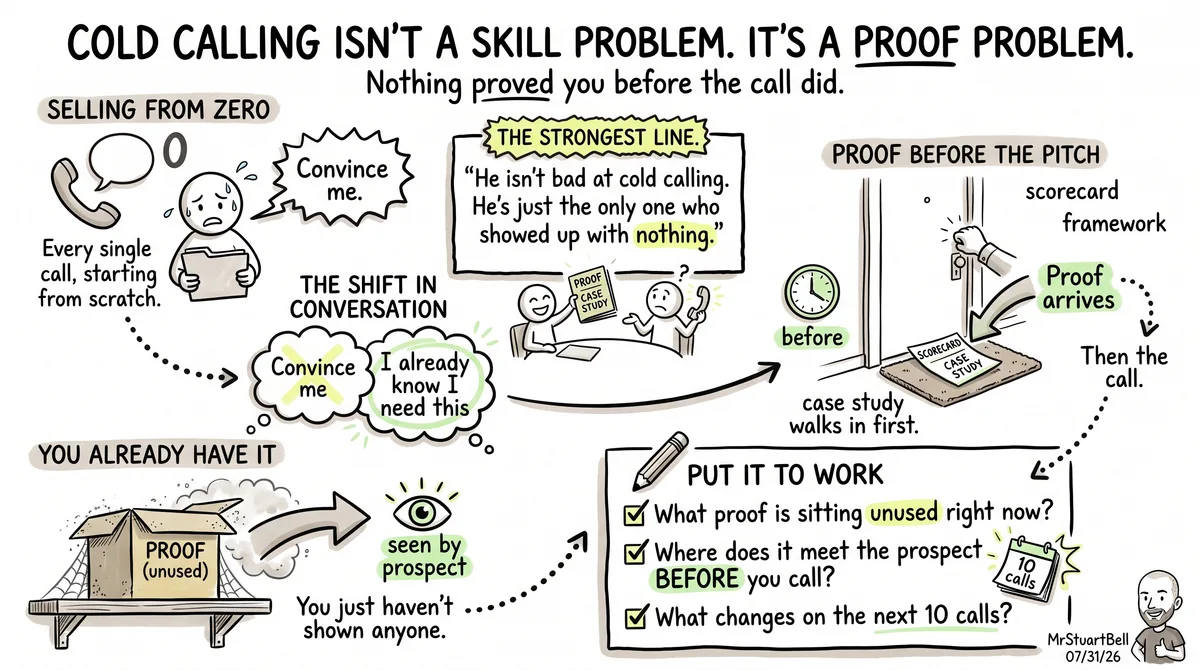
Cold outreach doesn't fail because of a weak pitch. It fails because nothing proved you before the call did.
An HVAC contractor works a list of homeowners whose furnaces are old enough to need replacing. Ninety calls. Nine people who don't hang up before he finishes his second sentence. He assumes the fix is obvious. Sharper script. Better timing on when he calls. Thicker skin for the eighty-one who hang up.
He rewrites the script. Same result. He starts calling earlier in the evening. Same result. Somewhere around month four he starts wondering if he's just bad at this.
He isn't. The tenth call that goes somewhere doesn't go better because his pitch improved. It goes better because that homeowner already saw something of his before the phone rang, a finished job two doors down, a review a neighbor mentioned, a checklist someone forwarded. The other eighty-nine hadn't seen anything. They were meeting him and his pitch at the exact same moment, cold.
He isn't bad at cold calling. He's just the only one on the call who showed up with nothing.
He's selling from zero. Every single time.
That's the default state for most professionals, not just HVAC guys. No proof, no positioning, no pre-frame. They walk into every conversation, every call, every meeting, having to build credibility from scratch, as if they've never done a job before and have no evidence otherwise.
The instinct when a call goes badly is to blame delivery. Better scripts, more calls, thicker skin, a course on objection handling. All of that assumes the gap is skill. It almost never is. The gap is that the prospect is meeting you for the first time in the exact moment you're also asking them for money. That's the hardest possible spot to sell from, and it's the spot cold outreach puts you in by default.
Sending more of the same pitch to more people doesn't fix this. It just repeats the problem at volume. Generic outreach, even personalized with real data, still lands as a numbers game to the person on the other end, because the thing missing isn't personalization. It's proof.
What "proof before the pitch" actually looks like
This is the shift. At zero, your first contact with a prospect is a sales conversation, you proving yourself live, in the room, from nothing. One layer up, your first touchpoint already delivered value before the ask ever happened.
For the HVAC guy, that's not complicated. A before-and-after photo of the last three furnace jobs on his street. A one-page checklist homeowners can use to tell if their unit is on its last legs, given away before he ever picks up the phone. A short diagnostic that asks five questions about the furnace's age, noise, and energy bills, and tells the homeowner where they land.
A homeowner who's seen one of those walks into the call already halfway convinced. A homeowner who's seen nothing is being sold to cold, no matter how good the script is. Same guy, same furnace, same price. Completely different call.
You already have the proof. You just haven't shown anyone.
This is the part that surprises people. Almost every high-trust business owner already has the raw material sitting around unused. Finished jobs. Client results. A framework they've built in their head over years of doing the work. They've just never turned it into something a prospect encounters before the phone rings.
That's a different fix than sales training, and it's a faster one. You don't need a better close. You need a proof asset doing the talking before you ever dial the number, so the prospect who picks up isn't a stranger deciding whether to trust you. They're someone who already decided, and is calling to find out what's next.
The HVAC guy who's still rewriting his script hasn't fixed anything by month six. The one who put a checklist in front of a hundred homeowners before he called a single one of them isn't pitching anymore. He's confirming what they already believe.
Put it to work
What proof do you already have sitting unused?
Finished jobs, before-and-afters, a framework you explain to every client. Pick the one piece that would make a stranger nod before you ever say a word to them.
Where does a prospect encounter that proof before they encounter you?
A checklist, a short diagnostic, a page they land on from a referral. It doesn't need to be complicated. It needs to exist before the call, not during it.
What would change about your next ten calls if every one of them started at "I already know I need this" instead of "convince me"?
That's the difference between selling from zero and confirming what someone already decided. Cold outreach stops feeling cold the moment there's something in front of it.