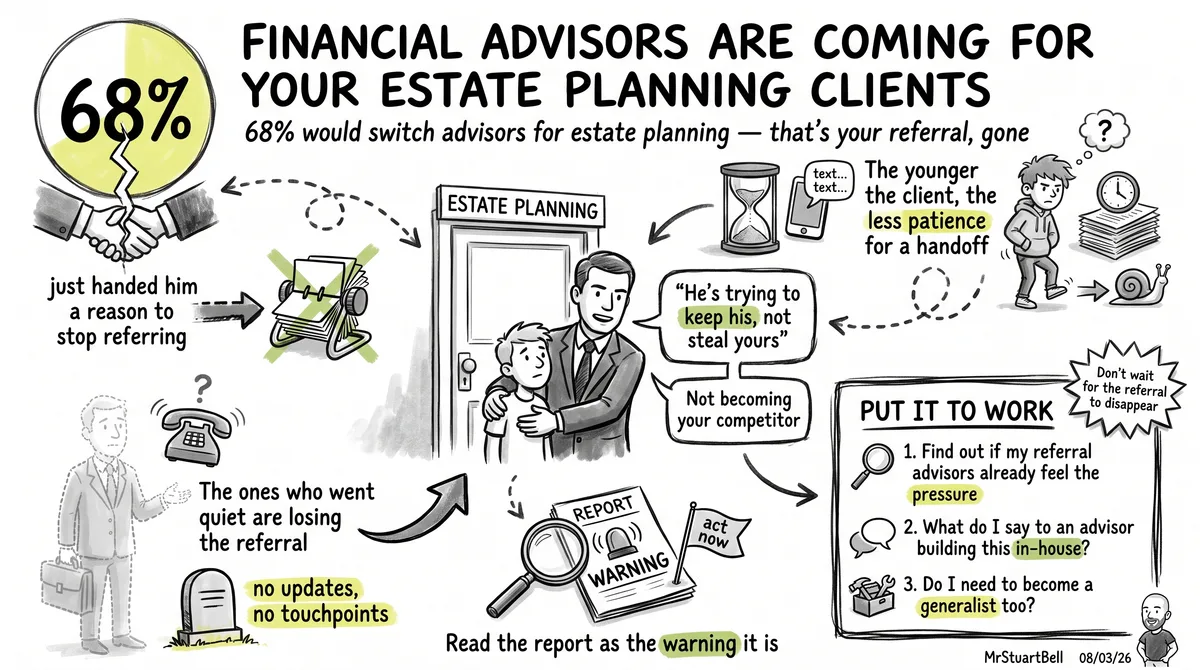
Your best referral source has a reason to stop referring, and 68% of his clients just handed it to him.
Trust & Will published its 2026 Financial Advisor Report in July, a national survey of 1,500 U.S. adults. The number that matters isn't the one about advisors. It's the one about their clients. 68% said they'd consider switching advisors to get estate planning under one roof. 61% think their advisor should already offer it, not as a bonus, as a baseline.
Read that as advisor industry news and you shrug and move on. Read it as an estate planning attorney whose best referrals have come from financial advisors for years, and it says something else. The person who's been sending you business is now getting pressure from his own clients to keep that business in-house.
The younger the client, the less patience for a handoff
Gen Z advisor adoption of estate planning jumped from 28% to 42% in a single year. Millennial adoption moved from 29% to 39%. These are the clients advisors are fighting hardest to keep, and they're the ones who expect one person and one relationship to handle their whole financial life. They didn't grow up thinking of "my advisor" and "my estate attorney" as separate people in separate offices. They see friction.
That's not a stat about a new service line. That's a generation deciding the handoff itself is the problem.
The advisor isn't trying to become your competitor. He's trying to stop losing clients at the exact moment he used to hand them to you.
He's not trying to steal your work. He's trying to keep his
I hear a version of this from CPAs and referral partners constantly. Most estate planning attorneys treat referral relationships like vending machines. Send a card, get a client, say thanks, repeat. But the advisor doesn't experience it that way. If his client needs estate planning and he can't deliver it himself, he risks losing the whole relationship at the exact moment his client needs him most. Adding estate planning in-house isn't him raiding your territory. It's him protecting his book of business.
That's not your problem to fix. It's your opening, if you're specific enough to be worth keeping in the loop.
The attorneys losing this referral are the ones who went quiet
The estate attorneys who lose these relationships aren't the ones who did bad work. They're the ones who drafted the documents, filed them, and disappeared until the next call, a decade later. An advisor watching that pattern from the outside doesn't see a trusted partner. He sees a vendor he can replace with a software module and a paralegal.
The fix isn't speed and it isn't price. It's being known for something specific instead of being the generalist estate attorney every advisor in town can barely tell apart from the next one. An advisor under pressure to consolidate doesn't need another attorney he describes as "does wills and trusts." He needs one he can describe in a sentence, because that sentence is what he says to the client who's about to walk.
And it's being findable when that client checks. Someone Googles your name the second an advisor mentions you, and what they find decides whether the referral survives the next 48 hours. If nothing comes up that proves you understand this specific situation, the advisor's referral does the introducing and your website does the losing.
Financial advisors already know this game. The good ones build these relationships deliberately, not by waiting for a happy client to remember their name at a dinner party. Estate attorneys who depend on advisor referrals need the same discipline, aimed at the advisors who used to send them clients without being asked.
Read the report as the warning it is
Trust & Will didn't write a report about attorneys. They wrote a report about advisors responding to what their clients are already telling them. That's the part worth sitting with. This isn't a future risk you get to plan around calmly. The advisors who send you clients are already feeling this pressure, this year, from clients who are already younger and less patient than the ones you built your practice on.
The attorney who reads this as interesting industry news is the one who finds out about the shift when the referrals just stop coming.
Put it to work
How do I find out if my referral advisors are already feeling this pressure?
Ask them directly. Not "how's business," but "are your clients asking you about estate planning more than they used to?" Most advisors will tell you exactly where they stand, and most haven't been asked.
What do I say to an advisor who's already building this in-house?
Don't compete on speed or price. Show him a client story specific enough that he can't build it himself in a weekend. Specificity is the moat a software module can't replicate.
Do I need to become a generalist to compete with advisors who now do "a bit of everything"?
The opposite. The more advisors blur into generalists, the more valuable a genuinely specific estate attorney becomes to the client who wants a real answer, not a bundled add-on.