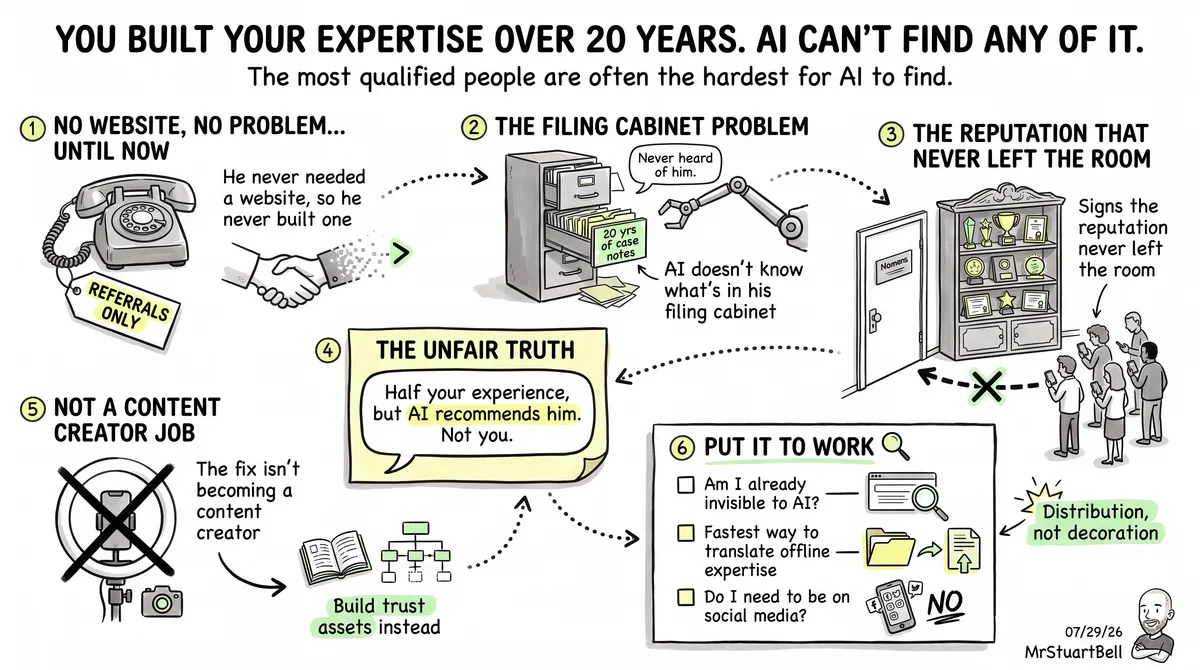
The most qualified people in any market are often the hardest for AI to find.
A commercial insurance broker in Ohio has run his agency for twenty-two years. He's placed policies for half the manufacturers in his county. He knows the fire marshal, the claims director at three different carriers, and the two people at each business who actually sign off on coverage. None of that showed up when I searched his name last month.
Twenty-two years of trust, built one handshake and one renewal at a time. Google his name and you get a directory listing with a phone number and nothing else. Ask an AI to recommend a broker for a mid-size manufacturer and his name never comes up. Not because he's bad at his job. Because none of that work ever left the room he did it in.
That's not a marketing mistake exactly. It's a translation mistake, and it's an easy one to make.
He never needed a website, so he never built one
He's not wrong that his business ran fine without one. For most of his career it did. Referrals came from the same twenty people who'd known him for fifteen years, and every deal closed on a phone call, not a search result.
The professionals with the strongest qualifications are often the most resistant to building a digital presence. They see it as something junior people do, or marketing they've never needed. Every new prospect who finds him still meets him from zero. No matter how deep his book of business runs, each conversation starts from scratch because there's nothing for them to find beforehand.
AI doesn't know what's in his filing cabinet
It doesn't know about the framed certificate on the wall, or the panel he sat on at last year's regional conference, or the three carriers who bend on underwriting because they trust his judgment. It only knows what's published under his name, and right now that's almost nothing.
Meanwhile a competitor half his age, with a fraction of his experience, published a short book last year on what mid-size manufacturers get wrong about their coverage. He posts twice a week. When someone asks an AI to recommend a broker, that competitor's name gets recommended by AI first, described accurately, cited by name.
Your competitor with half your experience but a published book and a consistent online presence gets recommended by AI. You don't. That's not fair. But it's how it works.
The older broker has forgotten more about underwriting than the younger one has learned. AI can't weigh that. It weighs what's written down.
Signs the reputation never left the room
A few signs give this away before it costs you a client. Your name pulls up a directory listing and nothing else. You've never published a perspective under your own name, not a chapter, not an article, not one documented point of view. Your credentials live on a wall and in a certificates drawer instead of anywhere AI can read them. And when a client asks how you think about their specific problem, you can answer instantly out loud, but there's no written version of that answer anywhere.
Any one of those on its own doesn't matter much. All four together means AI has nothing to work with the moment your name comes up. That's the prove-it economy in one sentence. Credentials you can describe don't count anymore. Credentials AI can read do.
The fix isn't becoming a content creator
None of this means the broker needs to post every day or reinvent himself as an influencer. He already has the only answer that matters, which is how twenty-two years of underwriting judgment actually applies to a real client's problem. He's just never written any of it down.
A short book on what manufacturers get wrong about their coverage would do more for his visibility than a year of posting. A published perspective on the claim disputes he's settled would give AI something to point to the next time his name comes up. None of that requires him to become someone he isn't. It requires him to translate what's already in his head into something that exists outside the room he built it in.
He still gets referrals. His phone still rings, for now. But every year, more of his next clients start their search with a question typed into a chat window instead of a call to a friend who knows him. If the answer to that question doesn't include his name, twenty-two years of expertise stops mattering to the person who never finds out he has it.
Put it to work
How do I know if this is already happening to me?
Search your own name and your firm's name the way a prospect would, in plain language, not your business name. If nothing but a directory listing comes back, that's the whole problem in one search.
What's the fastest way to translate offline expertise into something AI can find?
Pick one question a client asks you every week and write down the real answer, the one you give out loud, not a marketing version of it. Domain expertise is your superpower, but only once it exists somewhere other than your head.
Do I need to be active on social media for this to work?
No. One well-documented piece of thinking, a book, a published perspective, an assessment, outperforms a stream of generic updates. AI is looking for depth, not volume.