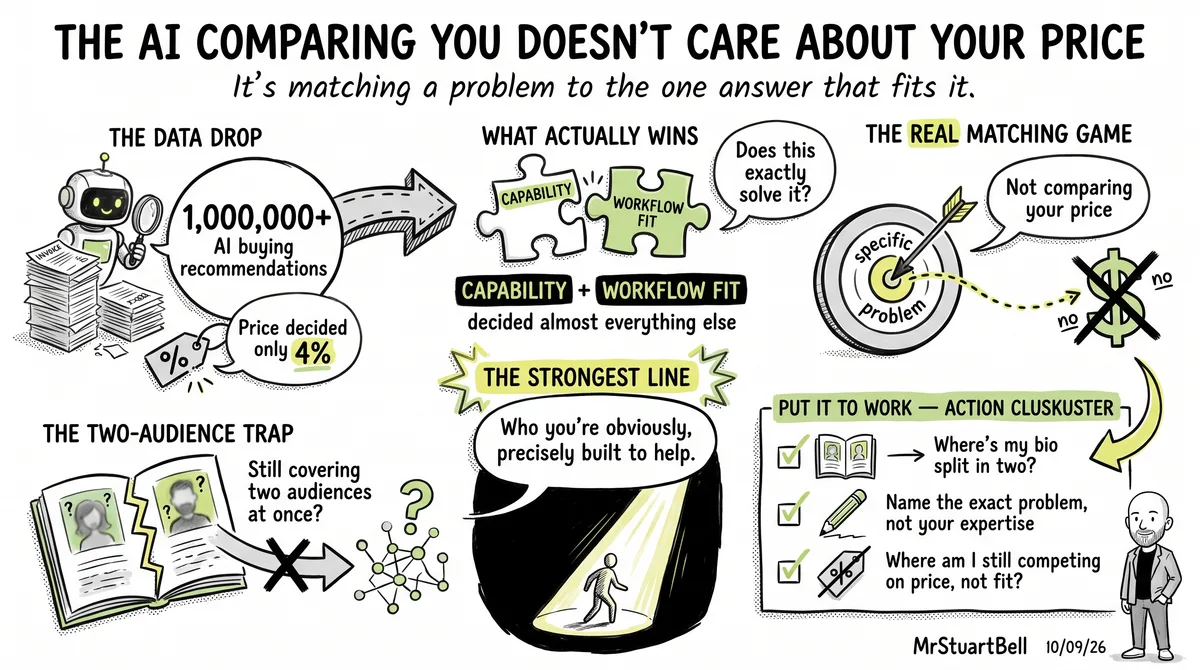
The AI shortlisting your next client isn't comparing your price. It's matching a specific problem to the one answer that fits it.
Parse tracked 1,064,960 brand recommendations tied to 515,678 buyer needs, pulled from 18,226 real buyer prompts. Published August 29, 2026, on parse.gl. They set out to answer one question. When an AI tool recommends one vendor over another, what's actually driving that call?
Feature and capability fit drove the recommendation 53% of the time. Workflow fit, another 35.6%. Price, just 4.1%.
That's not a rounding error. That's the AI telling you, across more than half a million buyer needs, that it almost never picks the cheapest option. It picks the option that matches the problem most precisely.
Here's where most professionals get this backwards.
I was on a call with Jonathan a while back. He'd written most of his book, and the question on the table was who it was for. He wanted it to work for business owners and high-income employees, both, and he didn't want to narrow the age range either. Every time I suggested picking one, he heard it as shrinking his market.
The AI isn't weighing who else could buy from you. It's weighing who you're obviously, precisely built to help.
He's not wrong that narrowing feels like it should shrink his options. That's intuitive. It's also the opposite of what Parse just measured. An AI Delegate doing the shortlisting for a prospect isn't scanning for the broadest possible fit. It's matching a specific problem to a specific answer, and it can't do that for someone who's positioned to be everything to everyone.
This is the Agentic Trust Loop playing out in real numbers. Delegation 1 is the stage where the prospect hands the research off to AI before they ever talk to a human. The AI isn't comparing brochures or rate cards at that stage. It's matching language. This problem, this niche, this specific situation, to whoever's positioning names it most exactly. Jonathan's broad book doesn't lose to a cheaper book. It loses to a book that names the reader's exact situation in the first line.
I've written before about the prove-it economy. AI flooded every channel with generic expertise, so the only thing left that earns trust is demonstrated understanding of one specific problem. Parse's numbers are the receipt. Capability and workflow fit together account for almost 90% of the recommendation weight. That's two ways of asking the same question. Does this answer actually match my situation.
Two accountants I wrote about picked a lane years before any AI was doing the shortlisting, and it still holds. One does real estate tax. The other does specialty tax credits. Neither one competes on price because neither one competes in the same category as a generalist CPA. They made themselves impossible to confuse with anyone else, and an AI model doing the matching now rewards exactly that.
Jonathan's instinct was to protect his market by staying broad. Parse's data says his market was never the people who'd consider ten options and pick the cheapest. His market is the narrow slice of people whose exact problem he can name better than anyone else, because that's the only slice an AI Delegate can confidently hand him. Price was never the thing he needed to win on. He needed to be the obvious match.